

Expert
Stem cell devisions
- Interested why stem cells devide
- Divide asymmetry
- Divisions of stem cells can get symmetrical and this can lead to cancer
- Seam cells divide in a stem cell matter
o See wich genes control seam cell division and study if these are the same in stem
cells in humans
Seam cells close the hypodermis (outer player of
the worms)
- By there division they make up the worm
- Two lateral rows of seam cells form a
polarized epithelium with stem-cell like
divisions.
- L1 has 10 seam cells when it hatches
o On both sides
o V1 to V4
- 1rst larval stage
o Asymmetrical
- Second stage there are 2 divisions
o Symmetrical and asymmetrical
- In the L4 stage the worms have 16 seam cells
- In the end all cell differentiate to epidermal cells
and migrate to the epidermis
- After L4 stage the worms become adult (16 seam
cells)
- Anterior: Differentiates (usually becomes part of
the hypodermal syncytium)
- Posterior: Proliferates further (retains the stem
cell-like fate)
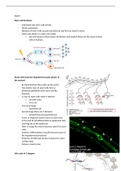
- Pictures: head to tail
Life cycle of C.elegans
, - Worms have homedefrical
- They can take care of themselves
- Eggs develop inside the parent
- After 30 eggs they are laid
- After 9 hours the eggs hatch
Research in C. elegans: Remove expression of a gene
and study the effect
- RNAi to knock out of down a gene
- RNT-1/BRO-1 drive proliferation
o RNT1 is a homologe to human runx (leukemia)
o Silent in the worms
Fever seam cells
14 or 12
Loss of symmetrical division
Loss of function
o Over express the genes
Net result is extra seam cells at adulthood
To many divisions
o In wild type animals RNT-1 is never seen in anterior
daughters that have ceased division
So RNT-1 is only seen in the seam cells
What other genes are involved in the regulation of the balance
between seam cell proliferation and differentiation?
- UNC-62 strain -> hyperplasia (lack of expression of UNC-62)
o UNC-62 is a transcription factor
o Can bind to the DNA
- Unc-62 expressed -> 16 seam cells
- Unc-62 not present -> seam cell hyperplasia
- CEH-20 strain
- General transcription factors
o Bind to the promotor regions at the TATA-Box
Stem cell devisions
- Interested why stem cells devide
- Divide asymmetry
- Divisions of stem cells can get symmetrical and this can lead to cancer
- Seam cells divide in a stem cell matter
o See wich genes control seam cell division and study if these are the same in stem
cells in humans
Seam cells close the hypodermis (outer player of
the worms)
- By there division they make up the worm
- Two lateral rows of seam cells form a
polarized epithelium with stem-cell like
divisions.
- L1 has 10 seam cells when it hatches
o On both sides
o V1 to V4
- 1rst larval stage
o Asymmetrical
- Second stage there are 2 divisions
o Symmetrical and asymmetrical
- In the L4 stage the worms have 16 seam cells
- In the end all cell differentiate to epidermal cells
and migrate to the epidermis
- After L4 stage the worms become adult (16 seam
cells)
- Anterior: Differentiates (usually becomes part of
the hypodermal syncytium)
- Posterior: Proliferates further (retains the stem
cell-like fate)
- Pictures: head to tail
Life cycle of C.elegans
, - Worms have homedefrical
- They can take care of themselves
- Eggs develop inside the parent
- After 30 eggs they are laid
- After 9 hours the eggs hatch
Research in C. elegans: Remove expression of a gene
and study the effect
- RNAi to knock out of down a gene
- RNT-1/BRO-1 drive proliferation
o RNT1 is a homologe to human runx (leukemia)
o Silent in the worms
Fever seam cells
14 or 12
Loss of symmetrical division
Loss of function
o Over express the genes
Net result is extra seam cells at adulthood
To many divisions
o In wild type animals RNT-1 is never seen in anterior
daughters that have ceased division
So RNT-1 is only seen in the seam cells
What other genes are involved in the regulation of the balance
between seam cell proliferation and differentiation?
- UNC-62 strain -> hyperplasia (lack of expression of UNC-62)
o UNC-62 is a transcription factor
o Can bind to the DNA
- Unc-62 expressed -> 16 seam cells
- Unc-62 not present -> seam cell hyperplasia
- CEH-20 strain
- General transcription factors
o Bind to the promotor regions at the TATA-Box


