

HLT 362V Week 5 Exercise 14 and 19- Understanding Simple Linear Regression &Understanding Pearson Chi-Square, {Already Scored an A}
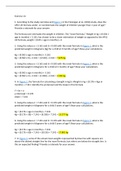
Exercise 14 1. According to the study narrative and Figure 1 in the Flannigan et al. (2014) study, does the APLS UK formula under- or overestimate the weight of children younger than 1 year of age? Provide a rationale for your answer. The formula over estimates the weight in children. The “novel formula,” Weight in kg = (0.502 × age in months) + 3.161, has shown to be a closer estimation of weight as opposed to the APLS UK formula, weight = (0.05 × age in months) + 4. 2. Using the values a = 3.161 and b = 0.502 with the novel formula in Figure 1, what is the predicted weight in kilograms (kg) for a child at 9 months of age? Show your calculations. Kg = (0.502 x age in months) + 3.161 Kg = (0.502 x 9) + 3.161 = (4.518) + 3.161 = 7.679 kg 3. Using the values a = 3.161 and b = 0.502 with the novel formula in Figure 1, what is the predicted weight in kilograms for a child at 2 months of age? Show your calculations. Kg = (0.502 x age in months) + 3.161 Kg = (0.502 x 2) + 3.161 = (1.004) + 3.161 = 4.165 kg 4. In Figure 2, the formula for calculating y (weight in kg) is Weight in kg = (0.176 × Age in months) + 7.241. Identify the yintercept and the slope in this formula. Y = bx + a y-intercept = 0.176 slope = 7.241 5. Using the values a = 7.241 and b = 0.176 with the novel formula in Figure 2, what is the predicted weight in kilograms for a child 3 years of age? Show your calculations. Kg = (0.176 × age in months) + 7.241 Kg = (0.176 × 36) + 7.241 = (6.336) + 7.241 = 13.577 kg
Document information
- Uploaded on
- May 26, 2022
- Number of pages
- 4
- Written in
- 2020/2021
- Type
- Exam (elaborations)
- Contains
- Questions & answers


