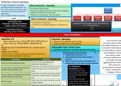
Production, income & spending
In theory Production, income & When Production > Spending
spending should be equal BUT not
the case in reality for instance when * Inventories will increase.
consumers save money instead of * Producers making more than consumers are buying.
spending it. * Signal to Producers to produce less
(Flow variables change constantly) * Reduction in production = less inventories
LAWS When Production < Spending
John Baptise LAW:
* Inventories will decrease. Spending (A) and Production (Y) could either be –
Production = Spending (ALWAYS!)
* Producers not making enough for consumers to
• Supply creates own demand A = Y (in equilibrium)
buy - A<Y
John Maynard Keynes: - A>Y
Spending causes Production
Basic Assumptions
Spending (A): Consumer Spending:
• What consumers buy: CONSUMPTION SPENDING (C) • Consumers buy different types of things An economic theo
• What firms buy: INVESTMENT SPENDING (I) • Large and stable part of total spending economy and its effec
If Keynesian economics w
Equilibrium is A=Y and A=C+I (No G or foreign sector) CONSUMPTION FUNCTION: economist John Mayna
THEN • Relationship between consumer spending and income in an attempt to unders
Equilibrium is Y=C+I
* Model is used to predict working of economy (ex ante) and
THREE important characteristics Subsequently, the ter
1. Positive (even if Income = 0) was used to refer t
record what already happened (ex post)
2. Consumption increase when income economic performan
increase
economic slumps
3. When income increase consumption will
increase BUT by less than increase in income aggregate demand th
and economic i
AUTONOMOUS government. Keynesia
Assumption: even if
someone doesn’t earn
to be a “demand-si
income they will still need changes in the ec
to consume goods (food,
clothing)
This is the part of your
consumption spending not
influenced by your income.
In theory Production, income & When Production > Spending
spending should be equal BUT not
the case in reality for instance when * Inventories will increase.
consumers save money instead of * Producers making more than consumers are buying.
spending it. * Signal to Producers to produce less
(Flow variables change constantly) * Reduction in production = less inventories
LAWS When Production < Spending
John Baptise LAW:
* Inventories will decrease. Spending (A) and Production (Y) could either be –
Production = Spending (ALWAYS!)
* Producers not making enough for consumers to
• Supply creates own demand A = Y (in equilibrium)
buy - A<Y
John Maynard Keynes: - A>Y
Spending causes Production
Basic Assumptions
Spending (A): Consumer Spending:
• What consumers buy: CONSUMPTION SPENDING (C) • Consumers buy different types of things An economic theo
• What firms buy: INVESTMENT SPENDING (I) • Large and stable part of total spending economy and its effec
If Keynesian economics w
Equilibrium is A=Y and A=C+I (No G or foreign sector) CONSUMPTION FUNCTION: economist John Mayna
THEN • Relationship between consumer spending and income in an attempt to unders
Equilibrium is Y=C+I
* Model is used to predict working of economy (ex ante) and
THREE important characteristics Subsequently, the ter
1. Positive (even if Income = 0) was used to refer t
record what already happened (ex post)
2. Consumption increase when income economic performan
increase
economic slumps
3. When income increase consumption will
increase BUT by less than increase in income aggregate demand th
and economic i
AUTONOMOUS government. Keynesia
Assumption: even if
someone doesn’t earn
to be a “demand-si
income they will still need changes in the ec
to consume goods (food,
clothing)
This is the part of your
consumption spending not
influenced by your income.