

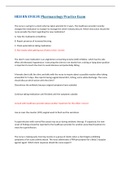
HESI RN EVOLVE Pharmacology Practice Exam The nurse is caring for a client who has taken atenolol for 2 years. The healthcare provider recently changed the medication to enalapril to manage the client's blood pressure. Which instruction should the nurse provide the client r egarding the new medication? A. Take the medication at bedtime. B. Report presence of increased bruising. C. Check pulse before taking medication. D. Rise slowly when getting out of bed or chair. Correct The client's new medication is an angiotensin -converting enzyme (ACE) inhibitor, which has the side effect oforthostatic hypotension. Instructing the client to rise slowly from a sitting or lying do wn position is important to teach the client to avoid dizziness and potentially falling. A female client calls the clinic and talks with the nurse to inquire about a possible reaction after taking amoxicillin for 5 days. She reports having vaginal discomf ort, itching, and a white discharge. The nurse should discuss which action with the client? Discontinue the antibiotic because original symptoms have subsided. Continue taking medication until finished until the symptoms subside. Consult with healthcare provider about another treatment for this effect. Correct Use an over -the-counter (OTC) vaginal wash to flush out the secretions. A superinfection with normal flora yeast may occur during antibiotic therapy. If suspected, the new onset of findings should be reported to the healthcare provider for another prescribed treatment to treat the superinfection. The nurse is making early morning rounds on a group of clients when a client begins exhibiting symptoms of an acute asthma attack. The nurse administers a PRN prescription for a Beta 2 receptor agonist agent. Which client response should the nurse expect? Tachycardia. Increased blood pressure. Rapid resolution of wheezing. Correct Improved pulse oximetry values. Correct Reduce fever airway inflammation . Beta 2 receptor agonist agents should provide immediate return of airflow and resolve wheezing and improve oxygenation. A client prescribed atenolol has a blood pressure of 120/68 mmHg, displaying a sinus bradycardia with a rate of 58 beats/minute, and a P -R interval of 0.24. Which action should the nurse take? Lower the head of the bed and assess the client for orthostatic vital sign changes. Give the medication as prescribed and continue to monitor the client. Correct Prepare to administer atropine sulfate IV push. Hold the prescribed dose and contact the healthcare provider. Since the client's blood pressure is within normal limits, and the pulse is above 50 beats/min with a first degree block, the medication can be administered. Atenolol is a beta -blocker that slows the heart rate and lowers the blood pressure; this drug is generally held if the heart rate is less tha n 50 beats/min or the client exhibits dizziness related to hypotension. The nurse is preparing the 0900 dose of losartan (Cozaar), an angiotensin II receptor blocker (ARB), for a client with hypertension and heart failure. The nurse reviews the client's l aboratory results and notes that the client's serum potassium level is 5.9 mEq/L. Which action should the nurse take first? Withhold the scheduled dose. Correct Check the client's apical pulse. Notify the healthcare provider. Repeat the serum potassium level. The nurse should first withhold the scheduled dose of Cozaar because the client is hyperkalemic (normal range 3.5 to 5 mEq/l). Although hypokalemia is usually associated with diuretic therapy in heart failure, hyperkalemia is associated with severa l heart failure medications, including ARBs. Because hyperkalemia may lead to cardiac dysrhythmias, the nurse should check the apical pulse for rate and rhythm, and blood pressure. Awarded 1.0 points out of 1.0 possible Upon admission to the emergency cen ter, an adult client with acute status asthmaticus is prescribed this series of medications. In which order should the nurse administer the prescribed medications? (Arrange from first to last.) Albuterol (Proventil) puffs. Salmeterol (Serevent Diskus). Prednisone (Deltasone) orally. Gentamicin (Garamycin) IM. Status asthmaticus is potentially a life -threatening respiratory event, so albuterol, a beta2 adrenergic agonist and short acting bronchodilator, should be administered by inhalation first to prov ide rapid and deep topical penetration to relieve bronchospasms, dilate the bronchioles, and increase oxygenation. In stepwise management of persistent asthma, a long -action bronchodilator, such as salmeterol (Serevent Diskus), with a 12 -hour duration of a ction should be given next. Prednisone, an oral corticosteroid, provides prolonged anti -inflammatory effects and should be given after the client's respiratory distress begins to resolves. Gentamicin, an antibiotic, is given deep IM, which can be painful, and may require repositioning the client, so should be last in the sequence. An adult client is given a prescription for a scopolamine patch (Transderm Scop) to prevent motion sickness while on a cruise. Which information should the nurse provide to the c lient? Apply the patch at least 4 hours prior to departure. Correct Change the patch every other day while on the cruise. Place the patch on a hairless area at the base of the skull. Drink no more than 2 alcoholic drinks during the cruise. Scopolamine, an anticholinergic agent, is used to prevent motion sickness and has a peak onset in 6 hours, so the client should be instructed to apply the patch at least 4 hours before departure on the cruise ship. The duration of the transdermal patch is 72 hours. Sc olopamine blocks muscarinic receptors in the inner ear and to the vomiting center, so the best application site of the patch is behind the ear. Anticholinergic medications are CNS depressants, so the client should be instructed to avoid alcohol while using the patch. A client with giardiasis is taking metronidazole (Flagyl) 2 grams PO. Which information should the nurse include in the client's instruction? Notify the clinic of any changes in the color of urine. Avoid overexposure to the sun. Stop the med ication after the diarrhea resolves. Take the medication with food. Correct
Preview 4 out of 34 pages
Exam (elaborations)
HESI RN EVOLVE Pharmacology Practice Exam
Preview 4 out of 34 pages
HESI RN EVOLVE Pharmacology Practice Exam
Content preview
Document information
- Uploaded on
- April 5, 2022
- Number of pages
- 34
- Written in
- 2020/2021
- Type
- Exam (elaborations)
- Contains
- Questions & answers
$15.99
Wrong document? Swap it for free
Within 14 days of purchase and before downloading, you can choose a different document. You can simply spend the amount again.
Written by students who passed
Immediately available after payment
Read online or as PDF

Reputation scores are based on the amount of documents a seller has sold for a fee and the reviews they have received for those documents. There are three levels: Bronze, Silver and Gold. The better the reputation, the more your can rely on the quality of the sellers work.
Available in package deal
Package deal
HESI RN EVOLVE PRACTICE EXAMS

