
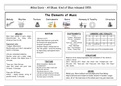
Miles Davis – All Blues. Kind of Blue released 1959.
The Elements of Music
Melody Rhythm Texture Instruments Genre Harmony & Tonality Structure
MELODY RHYTHM INSTRUMENTS HARMONY AND TONALITY
1 2 3 4
Main head melody is quite simple. Frontline
G7 G7 G7 G7
Trumpet – Miles Davis
Characterised by rising 6ths. Written in 6/4. Alto sax – Cannonball 5 6 7 8
(Interval from D to B) Often described as a jazz waltz. C7 C7 G7 G7
Adderley
Performed with swung quavers. Tenor sax – John Coltrane 9 10 11 12
Improvised solos: Frequent syncopation. Rhythm Section D7#9 Eb7#9 D7#9 G7 G7
Trumpet: Miles Davis Piano – Bill Evans
Drummer keeps a steady beat on
Mostly made up of short, syncopated Bass – Paul Chambers
the ride cymbal – varies the backing Solos make use of the mixolydian mode.
Drums – Jimmy Cobb
motifs. 4 choruses. by improvising a syncopated snare
drum part.
Alto sax: Cannonball Adderley
Quicker notes and a wider range. STRUCTURE
More virtuosic than Miles Davis. 4 Based on 12 bar blues progression. Each statement of the chords is
choruses. called a ‘chorus’
TEXTURE Intro – link (sax riff) – Head – link – Head – link – Trumpet solo – link –
Tenor sax: John Coltrane Mainly homophonic. Melody and Alto solo – link – Tenor solo – link – Piano solo – link – Head – link – Head –
Uses fast scales and quick runs. accompaniment. link – Outro.
Rhythm section takes a back seat
Virtuosic. 4 choruses.
during solo sections.
One person solos at a time. GENRE
Piano solo: Bill Evans Link section (saxes playing in thirds)
Calmer – simple melody, string of
Modal jazz. More laidback and uncomplicated than Bebop.
provides contrast in texture and gives
parallel chords. 2 choruses. Improvisations were based on modes. Greater freedom. Longer
the music space to breathe.
solos. All of the musicians on this album were top jazz musicians.
, Bernstein - Something’s Coming from West Side Story. 1957
The Elements of Music
Melody Rhythm Texture Instruments Genre Harmony & Tonality Structure
MELODY RHYTHM INSTRUMENTS GENRE
Almost entirely syllabic (one Integration of songs and acted scenes to tell a
note per syllable). Based on the Song for solo tenor story.
The metre changes between ¾ and 4/4. accompanied by a band Bernstein – influenced by jazz and music of
alternation of three main
Fast tempo and syncopation help to maintain made up of woodwind, Stravinsky.
themes.
excitement and anticipation. brass, percussion and West Side Story is based on Romeo and Juliet.
Syncopated, opening. Set in New York. Rival gas are the Sharks and the
Accompaniment – on beat bass part off beat strings.
chords. Creates cross rhythms. Jets.
Groundbreaking: dark theme of violence and tragedy.
Push rhythms anticipate the beat.
Quiet dynamics Extended dance scenes. Focus on scial problems of
Soft timbres (muted America.
trumpets, pizzicato
strings)
HARMONY AND TONALITY
STRUCTURE
Loud, dramatic theme in ¾. The air is humming Intro – bar 1-3 (bar 3 repeats ad lib)
In the key of D major. Two contrasting sections
Strings use harmonics Section A – 4-39
in C major.
(very high notes) and Section B – 40-105
tremolo. Section B1 – 106-140 (shortened)
Sharpened fourth. TRITONE! This interval is Section A1 – 141-157 (shortened)
common throughout West Side Story. (This Outro
interval was banned by the church years ago.
Creates tension…)
Lyrical and slow moving.
TEXTURE
Flattened seventh. (jazz influenced) This is the
Homophonic (melody and accompaniment)
last sung note. Unusual – the note is unresolved – Three main ideas in the accompaniment:
matches the sense of expectation in the story. 1. Repeated riff
Repetitions are not exact.
2. Short, mainly syncopated chords (this starts at bars 21-26)
Bernstein varies the words or Jazz influenced harmony. 3. Fast ‘um-cha’ accompaniment (first heard at bar 32)
metre.
The Elements of Music
Melody Rhythm Texture Instruments Genre Harmony & Tonality Structure
MELODY RHYTHM INSTRUMENTS HARMONY AND TONALITY
1 2 3 4
Main head melody is quite simple. Frontline
G7 G7 G7 G7
Trumpet – Miles Davis
Characterised by rising 6ths. Written in 6/4. Alto sax – Cannonball 5 6 7 8
(Interval from D to B) Often described as a jazz waltz. C7 C7 G7 G7
Adderley
Performed with swung quavers. Tenor sax – John Coltrane 9 10 11 12
Improvised solos: Frequent syncopation. Rhythm Section D7#9 Eb7#9 D7#9 G7 G7
Trumpet: Miles Davis Piano – Bill Evans
Drummer keeps a steady beat on
Mostly made up of short, syncopated Bass – Paul Chambers
the ride cymbal – varies the backing Solos make use of the mixolydian mode.
Drums – Jimmy Cobb
motifs. 4 choruses. by improvising a syncopated snare
drum part.
Alto sax: Cannonball Adderley
Quicker notes and a wider range. STRUCTURE
More virtuosic than Miles Davis. 4 Based on 12 bar blues progression. Each statement of the chords is
choruses. called a ‘chorus’
TEXTURE Intro – link (sax riff) – Head – link – Head – link – Trumpet solo – link –
Tenor sax: John Coltrane Mainly homophonic. Melody and Alto solo – link – Tenor solo – link – Piano solo – link – Head – link – Head –
Uses fast scales and quick runs. accompaniment. link – Outro.
Rhythm section takes a back seat
Virtuosic. 4 choruses.
during solo sections.
One person solos at a time. GENRE
Piano solo: Bill Evans Link section (saxes playing in thirds)
Calmer – simple melody, string of
Modal jazz. More laidback and uncomplicated than Bebop.
provides contrast in texture and gives
parallel chords. 2 choruses. Improvisations were based on modes. Greater freedom. Longer
the music space to breathe.
solos. All of the musicians on this album were top jazz musicians.
, Bernstein - Something’s Coming from West Side Story. 1957
The Elements of Music
Melody Rhythm Texture Instruments Genre Harmony & Tonality Structure
MELODY RHYTHM INSTRUMENTS GENRE
Almost entirely syllabic (one Integration of songs and acted scenes to tell a
note per syllable). Based on the Song for solo tenor story.
The metre changes between ¾ and 4/4. accompanied by a band Bernstein – influenced by jazz and music of
alternation of three main
Fast tempo and syncopation help to maintain made up of woodwind, Stravinsky.
themes.
excitement and anticipation. brass, percussion and West Side Story is based on Romeo and Juliet.
Syncopated, opening. Set in New York. Rival gas are the Sharks and the
Accompaniment – on beat bass part off beat strings.
chords. Creates cross rhythms. Jets.
Groundbreaking: dark theme of violence and tragedy.
Push rhythms anticipate the beat.
Quiet dynamics Extended dance scenes. Focus on scial problems of
Soft timbres (muted America.
trumpets, pizzicato
strings)
HARMONY AND TONALITY
STRUCTURE
Loud, dramatic theme in ¾. The air is humming Intro – bar 1-3 (bar 3 repeats ad lib)
In the key of D major. Two contrasting sections
Strings use harmonics Section A – 4-39
in C major.
(very high notes) and Section B – 40-105
tremolo. Section B1 – 106-140 (shortened)
Sharpened fourth. TRITONE! This interval is Section A1 – 141-157 (shortened)
common throughout West Side Story. (This Outro
interval was banned by the church years ago.
Creates tension…)
Lyrical and slow moving.
TEXTURE
Flattened seventh. (jazz influenced) This is the
Homophonic (melody and accompaniment)
last sung note. Unusual – the note is unresolved – Three main ideas in the accompaniment:
matches the sense of expectation in the story. 1. Repeated riff
Repetitions are not exact.
2. Short, mainly syncopated chords (this starts at bars 21-26)
Bernstein varies the words or Jazz influenced harmony. 3. Fast ‘um-cha’ accompaniment (first heard at bar 32)
metre.


