

Knowledge clips overview
Theme 1: Core IB theories
Theme 1: Value chains
Industry and company value chains
We can look at industries and companies in terms of value chains. à value that is added in
different stages.
Porter’s Value Chain (company’s value chain)
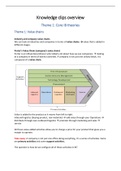
Porter is an influential professor who talked a lot about how we see companies. à looking
at a company in terms of distinct activities. A company is not just one unitary block, it is
composed of a value chain.
Value is added to the product as it moves from left to right.
Inbound logistics (buying product, raw materials) à add value through your Operations à
distribute through own outbound logistics à promote through marketing and sales à
service
All these value-added activities allow you to charge a price for your product that gives you a
margin to operate.
Take away: A company is not just one office doing everything, it’s a series of activities. Some
are primary activities and some support activities.
The question is how do we configure all of these activities in IB?
,Value chain and the boundary of the firm
Boundary of the firm means what does the firm do and what does someone else do?
There are a lot of options for outsourcing; some activities are better off with someone who
is specialized in this, when it’s not your expertise.
e.g. outsource your logistics
e.g. outsource product design
e.g. outsource marketing of your product to an advertisement companies
The international Industry Value Chain
This becomes more interesting if you’re talking in the international context
à you have the whole world to attribute your value chain around.
- From center of gravity to vertical integration?
- Where do you want to expand?
- Where are the profit pools? and where does a company have
strategic capabilities/expertise?
- What local market factors/institutions enter these decisions?
The question then becomes: do you outsource this, or do you invest
yourself in this activity if you’re planning to do something international?
Outsourcing vs. FDI
Outsourcing: turning over an organizational activity to an outside supplier that will perform
it on behalf of the focal firm.
• Offshore: outsourcing to a firm abroad
• Onshore: outsourcing to a domestic firm
e.g. Restaurant, do I set up my own delivery service, such as New York pizza? Or do I
outsource this part of our business to somebody else, such as to thuisbezorgd?
Outsourcing is in contrast to FDI where you set up subsidiaries abroad and the work is done
‘in-house’ but the location is overseas. So with FDI you set up your own activities abroad.
,Global value chain: the smiling curve
à look at where the value is added is and where the inputs are located
If you take Apple’s Iphone, it says ‘designed in California, assembled in China’. They decided
not to do all their activities in one place.
- New headquarter in California, focusing mostly on design. The CEOs are working in
California à high value added activities, high salaries.
- The assembly (montage) is done in China by Foxconn, not even by Apple. It would be
way too expensive to make the phone in California.
- Advertising is mostly based in NY or LA, this is typically outsourced. Outside apple,
but within a company that is expertise in advertisement.
- Apple is not the only one out there selling you products, such as Iphone accessories.
These are completely outside Apples value chain.
The value chain can be rather complex. You have to decide what activities you want to keep
inside the company, and where do you want to locate them if you want to locate them
outside of your company.
, Which one of the international operations modes do you choose from? Do you do it yourself
or do you use a partner? If you use a partner, what kind of operation mode do you use? If
you want to do your own activities abroad, which operation mode do you use?
à will be further explained during strategy course
à results you end up being a multinational enterprise
What is a MNE (TNC,MNC)? à multinational enterprise, transnational corporations and
multinational corporations are all similar.
• Company that engages in international (cross-border) economic activities
• Transnational corporations (TNCs) are incorporated or unincorporated enterprises
comprising parent enterprises and their foreign affiliates
• Parent enterprise: an enterprise that controls assets of other entities in countries
other than its home country, usually by owning a certain equity capital stake
(UNCTAD)
• Subsidiaries: incorporated enterprise in the host country in which another entity
directly owns more than half of the shareholders voting power
What are the challenges and benefits of being a MNE? à important question to ask
yourself
How to make sense of international complexity?
• Country level of analysis
à International economics and national competitiveness (some are more
competitive than others, e.g. in some countries labour is cheaper than in other
countries)
- National statistics on trade and FDI
- Macro level trends
Theme 1: Core IB theories
Theme 1: Value chains
Industry and company value chains
We can look at industries and companies in terms of value chains. à value that is added in
different stages.
Porter’s Value Chain (company’s value chain)
Porter is an influential professor who talked a lot about how we see companies. à looking
at a company in terms of distinct activities. A company is not just one unitary block, it is
composed of a value chain.
Value is added to the product as it moves from left to right.
Inbound logistics (buying product, raw materials) à add value through your Operations à
distribute through own outbound logistics à promote through marketing and sales à
service
All these value-added activities allow you to charge a price for your product that gives you a
margin to operate.
Take away: A company is not just one office doing everything, it’s a series of activities. Some
are primary activities and some support activities.
The question is how do we configure all of these activities in IB?
,Value chain and the boundary of the firm
Boundary of the firm means what does the firm do and what does someone else do?
There are a lot of options for outsourcing; some activities are better off with someone who
is specialized in this, when it’s not your expertise.
e.g. outsource your logistics
e.g. outsource product design
e.g. outsource marketing of your product to an advertisement companies
The international Industry Value Chain
This becomes more interesting if you’re talking in the international context
à you have the whole world to attribute your value chain around.
- From center of gravity to vertical integration?
- Where do you want to expand?
- Where are the profit pools? and where does a company have
strategic capabilities/expertise?
- What local market factors/institutions enter these decisions?
The question then becomes: do you outsource this, or do you invest
yourself in this activity if you’re planning to do something international?
Outsourcing vs. FDI
Outsourcing: turning over an organizational activity to an outside supplier that will perform
it on behalf of the focal firm.
• Offshore: outsourcing to a firm abroad
• Onshore: outsourcing to a domestic firm
e.g. Restaurant, do I set up my own delivery service, such as New York pizza? Or do I
outsource this part of our business to somebody else, such as to thuisbezorgd?
Outsourcing is in contrast to FDI where you set up subsidiaries abroad and the work is done
‘in-house’ but the location is overseas. So with FDI you set up your own activities abroad.
,Global value chain: the smiling curve
à look at where the value is added is and where the inputs are located
If you take Apple’s Iphone, it says ‘designed in California, assembled in China’. They decided
not to do all their activities in one place.
- New headquarter in California, focusing mostly on design. The CEOs are working in
California à high value added activities, high salaries.
- The assembly (montage) is done in China by Foxconn, not even by Apple. It would be
way too expensive to make the phone in California.
- Advertising is mostly based in NY or LA, this is typically outsourced. Outside apple,
but within a company that is expertise in advertisement.
- Apple is not the only one out there selling you products, such as Iphone accessories.
These are completely outside Apples value chain.
The value chain can be rather complex. You have to decide what activities you want to keep
inside the company, and where do you want to locate them if you want to locate them
outside of your company.
, Which one of the international operations modes do you choose from? Do you do it yourself
or do you use a partner? If you use a partner, what kind of operation mode do you use? If
you want to do your own activities abroad, which operation mode do you use?
à will be further explained during strategy course
à results you end up being a multinational enterprise
What is a MNE (TNC,MNC)? à multinational enterprise, transnational corporations and
multinational corporations are all similar.
• Company that engages in international (cross-border) economic activities
• Transnational corporations (TNCs) are incorporated or unincorporated enterprises
comprising parent enterprises and their foreign affiliates
• Parent enterprise: an enterprise that controls assets of other entities in countries
other than its home country, usually by owning a certain equity capital stake
(UNCTAD)
• Subsidiaries: incorporated enterprise in the host country in which another entity
directly owns more than half of the shareholders voting power
What are the challenges and benefits of being a MNE? à important question to ask
yourself
How to make sense of international complexity?
• Country level of analysis
à International economics and national competitiveness (some are more
competitive than others, e.g. in some countries labour is cheaper than in other
countries)
- National statistics on trade and FDI
- Macro level trends


