

NR 322 Passpoint Review Nclex Questions And Answers( Complete Solution Rated A)./
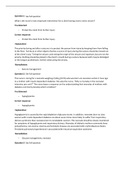
NR 322 Passpoint Review Nclex Questions And Answers Question 1 See full question What is the nurse’s most important intervention for a client having a tonic-clonic seizure? You Selected: • P rotec t the client from further injury Correct response: • Protect the client from further injury Explanation: The priority during and after a seizure is to protect the person from injury by keeping them from falling to the floor. Furniture or other objects that be a source of injury during the seizure should be moved out of the client’s way. Timing the seizure, and noting the origin of the seizure are important, but are not the priority. Nothing should be placed in the client’s mouth during a seizure because teeth may be dislodged or the tongue pushed back, further obstructing the airway. Remediation: • Seizure management Question 2 See full question The nurse is caring for a neonate weighing 4,536 g (10 lb) who was born via cesarean section 1 hour ago to a mother with insulin-dependent diabetes. She asks the nurse, “Why is my baby in the neonatal intensive care unit?” The nurse bases a response on the understanding that neonates of mothers with diabetes commonly develop which condition? You Selected: • hypoglycemia Correct response: • hypoglycemia Explanation: Hypoglycemia is caused by the rapid depletion of glucose stores. In addition, neonates born to class women with insulin dependent diabetes are about seven times more likely to suffer from respiratory distress syndrome than neonates born to nondiabetic women. This neonate should be closely monitored for symptoms of hypoglycemia and respiratory distress. Neonates of diabetic mothers commonly have polycythemia, not anemia. Anemia and hemolytic disease are associated with erythroblastosis fetalis. Persistent pulmonary hypertension is associated with meconium aspiration syndrome. Remediation: • Glucose management, neonatal
Document information
- Uploaded on
- March 11, 2022
- Number of pages
- 193
- Written in
- 2021/2022
- Type
- Exam (elaborations)
- Contains
- Questions & answers


