

ECONOMICS 1501
1: What economics is all about
**Economics is the study of the use of scarce resources to satisfy unlimited wants**
Wants – desires for goods and services - unlimited
Needs – necessities, essential for survival, eg food and water.
Demand – can only demand if you can afford it (purchasing power)
Opportunity cost - value to the decision maker of the best option that could
have been taken but wasn’t, eg watch a movie instead of studying for an exam
Scarcity - time, space and money
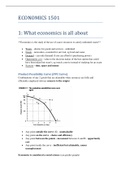
Product Possibility Curve (PPC Curve)
Combinations of any 2 goods that are attainable when resources are fully and
efficiently employed (always concave to the origin)
Any point outside the curve (G) - unattainable
Any point on the curve - choice and efficiency
Any point between the points - movement between A and B - opportunity
cost
Any point inside the curve - inefficient but attainable, causes
unemployment
Economics is considered a social science (can predict people)
, Micro-economics and Macro-economics
Micro-economics - individual parts of the economy in isolation
Macro-economics - overall economy
Micro economics Macro economics
Price of single prod Consumer price index, inflation
Changes in price of single product Total output of goods
Decisions of indiv cons and firms Combined outcome of decisions of all cons and firms
Market and demand for indiv goods Market and demand for all goods
Indivs decision whether to work or not Total supply of labour
Firms decision to expand/ export/ import Total supply, exports and imports
Positive and Normative economics
Positive statement - fact
Normative statement - opinion
Levels and rate of change
A small % (say 5%) of a large number (say R10 million) = R 500 000.
A large % (say 90%) of a small number (say R 10) = R9
Deceptive to read into percentages - know what the original base is
Rate of change calculation
Share price goes from R10 to R20 a share, rate of change or profit percentage
End value (R20) – beginning value (R10)
= * 100
Beginning value (R10)
= 100%
2: Closer look at economic problem
3 central economic questions - what, how and for whom
Central economic question 1: What to produce?
1. Consumer goods – consumed by individuals - 3 types
Non–durable goods, i.e. food, meds
Semi-durable goods, i.e. clothing, tyres
, Durable goods, i.e. cars, furniture
2. Capital goods – used to produce other goods (depreciate) eg roads, rivers
3. Final goods – consumed by indivs eg flour to use at home
4. Intermediate goods – inputs to produce other goods eg flour for cakes to sell
5. Private goods – consumed by an individual (such as food, clothing, furniture)
6. Public goods – used by the community at large (public parks, libraries and
roads)
7. Economic goods – good produced at a cost from scarce resources (groceries)
8. Free goods – not considered scarce, therefore have no direct price (air and
sun)
9. Homogeneous goods –considered identical (ounce of gold has the same
weight in any calculation system)
10. Heterogeneous goods – different characteristics based upon ability to
differentiate the product (marketing a particular feature of a washing powder
to get a higher price)
The Production Possibility Curve once again….
Shifts of PPC Curve
1. Improvement in Productivity – Society works more efficiently
2. Improvement in Technology – New inventions that improve production
Swivels of the PPC Curve
Improvement of only Productivity OR Technology Eg improvement in technology
favours consumer goods only, then it will swivel the consumer goods curve
upwards, while capital goods remains the same
, Applies in reverse if improvement in technology that will favour the capital good
*Summary of PPC
Attainable On/ inside PPC
Unattainable Outside PPC
Efficient On PPC
Inefficient Inside PPC
Increase in potential Outward shift of PPC
Central economic question 2: How should it be produced?
5 Factors of Production
1. Capital - used to produce other goods eg machinery (depreciates)
2. Natural resources & land
3. Labour
4. Entrepreneurship – entrepreneur is the driving force behind production
5. Technology
Money is NOT a factor of production
1: What economics is all about
**Economics is the study of the use of scarce resources to satisfy unlimited wants**
Wants – desires for goods and services - unlimited
Needs – necessities, essential for survival, eg food and water.
Demand – can only demand if you can afford it (purchasing power)
Opportunity cost - value to the decision maker of the best option that could
have been taken but wasn’t, eg watch a movie instead of studying for an exam
Scarcity - time, space and money
Product Possibility Curve (PPC Curve)
Combinations of any 2 goods that are attainable when resources are fully and
efficiently employed (always concave to the origin)
Any point outside the curve (G) - unattainable
Any point on the curve - choice and efficiency
Any point between the points - movement between A and B - opportunity
cost
Any point inside the curve - inefficient but attainable, causes
unemployment
Economics is considered a social science (can predict people)
, Micro-economics and Macro-economics
Micro-economics - individual parts of the economy in isolation
Macro-economics - overall economy
Micro economics Macro economics
Price of single prod Consumer price index, inflation
Changes in price of single product Total output of goods
Decisions of indiv cons and firms Combined outcome of decisions of all cons and firms
Market and demand for indiv goods Market and demand for all goods
Indivs decision whether to work or not Total supply of labour
Firms decision to expand/ export/ import Total supply, exports and imports
Positive and Normative economics
Positive statement - fact
Normative statement - opinion
Levels and rate of change
A small % (say 5%) of a large number (say R10 million) = R 500 000.
A large % (say 90%) of a small number (say R 10) = R9
Deceptive to read into percentages - know what the original base is
Rate of change calculation
Share price goes from R10 to R20 a share, rate of change or profit percentage
End value (R20) – beginning value (R10)
= * 100
Beginning value (R10)
= 100%
2: Closer look at economic problem
3 central economic questions - what, how and for whom
Central economic question 1: What to produce?
1. Consumer goods – consumed by individuals - 3 types
Non–durable goods, i.e. food, meds
Semi-durable goods, i.e. clothing, tyres
, Durable goods, i.e. cars, furniture
2. Capital goods – used to produce other goods (depreciate) eg roads, rivers
3. Final goods – consumed by indivs eg flour to use at home
4. Intermediate goods – inputs to produce other goods eg flour for cakes to sell
5. Private goods – consumed by an individual (such as food, clothing, furniture)
6. Public goods – used by the community at large (public parks, libraries and
roads)
7. Economic goods – good produced at a cost from scarce resources (groceries)
8. Free goods – not considered scarce, therefore have no direct price (air and
sun)
9. Homogeneous goods –considered identical (ounce of gold has the same
weight in any calculation system)
10. Heterogeneous goods – different characteristics based upon ability to
differentiate the product (marketing a particular feature of a washing powder
to get a higher price)
The Production Possibility Curve once again….
Shifts of PPC Curve
1. Improvement in Productivity – Society works more efficiently
2. Improvement in Technology – New inventions that improve production
Swivels of the PPC Curve
Improvement of only Productivity OR Technology Eg improvement in technology
favours consumer goods only, then it will swivel the consumer goods curve
upwards, while capital goods remains the same
, Applies in reverse if improvement in technology that will favour the capital good
*Summary of PPC
Attainable On/ inside PPC
Unattainable Outside PPC
Efficient On PPC
Inefficient Inside PPC
Increase in potential Outward shift of PPC
Central economic question 2: How should it be produced?
5 Factors of Production
1. Capital - used to produce other goods eg machinery (depreciates)
2. Natural resources & land
3. Labour
4. Entrepreneurship – entrepreneur is the driving force behind production
5. Technology
Money is NOT a factor of production


