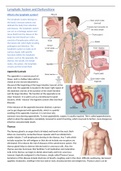
Lymphatic System and Dysfunctions
What is the lymphatic system?
The lymphatic system belongs to
the body’s immune system and
defends the body from infection
and disease. The lymphatic system
can act as a drainage system and
move fluid from the tissues in the
body into the blood but it also
consists of lymphocytes which are
the blood cells which fight invading
pathogens and infection. The
lymphatic system is made up of
various organs with specific
functions within the lymphatic
system, such as the appendix, the
thymus, the tonsils, the lymph
nodes, the spleen, the lymphatic
vessels and the lymph fluid.
Appendix/Lacteals
The appendix is a narrow pouch of
tissue, and is a hollow tube which is
closed at one end and attached to
the pouch-like beginning of the large intestine (cecum) at the
other end. The appendix is located in the lower right region of
the abdomen and sits at the junction of the small intestine
and the large intestine. The function of the appendix is not
clear; however, it is said to act as a storehouse for good
bacteria, which ‘reboots’ the digestive system after diarrheal
illnesses.
If the entrance of the appendix becomes blocked, a person
can be get diagnosed with appendicitis, which is a painful
swelling of the appendix, however, it is not clear why
someone may develop appendicitis. To treat appendicitis, surgery is usually required. This is called appendectomy,
which is when the appendix is completely removed to avoid it bursting, which may lead to further, more dangerous
infection and potentially death.
Thymus
The thymus gland is an organ that is bi-lobed and found in the neck. Both
lobes are covered by connective tissue capsules which are divided into
smaller lobules. T-cell lymphocytes develop in the thymus. Any T-cells which
include receptors for self-antigens or that do not include any receptors are
eliminated. This reduces the risk of diseases of the autoimmune system. The
thymus gland helps to destroy infected and/or cancerous cells. Also, the
thymus secretes hormones that facilitate T-cell replication and maturation.
Cells in the thymus can begin to divide abnormally and form cancerous
tumours (typically malignant) in the thymus, simply called Thymus Cancer.
Symptoms of this disease include shortness of breath, coughing, pain in the chest, difficulty swallowing, decreased
appetite, headaches, swelling in the face and/or neck, discoloured skin and weight loss. Thymus cancer can be
, treated with surgery, radiotherapy or chemotherapy. If left untreated, the cancerous cells in the thymus may begin
to divide and grow and can be transported to other areas of the body via the blood where they may begin to attack
other body tissues.
Bone Marrow
The bone marrow is the site of blood cell production. The bone
marrow is the spongy tissue inside the bone which contains
stem cells that produce blood cells. Pure red cell aplasia is a
disorder of blood production, where the bone marrow fails to
function in an adequate manner. This can be caused by the
patient’s own immune cells attacking blood-forming stem cells.
This can happen when the thymus has a tumour. Blood
transfusions which increase red blood cell levels is a common
treatment for this condition, as well as corticosteroids and
immunosuppressive therapy.
Tonsils
Tonsils are a large cluster of lymphatic cells. Most people have five
including: a single pharyngeal tonsil (called an adenoid) which is located in
the posterior wall of the upper part of the throat, a pair of palatine
tonsils located at the back of the mouth and a pair of lingual tonsils at
the base of the tongue. The tonsils combat bacteria and viruses which
enter our body through the mouth. However, they are vulnerable to
infection from these pathogens, which can lead to tonsillitis, which is the
inflammation of your tonsils due to infection. Symptoms can include a
sore throat, difficulty swallowing, loss of voice, a high temperature,
coughing a headache and other general cold/flu symptoms. A common treatment for the patient to have their tonsils
removed.
Lymph Nodes
The lymph nodes are knots of tissue joined to lymphatic vessels. They are found in the neck (cervical lymph nodes),
the armpits (axillary lymph nodes), the groin region (inguinal lymph nodes) and behind the knees (popliteal lymph
nodes). Their job is to produce and store cells that fight infection and disease. Bacteria, cancer cells and other
foreign particles that are absorbed by macrophages (a kind of
white blood cell) are washed out by the lymph nodes. Dendritic
cells (antigen presenting cells) trap and distribute to the
lymphocytes the antigenic material circulating in the lymph and
circulating in the blood, triggering the development of suitable T
and B cells, which are capable of mounting an immune response
against infectious organisms such as pathogens which have
these antigens on their surfaces.
The lymph nodes can become infected and swollen. The amount
of microbes obtained from the fluid in the tissue and circulated
in the lymph vessels that then move through the lymph nodes is
higher than what the macrophages (white blood cells) are
capable of ingesting, causing lymph node infection. This is called
lymphadenitis. This infection may result in a ruptured spleen
which would have to be removed surgically.
Spleen