

HUMAN REPRODUCTION
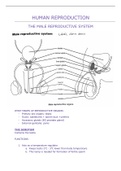
THE MALE REPRODUCTIVE SYSTEM
WHAT MAKES UP REPRODUCTIVE ORGANS:
- Primary sex organs: testis
- Ducts: epididymis + sperm duct +urethra
- Accessory glands (EG prostate gland)
- External genitalia: penis
THE SCROTUM
Contains the testis
FUNCTIONS:
1. Acts as a temperature regulator
a. Keeps testis 2℃ - 3℃ lower than body temperature
b. This temp is needed for formation of fertile sperm
, c. In cold conditions, the testis are pulled closer to abdomen for
warmth
d. In warm conditions, testes are suspended away from body
i. Thus sperm are always kept at a constant temp
2. Houses and protects testis
TESTIS
2 oval structures suspended outside the body in the scrotum
- in embryonic stage, testis are in abdominal cavity below kidneys, they descend
into to scrotum before birth
- Testis consist of many compartments/lobules containing highly convoluted
tubules - the seminiferous tubules
- Germinal epithelium lines tubules
- Between tubules are the interstitial cells/cells of leydig
FUNCTIONS:
The testis produce:
1. Sperm (male gametes)
a. By the germinal layer
2. Testosterone
a. By interstitial cells
THE DUCTS:
1. EPIDIDYMIS
a. Seminiferous tubules join to form epididymis - which is a highly
convoluted tubule about 5m long
FUNCTIONS:
Immature sperm enters epididymis were they:
1. Mature to become motile and fertile
2. Are stored for several months
a. If they stay longer, they are broken down by epithelial cells of the
epididymis and reabsorbed back into body
2. SPERM DUCT / VAS DEFERENS
a. The muscular sperm duct = continuation of epididymis
b. Leaves scrotum and passes through prostate gland, enters urethra
FUNCTION:
Sperm duct pushes mature sperm forward by strong peristaltic waves from
epididymis into urethra
- This is ejaculation
,PERISTALTIC WAVE: strong contraction of smooth muscle in the walls of ducts
URETHRA
Is the duct at the end of uro-genital system leading to the exterior
FUNCTION:
Urethra forms common duct for the transportation of semen and urine
- These processes never occur together
PROSTATE GLAND
Surrounds urethra at the base of the bladder
- With increasing age, the gland can enlarge + exert pressure on urethra
which slows down the emptying of the bladder
- Can be removed surgically
FUNCTION:
Secretes a fluid that aids the transport of the sperm - contains enzymes that
can make sperm more active
- Fluid makes up ⅓ of seminal fluid
PENIS
Urethra passes down the penis
Consists of erectile tissue (spongey) that run the length of the penis
Primary mechanism to make an erection:
- Dilation of dorsal and central arteries supplying blood to the penis
- Allows more blood to full the 3 spongy erectile tissue chambers
- Causes penis to lengthen + stiffen = erection
- Without erection, sperm cant be transferred to vagina during intercourse
- Head of penis = sensitive and is protected by foreskin
FUNCTION:
Penis deposits semen w sperm into female vagina during copulation
- Sperm are therefore brought closer to egg for fertilisation
- Increases chance of fertilisation
SEMEN (seminal fluid)
Consists of:
1. Sperm from testis
2. Seminal fluid from sperm duct and accessory glands (EG prostate)
, - Average number of sperm ejaculated is 50-250mil per ml, 700mil per
ejaculation
- Semen w sperm count of under 20ml is regarded as being infertile
- An erection is the stiffening of the penis while ejaculation is the expulsion
of semen
THE FEMALE REPRODUCTIVE TRACT
FEMALE REPRODUCTIVE ORGANS:
- Ovaries
- Accessory glands: fallopian tubes (oviduct) + uterus + vagina
- External genitalia: vulva
OVARIES
THE MALE REPRODUCTIVE SYSTEM
WHAT MAKES UP REPRODUCTIVE ORGANS:
- Primary sex organs: testis
- Ducts: epididymis + sperm duct +urethra
- Accessory glands (EG prostate gland)
- External genitalia: penis
THE SCROTUM
Contains the testis
FUNCTIONS:
1. Acts as a temperature regulator
a. Keeps testis 2℃ - 3℃ lower than body temperature
b. This temp is needed for formation of fertile sperm
, c. In cold conditions, the testis are pulled closer to abdomen for
warmth
d. In warm conditions, testes are suspended away from body
i. Thus sperm are always kept at a constant temp
2. Houses and protects testis
TESTIS
2 oval structures suspended outside the body in the scrotum
- in embryonic stage, testis are in abdominal cavity below kidneys, they descend
into to scrotum before birth
- Testis consist of many compartments/lobules containing highly convoluted
tubules - the seminiferous tubules
- Germinal epithelium lines tubules
- Between tubules are the interstitial cells/cells of leydig
FUNCTIONS:
The testis produce:
1. Sperm (male gametes)
a. By the germinal layer
2. Testosterone
a. By interstitial cells
THE DUCTS:
1. EPIDIDYMIS
a. Seminiferous tubules join to form epididymis - which is a highly
convoluted tubule about 5m long
FUNCTIONS:
Immature sperm enters epididymis were they:
1. Mature to become motile and fertile
2. Are stored for several months
a. If they stay longer, they are broken down by epithelial cells of the
epididymis and reabsorbed back into body
2. SPERM DUCT / VAS DEFERENS
a. The muscular sperm duct = continuation of epididymis
b. Leaves scrotum and passes through prostate gland, enters urethra
FUNCTION:
Sperm duct pushes mature sperm forward by strong peristaltic waves from
epididymis into urethra
- This is ejaculation
,PERISTALTIC WAVE: strong contraction of smooth muscle in the walls of ducts
URETHRA
Is the duct at the end of uro-genital system leading to the exterior
FUNCTION:
Urethra forms common duct for the transportation of semen and urine
- These processes never occur together
PROSTATE GLAND
Surrounds urethra at the base of the bladder
- With increasing age, the gland can enlarge + exert pressure on urethra
which slows down the emptying of the bladder
- Can be removed surgically
FUNCTION:
Secretes a fluid that aids the transport of the sperm - contains enzymes that
can make sperm more active
- Fluid makes up ⅓ of seminal fluid
PENIS
Urethra passes down the penis
Consists of erectile tissue (spongey) that run the length of the penis
Primary mechanism to make an erection:
- Dilation of dorsal and central arteries supplying blood to the penis
- Allows more blood to full the 3 spongy erectile tissue chambers
- Causes penis to lengthen + stiffen = erection
- Without erection, sperm cant be transferred to vagina during intercourse
- Head of penis = sensitive and is protected by foreskin
FUNCTION:
Penis deposits semen w sperm into female vagina during copulation
- Sperm are therefore brought closer to egg for fertilisation
- Increases chance of fertilisation
SEMEN (seminal fluid)
Consists of:
1. Sperm from testis
2. Seminal fluid from sperm duct and accessory glands (EG prostate)
, - Average number of sperm ejaculated is 50-250mil per ml, 700mil per
ejaculation
- Semen w sperm count of under 20ml is regarded as being infertile
- An erection is the stiffening of the penis while ejaculation is the expulsion
of semen
THE FEMALE REPRODUCTIVE TRACT
FEMALE REPRODUCTIVE ORGANS:
- Ovaries
- Accessory glands: fallopian tubes (oviduct) + uterus + vagina
- External genitalia: vulva
OVARIES



