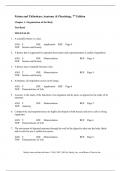
,Chapter 01: Introduction
Celentano: Gordis Epidemiology, 6th Edition
Test Bank
MULTIPLE CHOICE
1. Which of the following is an example of tertiary prevention?
a. Vaccination for rotavirus for children younger than the age of 1 year
b. Surgical amputation of an extremity with osteosarcoma (bone cancer)
c. Screening for gestational diabetes after 24 weeks of pregnancy
d. Sexual education program in elementary schools
e. Increasing taxes for buying cigarettes
ANS: B
Surgical amputation of an extremity with osteosarcoma (bone cancer) is an example in which
when a disease is present the treatment (amputation) is done to reduce the impact of disease
by preventing the tumor from dissemination. Vaccination for rotavirus for children younger
than the age of 1 year, sexual education program in elementary schools, and increasing taxes
for buying cigarettes represent examples of primary prevention. Screening for gestational
diabetes after 24 weeks of pregnancy is an example of secondary prevention.
2. This historic character observed that childbed fever mortality was more common among
women treated by physicians and medical students compared with women treated by
midwives. Based on his observations, he implemented a hand wash policy that resulted in a
decrease in mortality. Name the character that we are talking about.
a. John Snow
b. Edward Jenner
c. D.A. Henderson
d. Leon Gordis
e. Ignaz Semmelweis
ANS: E
Ignaz Semmelweis identified that medical students and physicians transmitted the disease by
not washing their hands after examining bodies at autopsies and conducting multiple
examinations in the clinic.
3. Thanks to the contributions of Edward Jenner, the following disease was eradicated later
by efforts organized by D.A. Henderson:
a. Cholera
b. Smallpox
c. Chickenpox
d. Polio
e. Zika
Copyright © 2020 by Elsevier, Inc. All rights reserved.
,Test Bank 1-2
ANS: B
Smallpox was eradicated in 1980. Edward Jenner vaccinated James Phipps in 1796 against
smallpox. Almost 200 years later, the World Health Organization (WHO) commissioned
D.A. Henderson to lead the efforts to eradicate the disease.
4. Over the past century, a marked decline in the mortality rates of many infectious diseases
has been observed. Which of the following is the most likely reason for the observed decline
in mortality rates from common infectious diseases?
a. Development of penicillin
b. Development of insulin
c. Development of vaccines
d. Improvement in social conditions
e. Worse sanitation and unsafe water
ANS: D
Although medical treatments potentially helped in the decrease of infectious diseases, the
advancement in social conditions played a major role. These improvements include better
sanitation, safe disposal of waste, better nutrition, and improvement in housing conditions.
Copyright © 2020 by Elsevier, Inc. All rights reserved.
, Chapter 02: The Dynamics of Disease Transmission
Celentano: Gordis Epidemiology, 6th Edition
Test Bank
MULTIPLE CHOICE
1. Which term most accurately describes the following definition? “The occurrence in a
community or region of cases of an illness, specific health-related behavior, or other health-
related events clearly in excess of normal expectancy.” [Porta M, ed. A Dictionary of
Epidemiology. New York: Oxford University Press; 2014.]
a. Endemic
b. Epidemic
c. Pandemic
d. Attack rate
e. Incubation period
ANS: B
An epidemic is the occurrence of health-related events in a community or region, in clear
excess of normal expectation. Endemic is not true because it is defined as the constant
occurrence of a disease, disorder, or noxious infectious agent in a geographic area or
population group. Pandemic is not true because it is defined as an epidemic occurring over a
very wide area, crossing international boundaries, and usually affecting a large number of
people. Attack rate is not true because it is defined as number of people at risk in whom a
certain illness develops over total number of people at risk. Incubation period is not true
because it is the interval from receipt of infection to the time of onset of clinical illness (the
onset of recognizable symptoms).
2. What is the most accurate definition of the incubation period (of an infectious disease)?
a. The time of onset of clinical illness or the onset of recognizable symptoms
b. The interval from receipt of infection to the time of onset of clinical illness (the onset of
recognizable symptoms)
c. The time of invasion by an infectious agent
d. The time between initiation of infection and first shedding or excretion of the agent
e. The period between exposure and the onset of infectiousness
ANS: B
The incubation period is defined as the interval from receipt of infection to the time of onset
of clinical illness (the onset of recognizable symptoms); in other words, the time between the
moment of developing symptoms and the moment of invasion by an infectious agent. “The
time of onset of clinical illness or the onset of recognizable symptoms” is not true as it
corresponds to “time of onset.” “The time of invasion by an infectious agent” is not true as it
corresponds to “time of infection.” “The time between initiation of infection and first
shedding or excretion of the agent” and “The period between exposure and the onset of
infectiousness” are not true as they correspond to the latent period. (The latent period is
Copyright © 2020 by Elsevier, Inc. All rights reserved.
Celentano: Gordis Epidemiology, 6th Edition
Test Bank
MULTIPLE CHOICE
1. Which of the following is an example of tertiary prevention?
a. Vaccination for rotavirus for children younger than the age of 1 year
b. Surgical amputation of an extremity with osteosarcoma (bone cancer)
c. Screening for gestational diabetes after 24 weeks of pregnancy
d. Sexual education program in elementary schools
e. Increasing taxes for buying cigarettes
ANS: B
Surgical amputation of an extremity with osteosarcoma (bone cancer) is an example in which
when a disease is present the treatment (amputation) is done to reduce the impact of disease
by preventing the tumor from dissemination. Vaccination for rotavirus for children younger
than the age of 1 year, sexual education program in elementary schools, and increasing taxes
for buying cigarettes represent examples of primary prevention. Screening for gestational
diabetes after 24 weeks of pregnancy is an example of secondary prevention.
2. This historic character observed that childbed fever mortality was more common among
women treated by physicians and medical students compared with women treated by
midwives. Based on his observations, he implemented a hand wash policy that resulted in a
decrease in mortality. Name the character that we are talking about.
a. John Snow
b. Edward Jenner
c. D.A. Henderson
d. Leon Gordis
e. Ignaz Semmelweis
ANS: E
Ignaz Semmelweis identified that medical students and physicians transmitted the disease by
not washing their hands after examining bodies at autopsies and conducting multiple
examinations in the clinic.
3. Thanks to the contributions of Edward Jenner, the following disease was eradicated later
by efforts organized by D.A. Henderson:
a. Cholera
b. Smallpox
c. Chickenpox
d. Polio
e. Zika
Copyright © 2020 by Elsevier, Inc. All rights reserved.
,Test Bank 1-2
ANS: B
Smallpox was eradicated in 1980. Edward Jenner vaccinated James Phipps in 1796 against
smallpox. Almost 200 years later, the World Health Organization (WHO) commissioned
D.A. Henderson to lead the efforts to eradicate the disease.
4. Over the past century, a marked decline in the mortality rates of many infectious diseases
has been observed. Which of the following is the most likely reason for the observed decline
in mortality rates from common infectious diseases?
a. Development of penicillin
b. Development of insulin
c. Development of vaccines
d. Improvement in social conditions
e. Worse sanitation and unsafe water
ANS: D
Although medical treatments potentially helped in the decrease of infectious diseases, the
advancement in social conditions played a major role. These improvements include better
sanitation, safe disposal of waste, better nutrition, and improvement in housing conditions.
Copyright © 2020 by Elsevier, Inc. All rights reserved.
, Chapter 02: The Dynamics of Disease Transmission
Celentano: Gordis Epidemiology, 6th Edition
Test Bank
MULTIPLE CHOICE
1. Which term most accurately describes the following definition? “The occurrence in a
community or region of cases of an illness, specific health-related behavior, or other health-
related events clearly in excess of normal expectancy.” [Porta M, ed. A Dictionary of
Epidemiology. New York: Oxford University Press; 2014.]
a. Endemic
b. Epidemic
c. Pandemic
d. Attack rate
e. Incubation period
ANS: B
An epidemic is the occurrence of health-related events in a community or region, in clear
excess of normal expectation. Endemic is not true because it is defined as the constant
occurrence of a disease, disorder, or noxious infectious agent in a geographic area or
population group. Pandemic is not true because it is defined as an epidemic occurring over a
very wide area, crossing international boundaries, and usually affecting a large number of
people. Attack rate is not true because it is defined as number of people at risk in whom a
certain illness develops over total number of people at risk. Incubation period is not true
because it is the interval from receipt of infection to the time of onset of clinical illness (the
onset of recognizable symptoms).
2. What is the most accurate definition of the incubation period (of an infectious disease)?
a. The time of onset of clinical illness or the onset of recognizable symptoms
b. The interval from receipt of infection to the time of onset of clinical illness (the onset of
recognizable symptoms)
c. The time of invasion by an infectious agent
d. The time between initiation of infection and first shedding or excretion of the agent
e. The period between exposure and the onset of infectiousness
ANS: B
The incubation period is defined as the interval from receipt of infection to the time of onset
of clinical illness (the onset of recognizable symptoms); in other words, the time between the
moment of developing symptoms and the moment of invasion by an infectious agent. “The
time of onset of clinical illness or the onset of recognizable symptoms” is not true as it
corresponds to “time of onset.” “The time of invasion by an infectious agent” is not true as it
corresponds to “time of infection.” “The time between initiation of infection and first
shedding or excretion of the agent” and “The period between exposure and the onset of
infectiousness” are not true as they correspond to the latent period. (The latent period is
Copyright © 2020 by Elsevier, Inc. All rights reserved.