Written by students who passed Immediately available after payment Read online or as PDF Wrong document? Swap it for free 4.6 TrustPilot
logo-home
Document preview thumbnail
Preview 2 out of 5 pages
Summary

Summary Breathing and respiration

Document preview thumbnail
Preview 2 out of 5 pages

Chapter 1 of the book of biology for you. It's about breathing and burning. Don't look at the name of the document because I wrote chapter 3 wrongthere.

Content preview

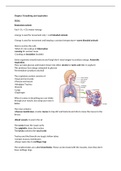
Chapter 3 breathing and respiration

Notes:

Respiratory system

Fuel + O₂ = CO₂+water+energy

-Energy is used for movement only = cold blooded animals

-Energy is used for movement and keeping a constant temperature= warm blooded animals

How to survive the cold:
-When it’s too cold go in hibernation
-Leaving for warmer areas
-Creating an insulation (isolatie)

Some organisms (mostly bacteria and fungi) don’t need oxygen to produce energy: Anaerobic
respiration.
They can take glucose and break it down into either alcohol or lactic acid (like in yoghurt)
This produces less energy compared to glucose
Fermentation (produces alcohol)

The respiratory system consists of:
-Nasal and oral cavity
-Pharynx and Larynx
-Windpipe/Trachea
-Bronchi
-Lungs
-Diaphragm

When it comes to breathing you can inhale
through your mouth, but using your nose is
better.

The nose contains:
-Mucous membranes, creates mucus to trap dirt and bacteria and cilia to move the mucus to the
throat.

-Blood vessels, to warm the air

The uvula closes the nasal cavity
The epiglottis closes the trachea
The larynx contains the vocal cords

Trachea and the Bronchi are tough, hollow tubes
-Contain mucous membranes
-Always open due to cartilage rings

The smallest tubes are called bronchioles. These can be closed with the muscles, since they don’t
have cartilage rings.

, The bronchioles end with alveoli
- Very thin ‘balloons’ surrounded by capillaries (very small blood vessels)
-This is where oxygen is moved into the body and carbon dioxide is removed, which is called gas
exchange.

Gas exchange
Diffusion:

Movement of molecules from a high concentration (many molecules in one place) to a low
concentration (few molecules in one place) by themselves.
This requires a large surface and a short distance to happen.

Breathing: air in/out of the lungs
Respiration: burning food for energy
Gas exchange: O₂ into blood, CO₂ into air.

Air is moved in and out by changing the long volume
-Lungs get bigger -> air is sucked in
-Lungs get smaller -> air is pushed out

This can be done through thoracic or abdominal breathing.

Thoracic Breathing
Thorax= chest
Happens when the intercostal muscles, the muscles between the ribs, contract.

Muscles pull the rubs up and out, which makes the chest cavity bigger and air is sucked into the
lungs.

Abdominal Breathing
Happens when the diaphragm under the lungs contracts.

First the diaphragm flattens and pulls the lungs down, the chest cavity becomes bigger and air is
sucked in.

Lung problems
Asthma
Is a chronic disease causing the muscles around the bronchioles contract, reducing the airflow of the
alveoli.

Allergies
Means you are really sensitive to specific (harmless) things and your body will ‘overreact’ to them.

One of them is hay fever, reaction to pollen from plants, which causes swelling of mucous
membranes and lots of sneezing and coughing.

Document information

Level
School year
2
Uploaded on
January 29, 2022
Number of pages
5
Written in
2021/2022
Type
Summary
$8.00

Wrong document? Swap it for free Within 14 days of purchase and before downloading, you can choose a different document. You can simply spend the amount again.
Written by students who passed
Immediately available after payment
Read online or as PDF

Sold
0
Followers
0
Items
2
Last sold
-


Why students choose Stuvia

Created by fellow students, verified by reviews

Quality you can trust: written by students who passed their tests and reviewed by others who've used these notes.

Didn't get what you expected? Choose another document

No worries! You can instantly pick a different document that better fits what you're looking for.

Pay as you like, start learning right away

No subscription, no commitments. Pay the way you're used to via credit card and download your PDF document instantly.

Student with book image

“Bought, downloaded, and aced it. It really can be that simple.”

Alisha Student

Working on your references?

Create accurate citations in APA, MLA and Harvard with our free citation generator.

Working on your references?

Frequently asked questions