
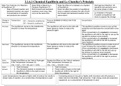
3.1.6.1 Chemical Equilibria and Le Chatelier's Principle
State Two Features of a Reaction State What is Meant by a State the Effect of a Catalyst on a System Homogenous Reaction: All
at Equilibrium (2) Dynamic Equilibrium (1) at Equilibrium reactants and products are in
- Rate of forward reaction and Both forward and backward Does not affect the position of equilibrium the same phase or state
backward reaction are equal reactions never stop, they since a catalyst increases the rate of both
- Concentrations of reactants occur at the same time the forward and backward reaction to the Le Chatelier’s Principle:
and products are constant same extent A system at equilibrium will
move to oppose the change
Change in Temperature ΔH+ = forward is endothermic Pressure (NUMBER OF MOLES HAS TO BE Concentration
Reaction: ΔH- = forward is exothermic DIFFERENT)
Increase: The equilibrium moves to the endothermic The equilibrium will move to the side with The equilibrium position moves to use up that
direction to lower the temperature fewer gaseous moles to reduce the substance and decrease the concentration once
pressure again again.
(If the concentration of a reactant is increased,
the equilibrium will shift to the right to use up the
reactant to produce more product)
(If the concentration of a product is increased,
the equilibrium will shift to the left to produce
more reactant)
Decrease: The equilibrium moves to the exothermic The equilibrium will move to the side with The equilibrium position moves to make more of
direction to increase the temperature fewer gaseous moles to reduce the it and increase the concentration once again
pressure again (If the concentration of a reactant is decreased,
the equilibrium will shift to the left and use up
the product to produce more reactant)
(If the concentration of a product is decreased,
the equilibrium will shift to the right to produce
more product)
Exam Explain the Effect on the Yield of Hydrogen Explain the Effect on the Yield of methanol
Question: if the Temperature Increases (3) if the Temperature Increases (3)
CH4 + H2O ⇋ CO + 3H2 (ΔH = +206) CO2 + 3H2 ⇋ CH3OH + H2O
Exam 1. Yield increases 1. Yield increases
Answer: 2. The (forward) reaction is endothermic 2. Fewer moles (of gas) on the right
3. Equilibrium shifts to the right to lower 3. Equilibrium shifts to the right to
the temperature lower the pressure
Lower temperatures may give a higher yield of product but results in Increasing pressure may give a higher yield of product and will produce a
slower rates of reaction, so a compromise of temperature is used faster rate but industrially, high pressures = high energy costs and expensive
equipment, so a compromise of temperature is used


