Name Ariel Gutierrez Period 5
Collision Theory
Vocabulary: activated complex, catalyst, chemical reaction, concentration, enzyme, half-life, molecule,
product, reactant, surface area. Click here to see academic vocabulary with definitions
Prior Knowledge Questions (Do these BEFORE using the Gizmo.)
1. Suppose you added a spoonful of sugar to hot water and another to ice-cold water. Which type of water will
cause the sugar to dissolve more quickly?
hot water
2. Suppose you held a lighted match to a solid hunk of wood and another match to a pile of wood shavings.
Which form of wood will catch fire more easily?
the shavings
Gizmo Warm-up
A chemical reaction causes the chemical compositions of substances
to change. Reactants are substances that enter into a reaction, and
products are substances produced by the reaction. The Collision
Theory Gizmo allows you to experiment with several factors that affect
the rate at which reactants are transformed into products in a chemical
reaction.
Open the Collision Theory Gizmo. Remember to login
so the Gizmo does not log you off.
You will need blue, green, and orange markers or colored pencils for the
first part of this activity.
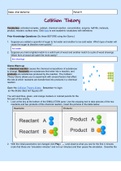
1. Look at the key at the bottom of the SIMULATION pane. Use the snipping tool to take pictures of the two
reactants and two products of this chemical reaction. Insert the pictures in the table below:
Reactants: Products:
2. With the initial parameters not changed click Play ( ) and observe what you see for the first 4 minutes
(note that these are “simulation minutes” and not our minutes) and then pause the simulation. Describe the
, nature of the collisions (orientation, frequency, and energy) and the outcome of the collisions (reaction or
no reaction?
the reactants started moving around and combined to form the products. It started with 20 reactants
and ended with 18 reactants and 2 products at a fast speed once they bump into each other.
3. With the same initial parameters click Play ( ) to continue the simulations and observe what you see
from 4 to 8 minutes. Describe the nature of the collisions (orientation, frequency, and energy) and the
outcome of the collisions (reaction or no reaction?
during the 4 to 8 minutes it ended with 14 reactants and 6 products with the speed going faster when
they collided into each other.
Get the Gizmo ready:
● Click Reset ( ).
Activity A:
● Set the parameters with the Reactant
Temperature concentration set to 1.0 mol/L, the Catalyst
concentration set to 0.00 mol/L, and the Surface
area is Minimum.
Question: How does temperature affect the rate of a chemical reaction?
1. Observe: Select the ANIMATION tab at the top of the simulation. View the animation with No catalyst
selected.
● Describe the nature of the collisions (orientation, frequency, and energy) and the outcome of the
collisions (reaction or no reaction?
When the blue and the green carrying the orange meet the blue takes the orange and keeps moving
while the green loses the orange and moves away at a fast rate.
● When two reactant molecules meet, they form a temporary structure called an activated complex.
The activated complex breaks up into the product molecules.
2. Observe: Return to the CONTROLS tab at the top of the simulation. Set new parameters with the
Temperature to 0 °C and the Simulation speed to its maximum setting. Click Play.
A. Describe the kinetic energy of the molecules.
Reactant A moves around but doesn’t combine with Reactant B.
B. Now set the Temperature to 200 °C. How does increasing the temperature affect the kinetic energy
of the molecules?
The two reactants move and combine very fast.
C. What do you notice about the chemical reaction at the higher temperature? Describe the nature of
the collisions (orientation, frequency, and energy) and the outcome of the collisions (reaction or no
reaction?
3. Interpret: Run the simulation for about 7 minutes with the parameter set at 200 °C and then pause the
simulation. Select the GRAPH tab. Click the zoom out button (–) until you can see the whole graph. Use
the snipping tool to take pictures of the graph. Insert the picture in the table below:
Collision Theory
Vocabulary: activated complex, catalyst, chemical reaction, concentration, enzyme, half-life, molecule,
product, reactant, surface area. Click here to see academic vocabulary with definitions
Prior Knowledge Questions (Do these BEFORE using the Gizmo.)
1. Suppose you added a spoonful of sugar to hot water and another to ice-cold water. Which type of water will
cause the sugar to dissolve more quickly?
hot water
2. Suppose you held a lighted match to a solid hunk of wood and another match to a pile of wood shavings.
Which form of wood will catch fire more easily?
the shavings
Gizmo Warm-up
A chemical reaction causes the chemical compositions of substances
to change. Reactants are substances that enter into a reaction, and
products are substances produced by the reaction. The Collision
Theory Gizmo allows you to experiment with several factors that affect
the rate at which reactants are transformed into products in a chemical
reaction.
Open the Collision Theory Gizmo. Remember to login
so the Gizmo does not log you off.
You will need blue, green, and orange markers or colored pencils for the
first part of this activity.
1. Look at the key at the bottom of the SIMULATION pane. Use the snipping tool to take pictures of the two
reactants and two products of this chemical reaction. Insert the pictures in the table below:
Reactants: Products:
2. With the initial parameters not changed click Play ( ) and observe what you see for the first 4 minutes
(note that these are “simulation minutes” and not our minutes) and then pause the simulation. Describe the
, nature of the collisions (orientation, frequency, and energy) and the outcome of the collisions (reaction or
no reaction?
the reactants started moving around and combined to form the products. It started with 20 reactants
and ended with 18 reactants and 2 products at a fast speed once they bump into each other.
3. With the same initial parameters click Play ( ) to continue the simulations and observe what you see
from 4 to 8 minutes. Describe the nature of the collisions (orientation, frequency, and energy) and the
outcome of the collisions (reaction or no reaction?
during the 4 to 8 minutes it ended with 14 reactants and 6 products with the speed going faster when
they collided into each other.
Get the Gizmo ready:
● Click Reset ( ).
Activity A:
● Set the parameters with the Reactant
Temperature concentration set to 1.0 mol/L, the Catalyst
concentration set to 0.00 mol/L, and the Surface
area is Minimum.
Question: How does temperature affect the rate of a chemical reaction?
1. Observe: Select the ANIMATION tab at the top of the simulation. View the animation with No catalyst
selected.
● Describe the nature of the collisions (orientation, frequency, and energy) and the outcome of the
collisions (reaction or no reaction?
When the blue and the green carrying the orange meet the blue takes the orange and keeps moving
while the green loses the orange and moves away at a fast rate.
● When two reactant molecules meet, they form a temporary structure called an activated complex.
The activated complex breaks up into the product molecules.
2. Observe: Return to the CONTROLS tab at the top of the simulation. Set new parameters with the
Temperature to 0 °C and the Simulation speed to its maximum setting. Click Play.
A. Describe the kinetic energy of the molecules.
Reactant A moves around but doesn’t combine with Reactant B.
B. Now set the Temperature to 200 °C. How does increasing the temperature affect the kinetic energy
of the molecules?
The two reactants move and combine very fast.
C. What do you notice about the chemical reaction at the higher temperature? Describe the nature of
the collisions (orientation, frequency, and energy) and the outcome of the collisions (reaction or no
reaction?
3. Interpret: Run the simulation for about 7 minutes with the parameter set at 200 °C and then pause the
simulation. Select the GRAPH tab. Click the zoom out button (–) until you can see the whole graph. Use
the snipping tool to take pictures of the graph. Insert the picture in the table below: