

Evaluate the likely effects on the Swiss economy of the decision by the SNB to
allow the franc to float freely against the euro.
A free-floating exchange rate system is a system whereby the value of a
currency is determined entirely by free market forces, and it is possible for the
value of a currency to change on a day-to-day basis.
The decision made by the SNB to
allow the Swiss franc to float freely
against the Euro may result in the
Swiss economy declining in growth.
Line 10 of extract 1 states “In
January 2015, the SNB abandoned its
efforts to link the Swiss franc to the
euro, allowing it to float freely. The
Swiss franc rose by almost 30%.” As
a result of the franc appreciating by 30%, this leads to a fall in the demand for
exports as goods become more expensive, whereas the demand for imports
increases as goods and services become cheaper. Thus, negatively affecting
international competitiveness. Line 14 of the extract states “It will also have an
impact on Swiss exporters competitiveness in the Eurozone market, which
accounts for 55% of all Swiss exports.” Given that 55% of all Swiss exports are
distributed to the Eurozone, this may significantly affect Switzerland’s net
trade (x-m) as the franc becomes stronger. Ceteris Paribus, a worsening of the
net trade balance will cause a fall in aggregate demand [C+I+G+(X-M)]. In the
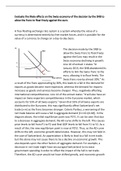
diagram above, the initial equilibrium point was P1Y1. It can be seen that due
to a decrease in aggregate demand, the AD curve shifts to the left. This causes
price levels to fall from P1 to P2 and Real GDP levels to fall from Y1 to Y2. As a
result of this, the new equilibrium point is now at P2Y2. Thus, as the AD curve
shifts to the left, economic growth deteriorates. However, this may not hold in
the case of Switzerland. An appreciation is likely to lead to a fall in net trade,
but this alone may not cause there to be a decline on economic growth. This
also depends upon the other factors of aggregate demand. For example, a
decrease in net trade might have encouraged Switzerland to increase
government spending in order to offset the impact of the fall in net trade.
Therefore, the AD curve would not have shifted greatly, and economic growth
allow the franc to float freely against the euro.
A free-floating exchange rate system is a system whereby the value of a
currency is determined entirely by free market forces, and it is possible for the
value of a currency to change on a day-to-day basis.
The decision made by the SNB to
allow the Swiss franc to float freely
against the Euro may result in the
Swiss economy declining in growth.
Line 10 of extract 1 states “In
January 2015, the SNB abandoned its
efforts to link the Swiss franc to the
euro, allowing it to float freely. The
Swiss franc rose by almost 30%.” As
a result of the franc appreciating by 30%, this leads to a fall in the demand for
exports as goods become more expensive, whereas the demand for imports
increases as goods and services become cheaper. Thus, negatively affecting
international competitiveness. Line 14 of the extract states “It will also have an
impact on Swiss exporters competitiveness in the Eurozone market, which
accounts for 55% of all Swiss exports.” Given that 55% of all Swiss exports are
distributed to the Eurozone, this may significantly affect Switzerland’s net
trade (x-m) as the franc becomes stronger. Ceteris Paribus, a worsening of the
net trade balance will cause a fall in aggregate demand [C+I+G+(X-M)]. In the
diagram above, the initial equilibrium point was P1Y1. It can be seen that due
to a decrease in aggregate demand, the AD curve shifts to the left. This causes
price levels to fall from P1 to P2 and Real GDP levels to fall from Y1 to Y2. As a
result of this, the new equilibrium point is now at P2Y2. Thus, as the AD curve
shifts to the left, economic growth deteriorates. However, this may not hold in
the case of Switzerland. An appreciation is likely to lead to a fall in net trade,
but this alone may not cause there to be a decline on economic growth. This
also depends upon the other factors of aggregate demand. For example, a
decrease in net trade might have encouraged Switzerland to increase
government spending in order to offset the impact of the fall in net trade.
Therefore, the AD curve would not have shifted greatly, and economic growth


