

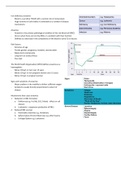
Iron deficiency anaemia
- Blood is a sensitive TISSUE with a central role in homeostasis
- Huge turnover of cells makes it vulnerable to a number of disease
mechanisms
Anaemia:
- Anaemia is the primary pathological condition of the red blood cell (RBC)
- Occurs when there are too few RBCs or a problem with their function
- Defined as a decrease in the competence of the blood to carry O2 to tissues
Risk Factors:
- Extremes of age
- Female gender: pregnancy, lactation, menstruation
- Babies born prematurely
- Long term or serious illness
- Poor diet
The World Health Organisation (WHO) defines anaemia as a
haemoglobin:
- Below 130 g/L in men over 15 years
- Below 120 g/L in non-pregnant women over 15 years
- Below 110 g/L in pregnant women
Signs and symptoms of anaemia:
- Major problem is the inability to deliver sufficient oxygen
- Symptoms usually directly proportional to extent of
disease
Mechanisms that cause anaemia:
1. Reduction in RBC formation
a. Deficiency (e.g. Fe (Hb), B12, Folate) - effect on cell
division
b. Leukaemia - suppresses production of RBCs
2. Reduced RBC survival
a. Haemolytic anaemias e.g. Hereditary
b. Spherocytosis Chronic Blood Loss e.g. after trauma
c. Enlarged Spleen e.g. Leukaemia
, Classification of anaemia
The role of iron and maintaining homeostasis
Why does iron deficiency cause anaemia?
- The main function of red blood cells is to carry O2 to the tissues and
return CO2 to the lungs
- Each red blood cell contains approximately 640 million haemoglobin
molecules
Haemoglobin
- Contains a 4 polypeptides
- Each polypeptide has a haem prosthetic group
- Each haem has an iron atom at its centre and can bind one oxygen
molecule
- 4 haem groups per haemoglobin molecule that together can bind 4
oxygen molecules
Haem prosthetic group:
- A protoporphyrin IX completed with ferrous iron (Fe2+)
- Protoporphyrin is an organic compound made up of 4 pyrrole rings
- Binds oxygen reversibly, without oxidation of the haem
Iron distribution overview:
- Total iron concentration in the body: ✓ 40-50mg of iron/kg of body weight
- Blood is a sensitive TISSUE with a central role in homeostasis
- Huge turnover of cells makes it vulnerable to a number of disease
mechanisms
Anaemia:
- Anaemia is the primary pathological condition of the red blood cell (RBC)
- Occurs when there are too few RBCs or a problem with their function
- Defined as a decrease in the competence of the blood to carry O2 to tissues
Risk Factors:
- Extremes of age
- Female gender: pregnancy, lactation, menstruation
- Babies born prematurely
- Long term or serious illness
- Poor diet
The World Health Organisation (WHO) defines anaemia as a
haemoglobin:
- Below 130 g/L in men over 15 years
- Below 120 g/L in non-pregnant women over 15 years
- Below 110 g/L in pregnant women
Signs and symptoms of anaemia:
- Major problem is the inability to deliver sufficient oxygen
- Symptoms usually directly proportional to extent of
disease
Mechanisms that cause anaemia:
1. Reduction in RBC formation
a. Deficiency (e.g. Fe (Hb), B12, Folate) - effect on cell
division
b. Leukaemia - suppresses production of RBCs
2. Reduced RBC survival
a. Haemolytic anaemias e.g. Hereditary
b. Spherocytosis Chronic Blood Loss e.g. after trauma
c. Enlarged Spleen e.g. Leukaemia
, Classification of anaemia
The role of iron and maintaining homeostasis
Why does iron deficiency cause anaemia?
- The main function of red blood cells is to carry O2 to the tissues and
return CO2 to the lungs
- Each red blood cell contains approximately 640 million haemoglobin
molecules
Haemoglobin
- Contains a 4 polypeptides
- Each polypeptide has a haem prosthetic group
- Each haem has an iron atom at its centre and can bind one oxygen
molecule
- 4 haem groups per haemoglobin molecule that together can bind 4
oxygen molecules
Haem prosthetic group:
- A protoporphyrin IX completed with ferrous iron (Fe2+)
- Protoporphyrin is an organic compound made up of 4 pyrrole rings
- Binds oxygen reversibly, without oxidation of the haem
Iron distribution overview:
- Total iron concentration in the body: ✓ 40-50mg of iron/kg of body weight


