

-1-
FREE RADICALS NOTES
Definitions
Free radical – organic species with an unpaired electron, not including carbenes and
certain photochemically excited compounds.
Stabilised – include carbon-centred radicals, R•, for which the R-H bond strength is
less than that for the corresponding C-H in (1o/2o/3o) alkane. Usually transient.
Persistent – radicals with a lifetime significantly greater than methyl under the same
conditions. Not necessarily stabilised. Lifetimes range from seconds to years.
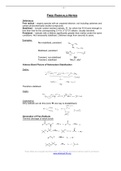
Examples:
Non-stabilised, persistent
Stabilised, persistent
Transient, non-stabilised Me•
Transient, stabilised Me3C•, allyl•
Valence Bond Picture of Heteroatom Stabilisation
Dative:
Therefore stabilised.
Capto:
Captodative:
Only radicals can do this (ionic Î one way is destabilised).
Generation of Free Radicals
Thermal cleavage of weak bonds
These Notes are copyright Alex Moss 2003. They may be reproduced without need for permission.
www.alchemyst.f2o.org
, -2-
Photochemical cleavage of weak bonds
Useful as heat can destabilise compound.
Initiating compound must absorb light of appropriate wavelength to cleave the bond.
Note that the latter reaction is technically a “phototransformation”.
Electron Transfer
Electrolytic –
Redox (Fenton) –
Dissolving Metal –
SRN’ (Sandmeyer) –
Giese’s Mercury Method –
• Room temperature.
• No UV initiation.
• Clean - Hg• by-product.
But, competing direction reduction is bad:
R-Hg-H + R• Æ RH + Hg•
Birch Reduction –
1 electron process.
Regiochemistry applies when substituted.
See other notes (e.g. Oxidation and Reduction Notes) for the mechanism.
Simple Reactions
Radical Combination –
Combining two radicals to terminate a chain reaction, R•+R• Æ R-R. Often slow due
to low concentrations of radicals generally. Only really viable for long-lived radicals or
via solvent cages (can be rapid in the latter case).
Radical Abstraction –
Attack often on a H atom or Halogen atom.
These Notes are copyright Alex Moss 2003. They may be reproduced without need for permission.
www.alchemyst.f2o.org
, -3-
Can be thought of as displacement reaction.
Radical Addition –
Radicals can add to double or triple bonds, and it is often the case that anti-
Markovnikov product can be obtained by this route. For example:
Fragmentation –
This is the reverse of radical addition, and often occurs as β-elimination. An example
would be:
Rearrangements –
These are radical reactions that occur intramolecularly (often abstraction). It can lead
to cyclisation of long chain compounds.
Some examples:
Chain Reactions
Example:
Series of events:
These Notes are copyright Alex Moss 2003. They may be reproduced without need for permission.
www.alchemyst.f2o.org
FREE RADICALS NOTES
Definitions
Free radical – organic species with an unpaired electron, not including carbenes and
certain photochemically excited compounds.
Stabilised – include carbon-centred radicals, R•, for which the R-H bond strength is
less than that for the corresponding C-H in (1o/2o/3o) alkane. Usually transient.
Persistent – radicals with a lifetime significantly greater than methyl under the same
conditions. Not necessarily stabilised. Lifetimes range from seconds to years.
Examples:
Non-stabilised, persistent
Stabilised, persistent
Transient, non-stabilised Me•
Transient, stabilised Me3C•, allyl•
Valence Bond Picture of Heteroatom Stabilisation
Dative:
Therefore stabilised.
Capto:
Captodative:
Only radicals can do this (ionic Î one way is destabilised).
Generation of Free Radicals
Thermal cleavage of weak bonds
These Notes are copyright Alex Moss 2003. They may be reproduced without need for permission.
www.alchemyst.f2o.org
, -2-
Photochemical cleavage of weak bonds
Useful as heat can destabilise compound.
Initiating compound must absorb light of appropriate wavelength to cleave the bond.
Note that the latter reaction is technically a “phototransformation”.
Electron Transfer
Electrolytic –
Redox (Fenton) –
Dissolving Metal –
SRN’ (Sandmeyer) –
Giese’s Mercury Method –
• Room temperature.
• No UV initiation.
• Clean - Hg• by-product.
But, competing direction reduction is bad:
R-Hg-H + R• Æ RH + Hg•
Birch Reduction –
1 electron process.
Regiochemistry applies when substituted.
See other notes (e.g. Oxidation and Reduction Notes) for the mechanism.
Simple Reactions
Radical Combination –
Combining two radicals to terminate a chain reaction, R•+R• Æ R-R. Often slow due
to low concentrations of radicals generally. Only really viable for long-lived radicals or
via solvent cages (can be rapid in the latter case).
Radical Abstraction –
Attack often on a H atom or Halogen atom.
These Notes are copyright Alex Moss 2003. They may be reproduced without need for permission.
www.alchemyst.f2o.org
, -3-
Can be thought of as displacement reaction.
Radical Addition –
Radicals can add to double or triple bonds, and it is often the case that anti-
Markovnikov product can be obtained by this route. For example:
Fragmentation –
This is the reverse of radical addition, and often occurs as β-elimination. An example
would be:
Rearrangements –
These are radical reactions that occur intramolecularly (often abstraction). It can lead
to cyclisation of long chain compounds.
Some examples:
Chain Reactions
Example:
Series of events:
These Notes are copyright Alex Moss 2003. They may be reproduced without need for permission.
www.alchemyst.f2o.org


