
Speech and Language
Lateralisation: left tend right hemisphere slightly different specialised. E.g.
In most people the left hemisphere is specialised for language
The right for visuospatial tasks (mental rotation). Emotion more in right hemisphere; Emotional
aspects of language; Emotional facial expression little bit more expressed in left facial musculature
(under control of right hemisphere) more fully expressed emotions left side face.
Facial recognition in the right inferior temporal lobe; damage problem with facial recognition, ‘facial
blindness’ or prosopagnosia.
hemispheric specialisation for language, emotion, facial recognition. The idea that every person had a
dominant hemisphere is misleading you always need bot hemispheres they participate in these processes.
Dominant hemisphere idea is a myth.
Language lateralisation. What is language? Symbolic representation of ideas/concepts with the aim for
communication. Associate arbitrary symbols with specific meanings to express ideas. Symbolic
representation of objects, concepts and feelings with goal of communication.
> Need gramma (rules) set of rules for using symbols.
> Syntax = ordering of symbols (words) to generate useful meanings.
> Prosody = emotional valence, coloring of speech (varying intensity, pitch stress). Absent in written
language ‘punctuation, typography, emoticons’
Cortical language;
Frontal cortex; motor planning and control mouth, tongue, larynx
Auditive cortex; sound perception
Visual cortex; perception written language and sign language
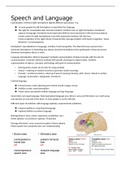
Sound does not equal language. Need specialised language area; Broca’s area and Wernicke’s are, both areas
only present on one side of the brain. In most people in on the left side.
Different types of problems with language (aphasia; acquired brain problems);
Impaired ability to comprehend language
Impaired ability to produce language
Damage Broca’s area; motor, expressive, production, non-
fluent aphasia, or just Broca’s aphasia. Production
Damage Wernicke’s area; sensory/receptive/ fluent aphasia.
Fluent speech but comprehension not. Understanding


