NUR 2488 MENTAL HEALTH NURSING FINAL EXAM KEY CONCEPTS
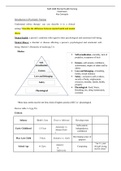
Introduction in Psychiatric Nursing Understand milieu therapy- can you describe it in a clinical setting? Describe the difference between mental health and mental illness Mental health: a person’s condition with regard to their psychological and emotional well-being: Mental illness: a disorder or disease affecting a person’s psychological and emotional well-being. Maslow’s Hierarchy of needs (pg 31) Review table 3-2 (pg 28) Erikson Infancy Birth-1.5yrs Trust vs. Mistrust Develops trust Early Childhood 1.5-3yrs Autonomy vs. Shame/Doubt Self-control; independence; confidence Play Late Child 3-6yrs Initiative vs. Guilt Developing sense of purpose School Age 6-12yrs Industry vs. Inferiority Competing “An 11-year- old girl trying out for cheer” Adolescent 12-20yrs Identity vs. Role Confusion Secure sense of self Young Adult 20-30yrs Intimacy vs. Isolation Ability to love and be loved Adulthood 30-65yrs Generativity vs. Stagnation Nurturing subsequent generations Old Adult 65-death Integrity vs. Despair Acceptance of life Freud-(Apply concept of Id, Ego and Superego) (page 19) One of Freud’s later and widely known constructs concerns the intrapsychic struggle that occurs within the brain among the id, the ego, and the superego. The id is the primitive, pleasure-seeking part (according to Freud, predominantly sexual pleasure) of our personalities that lurks in the unconscious mind. (Unconscious) Pleasure-pain principle Id, the instinctive and primitive mind, is dominant Demanding, impulsive, irrational, asocial, selfish, trustful, omnipotent, and dependent Primary thought processes Unconscious instincts—source-energy-aim-object Mouth—primary source of pleasure Immediate release of tension/anxiety and immediate gratification through oral gratification Task—develop a sense of trust that needs will be met The ego is our sense of self and acts as an intermediary between the id and the world by using ego defense mechanisms, such as repression, denial, and rationalization (conscious) The superego is assigned to those processes that Freud referred to as our conscience (our sense of what is right or wrong) and is greatly influenced by our parents’ or caregivers’ moral and ethical stances. The assumption is made that in healthy individuals, the ego is able to realistically evaluate situations, limit the id’s primitive impulses, and keep the superego from becoming too rigid and obsessive. (Unconscious) Therapeutic Communication Be able to given examples of verbal and non-verbal communication ABLE 8-2 Techniques that Enhance Communication Technique Discussion Examples Using silence Gives the person time to collect thoughts or think through a point. Encourage a person to talk by waiting for the answers. Accepting Indicates that the person has been understood. The statement does not necessarily indicate agreement but is nonjudgmental. However, nurses should not imply that they understand when they do not understand. “Yes.” “Uh-huh.” “I follow what you say.” Giving recognition Indicates awareness of change and personal efforts. Does not imply good or bad, or right or wrong. “Good morning, Mr. James.” “You’ve combed your hair today.” “I notice that you shaved today.” Offering self Offers presence, interest, and a desire to understand. Is not offered to get the person to talk or behave in a specific way. “I would like to spend time with you.” “I’ll stay here and sit with you a while.” Offering general leads Allows the other person to take direction in the discussion. Indicates that the nurse is interested in what comes next. “Go on.” “And then?” “Tell me about it.” Giving broad openings Clarifies that the lead is to be taken by the patient. However, the nurse discourages pleasantries and small talk. “Where would you like to begin?”
Document information
- Uploaded on
- December 22, 2021
- Number of pages
- 60
- Written in
- 2021/2022
- Type
- Exam (elaborations)
- Contains
- Questions & answers