GIZMOS Student Exploration Natural
O
Selection Student Exploration: Natural Selection
Vocabulary:biological evolution, camouflage, Industrial Revolution, lichen, morph, natural selection, peppered
moth
Prior Knowledge Questions (Do these BEFORE using the Gizmo.)
The peppered moth (Biston betularia) is a common moth found in
Europe, Asia, and North America. It is commonly found in two forms, or
morphs: a dark morph and a light, speckled morph. Birds are a frequent
predator of the peppered moth.
1. Which morph do you think would be easier to see on a dark tree
trunk? The light morph
2. Which morph do you think would be easier to see on a light tree
m
er as
trunk? The dark morph
co
eH w
o.
Gizmo Warm-up
rs e
The Natural Selection Gizmo™ allows you to play the role of a bird
ou urc
feeding on peppered moths. The initial population of 40 moths is scattered
over 20 tree trunks. Click on moths to capture them. Click the Next tree
button or hit the spacebar on your keyboard to advance to the next tree.
o
1. Check that LIGHT TREES is selected. Click Start and hunt moths
aC s
for one year.
vi y re
A. How many dark moths did you capture? 4
B. How many light moths did you capture? 5
ed d
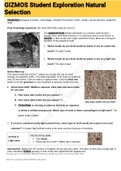
How many moths can you find?
ar stu
C. Camouflage is coloring or patterns that help an organism
to blend in withthe background. Which type of moth is better camouflaged on light bark? The
is
lighter moth is better
Th
2. If a forest contained mostly light-colored trees, which type of moth would you expect to be most
sh
common? I’d expect light-colored moths to be more common because of evolution.
Get the Gizmo ready:
Activity A:
Click Reset.
Light trees
Check that the LIGHT TREES tab is selected.
Introduction: Before the 19th century in England, the air was very clean. The bark on trees was usually light in
color. Abundant lichens growing on tree trunks also lightened their appearance.
This study source was downloaded by 100000828331062 from CourseHero.com on 07-17-2021 05:56:27 GMT -05:00
https://www.coursehero.com/file/18448328/O-moths-gizmo/
O
Selection Student Exploration: Natural Selection
Vocabulary:biological evolution, camouflage, Industrial Revolution, lichen, morph, natural selection, peppered
moth
Prior Knowledge Questions (Do these BEFORE using the Gizmo.)
The peppered moth (Biston betularia) is a common moth found in
Europe, Asia, and North America. It is commonly found in two forms, or
morphs: a dark morph and a light, speckled morph. Birds are a frequent
predator of the peppered moth.
1. Which morph do you think would be easier to see on a dark tree
trunk? The light morph
2. Which morph do you think would be easier to see on a light tree
m
er as
trunk? The dark morph
co
eH w
o.
Gizmo Warm-up
rs e
The Natural Selection Gizmo™ allows you to play the role of a bird
ou urc
feeding on peppered moths. The initial population of 40 moths is scattered
over 20 tree trunks. Click on moths to capture them. Click the Next tree
button or hit the spacebar on your keyboard to advance to the next tree.
o
1. Check that LIGHT TREES is selected. Click Start and hunt moths
aC s
for one year.
vi y re
A. How many dark moths did you capture? 4
B. How many light moths did you capture? 5
ed d
How many moths can you find?
ar stu
C. Camouflage is coloring or patterns that help an organism
to blend in withthe background. Which type of moth is better camouflaged on light bark? The
is
lighter moth is better
Th
2. If a forest contained mostly light-colored trees, which type of moth would you expect to be most
sh
common? I’d expect light-colored moths to be more common because of evolution.
Get the Gizmo ready:
Activity A:
Click Reset.
Light trees
Check that the LIGHT TREES tab is selected.
Introduction: Before the 19th century in England, the air was very clean. The bark on trees was usually light in
color. Abundant lichens growing on tree trunks also lightened their appearance.
This study source was downloaded by 100000828331062 from CourseHero.com on 07-17-2021 05:56:27 GMT -05:00
https://www.coursehero.com/file/18448328/O-moths-gizmo/