
100% satisfaction guarantee Immediately available after payment Both online and in PDF No strings attached 4.2 TrustPilot
logo-home
Exam (elaborations)

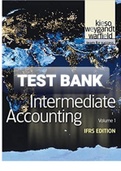
Exam (elaborations) TEST BANK FOR Intermediate Accounting IFRS Edition Volume 1 By Kieso Weygandt and Warfield Intermediate Accounting, ISBN: 9780470616307

Rating
-
Sold
-
Pages
1005
Grade
A+
Uploaded on
13-12-2021
Written in
2021/2022

Exam (elaborations) TEST BANK FOR Intermediate Accounting IFRS Edition Volume 1 By Kieso Weygandt and Warfield Intermediate Accounting, ISBN: 6307 Financial Reporting and Accounting Standards ASSIGNMENT CLASSIFICATION TABLE Topics Questions Cases 1. Global markets. 1 2. Environment of accounting. 2, 3, 4 4, 5, 7 3. Objective of financial reporting. 5, 6, 7, 8, 9, 10 2 4. Standard-setting organizations. 11, 12, 13, 14, 15, 16, 17, 18 1, 3, 6 5. Financial reporting challenges. 19, 20, 21, 22, 23, 24, 25 8, 9, 10 6. Ethical issues. 26 11, 12, 16 *7. Authoritative U.S. pronouncements and policy-setting bodies. 27, 28, 29, 30, 31, 32, 33, 34, 35, 36, 37, 38 13, 14, 15 *These questions and cases address material in the appendix to the chapter. To download more slides, ebook, solutions and test bank, visit 1-2 Copyright © 2011 John Wiley & Sons, Inc. Kieso, IFRS, 1/e, Solutions Manual (For Instructor Use Only) ASSIGNMENT CHARACTERISTICS TABLE Item Description Level of Difficulty Time (minutes) CA1-1 IFRS and standard-setting. Simple 5–10 CA1-2 IFRS and standard-setting. Simple 5–10 CA1-3 Financial reporting and accounting standards. Simple 15–20 CA1-4 Financial accounting. Simple 15–20 CA1-5 Need for IASB. Simple 15–20 CA1-6 IASB role in standard-setting. Simple 15–20 CA1-7 Accounting numbers and the environment. Simple 10–15 CA1-8 Politicalization of IFRS. Complex 15–20 CA1-9 Models for setting IFRS. Simple 10–15 CA1-10 Economic consequences. Moderate 25–35 CA1-11 Rule-making Issues. Complex 20–25 CA1-12 Financial reporting pressures. Moderate 25–35 *CA1-13 GAAP terminology. Moderate 20–30 *CA1-14 Accounting organizations and documents issued. Simple 3–5 *CA1-15 Accounting pronouncements. Simple 5–7 CA1-16 GAAP and economic consequences. Moderate 25–35 To download more slides, ebook, solutions and test bank, visit Copyright © 2011 John Wiley & Sons, Inc. Kieso, IFRS, 1/e, Solutions Manual (For Instructor Use Only) 1-3 ANSWERS TO QUESTIONS 1. World markets are becoming increasingly intertwined. The tremendous variety and volume of both exported and imported goods indicates the extensive involvement in international trade. As a result, the move towards adoption of international financial reporting standards has and will continue in the future. 2. Financial accounting measures, classifies, and summarizes in report form those activities and that information which relate to the enterprise as a whole for use by parties both internal and external to a business enterprise. Managerial accounting also measures, classifies, and summarizes in report form enterprise activities, but the communication is for the use of internal, managerial parties, and relates more to subsystems of the entity. Managerial accounting is management decision oriented and directed more toward product line, division, and profit center reporting. 3. Financial statements generally refer to the four basic financial statements: statement of financial position, income statement, statement of cash flows, and statement of changes in equity. Financial reporting is a broader concept; it includes the basic financial statements and any other means of communicating financial and economic data to interested external parties. 4. If a company’s financial performance is measured accurately, fairly, and on a timely basis, the right managers and companies are able to attract investment capital. To provide unreliable and irrelevant information leads to poor capital allocation which adversely affects the securities market. 5. The objective of general purpose financial reporting is to provide financial information about the reporting entity that is useful to present and potential equity investors, lenders, and other creditors in making decisions in their capacity as capital providers. 6. General purpose financial statements provide financial reporting information to a wide variety of users. To be cost effective in providing this information, general purpose financial statements provide at the least cost the most useful information possible. 7. Shareholders, creditors, suppliers, employees, and regulators all use general purpose financial statements. The primary user group is capital providers (shareholders and creditors). 8. The proprietary perspective is not considered appropriate because this perspective generally does not reflect a realistic view of the financial reporting environment. Instead the entity perspective is adopted which is consistent with the present business environment where most companies engaged in financial reporting have substance distinct from their investors. 9. The objective of financial reporting is primarily to provide information to investors interested in assessing the company’s ability to generate net cash inflows and management’s ability to protect and enhance the capital providers’ investments. Financial reporting should help investors assess the amounts, timing and uncertainty of prospective cash inflows. 10. A single set of high quality accounting standards ensures adequate comparability. Investors are able to make better investment decisions if they receive financial information from a U.S. company that is comparable to an international competitor. 11. The two organizations involved in international standard-setting are IOSCO (International Organization of Securities Commissions) and the IASB (International Accounting Standards Board.) The IOSCO does not set accounting standards, but ensures that the global markets can operate in an efficient and effective manner. Conversely, the IASB’s mission is to develop a single set of high quality, understandable and international financial reporting standards (IFRSs) for general purpose financial statements. To download more slides, ebook, solutions and test bank, visit 1-4 Copyright © 2011 John Wiley & Sons, Inc. Kieso, IFRS, 1/e, Solutions Manual (For Instructor Use Only) Questions Chapter 1 (Continued) 12. The Financial Accounting standards Board (FASB) is an independent organization whose mission is to establish and improve standards of financial accounting and reporting for U.S. companies. 13. The purpose of the IOSCO is to facilitate cross-border cooperation, reduce global systemic risk, protect investors, and ensure fair and efficient securities markets. 14. The mission of the IASB is to develop, in the public interest, a single set of high quality, understandable and international financial reporting standards (IFRSs) for general purpose financial statements. 15. The IASB preliminary views are based on research and analysis conducted by the IASB staff. IASB exposure drafts are issued after the Board evaluates research and public response to preliminary views. IASB standards are issued after the Board evaluates responses to the exposure draft. 16. IASB standards are financial accounting standards issued by the IASB and are referred to as International Financial Reporting Standards (IFRS). The IASB Framework for financial reporting sets forth fundamental objectives and concepts that the Board uses in developing future standards of financial reporting. The intent of the Framework is to form a cohesive set of interrelated concepts that will serve as tools for solving existing and emerging problems in a consistent manner. 17. International Financial Reporting Standards are the most authoritative, followed by International Financial Reporting Interpretations then the IASB framework. 18. The International Financial Reporting Interpretations Committee (IFRIC) applies a principles-based approach in providing interpretative guidance. The IFRIC issues interpretations that cover newly identified financial reporting issues not specifically dealt with in IFRS, and issues where conflicting interpretations have developed, or seem likely to develop in the absence of authoritative guidance. 19. Some major challenges facing the accounting profession relate to the following items: Nonfinancial measurement—how to report significant key performance measurements such as customer satisfaction indexes, backlog information and reject rates on goods purchased. Forward-looking information—how to report more future oriented information. Soft assets—how to report on intangible assets, such as market know-how, market dominance, and well-trained employees. Timeliness—how to report more real-time information. 20. The sources of pressure are innumerable, but the most intense and continuous pressure to change or influence the development of IFRS come from individual companies, industry associations, governmental agencies, practicing accountants, academicians, professional accounting organizations, and investing public. To download more slides, ebook, solutions and test bank, visit Copyright © 2011 John Wiley & Sons, Inc. Kieso, IFRS, 1/e, Solutions Manual (For Instructor Use Only) 1-5 Questions Chapter 1 (Continued) 21. IFRS are considered principles-based accounting. These standards provide more general guidance by starting with broad objectives, outcomes, and principles without providing detailed guidance. U.S. GAAP (referred to as rules-based accounting) is based on the assumption that management needs detailed accounting guidance to ensure that the transaction is reported consistently and appropriately. 22. Economic consequences means the impact of accounting reports on the wealth positions of issuers and users of financial information and the decision-making behavior resulting from that impact. In other words, accounting information impacts various users in many different ways which leads to wealth transfers among these various groups. If politics plays an important role in the development of accounting rules, the rules will be subject to manipulation for the purpose of furthering whatever policy prevails at the moment. No matter how well intentioned the rule maker may be, if information is designed to indicate that investing in a particular enterprise involves less risk than it actually does, or is designed to encourage investment in a particular segment of the economy, financial reporting will suffer an irreplaceable loss of credibility. 23. No one particular proposal is expected in answer to this question. The students’ proposals, however, should be defensible relative to the following criteria: (1) The method must be efficient, responsive, and expeditious. (2) The method must be free of bias and be above or insulated from pressure groups. (3) The method must command widespread support if it does not have legislative authority. (4) The method must produce sound yet practical accounting principles or standards. The students’ proposals might take the form of alterations of the existing methodology, an accounting court (as proposed by Leonard Spacek), or governmental device. 24. Concern exists about fraudulent financial reporting because it can undermine the entire financial reporting process. Failure to provide information to users that is accurate can lead to inappropriate allocations of resources in our economy. In addition, failure to detect massive fraud can lead to additional governmental oversight of the accounting profession. 25. The expectations gap is the difference between what people think accountants should be doing and what accountants think they can do. It is a difficult gap to close. The accounting profession recognizes it must play an important role in narrowing this gap. To meet the needs of society, the profession is continuing its efforts in developing accounting standards, such as numerous pronouncements issued by the IASB, to serve as guidelines for recording and processing business transactions in the changing economic environment. 26. Accountants must perceive the moral dimensions of some situations because IFRS does not define or cover all specific features that are to be reported in financial statements. In these instances accountants must choose among alternatives. These accounting choices influence whether particular stakeholders may be harmed or benefited. Moral decision-making involves awareness of potential harm or benefit and taking responsibility for the choices. *27. The purpose of the Securities and Exchange Commission (SEC) is to help develop and standardize financial information presented to stockholders. The SEC has broad powers to prescribe the accounting practices and standards to be employed by companies within its jurisdiction. *28. The Financial Accounting Standards Board’s (FASB) mission is to establish and improve standards of financial accounting and reporting for the guidance of the public, including issuers, auditors, and users of financial information. To download more slides, ebook, solutions and test bank, visit 1-6 Copyright © 2011 John Wiley & Sons, Inc. Kieso, IFRS, 1/e, Solutions Manual (For Instructor Use Only) Questions Chapter 1 (Continued) *29. Accounting Research Bulletins were pronouncements on accounting practice issued by the Committee on Accounting Procedure between 1939 and 1959; since 1964 they have been recognized as accepted accounting practice unless superseded in part or in whole by an opinion of the APB or an FASB standard. APB Opinions were issued by the Accounting Principles Board during the years 1959 through 1973 and, unless superseded by FASB Statements, are recognized as accepted practice and constitute the requirements to be followed by all business enterprises. FASB Statements are pronouncements of the Financial Accounting Standards Board and currently represent the accounting profession’s authoritative pronouncements on financial accounting and reporting practices. *30. The explanation should note that generally accepted accounting principles or standards have “substantial authoritative support.” They consist of accounting practices, procedures, theories, concepts, and methods which are recognized by a large majority of practicing accountants as well as other members of the business and financial community. Bulletins issued by the Committee on Accounting Procedure, opinions rendered by the Accounting Principles Board, and statements issued by the Financial Accounting Standards Board constitute “substantial authoritative support.” *31. It was believed that FASB Statements would carry greater weight than APB Opinions because of significant differences between the FASB and the APB, namely: (1) The FASB has a smaller membership of full-time compensated members; (2) the FASB has greater autonomy and increased independence; and (3) the FASB has broader representation than the APB. *32. The technical staff of the FASB conducts research on an identified accounting topic and prepares a “preliminary views” that is released by the Board for public reaction. The Board analyzes and evaluates the public response to the preliminary views, deliberates on the issues, and issues an “exposure draft” for public comment. The preliminary views merely presents all facts and alternatives related to a specific topic or problem, whereas the exposure draft is a tentative “statement.” After studying the public’s reaction to the exposure draft, the Board may reevaluate its position, revise the draft, and vote on the issuance of a final statement. *33. Statements of financial accounting standards constitute generally accepted accounting principles and dictate acceptable financial accounting and reporting practices as promulgated by the FASB. The first standards statement was issued by the FASB in 1973. Statements of financial accounting concepts do not establish generally accepted accounting principles. Rather, the concepts statements set forth fundamental objectives and concepts that the FASB intends to use as a basis for developing future standards. The concepts serve as guidelines in solving existing and emerging accounting problems in a consistent, sound manner. Both the standards statements and the concepts statements may develop through the same process from discussion memorandum, to exposure draft, to a final approved statement. *34. Rule 203 of the Code of Professional Conduct prohibits a member of the AICPA from expressing an opinion that financial statements conform with GAAP if those statements contain a material departure from an accounting principle promulgated by the FASB, or its predecessors, the APB and the CAP, unless the member can demonstrate that because of unusual circumstances the financial statements would otherwise have been misleading. Failure to follow Rule 203 can lead to a loss of a CPA’s license to practice. This rule is extremely important because it requires auditors to follow FASB standards. To download more slides, ebook, solutions and test bank, visit Copyright © 2011 John Wiley & Sons, Inc. Kieso, IFRS, 1/e, Solutions Manual

Show more Read less


Whoops! We can’t load your doc right now. Try again or contact support.

Document information

Uploaded on
December 13, 2021
Number of pages
1005
Written in
2021/2022
Type
Exam (elaborations)
Contains
Questions & answers

Subjects

Content preview

,To download more slides, ebook, solutions and test bank, visit http://downloadslide.blogspot.com


CHAPTER 1
Financial Reporting and Accounting Standards

ASSIGNMENT CLASSIFICATION TABLE

Topics Questions Cases

1. Global markets. 1

2. Environment of accounting. 2, 3, 4 4, 5, 7

3. Objective of financial reporting. 5, 6, 7, 8, 9, 10 2

4. Standard-setting organizations. 11, 12, 13, 14, 1, 3, 6
15, 16, 17, 18

5. Financial reporting challenges. 19, 20, 21, 22, 8, 9, 10
23, 24, 25

6. Ethical issues. 26 11, 12, 16

*7. Authoritative U.S. pronouncements 27, 28, 29, 30, 31, 13, 14, 15
and policy-setting bodies. 32, 33, 34, 35, 36,
37, 38


*These questions and cases address material in the appendix to the chapter.


Copyright © 2011 John Wiley & Sons, Inc. Kieso, IFRS, 1/e, Solutions Manual (For Instructor Use Only) 1-1

, To download more slides, ebook, solutions and test bank, visit http://downloadslide.blogspot.com

ASSIGNMENT CHARACTERISTICS TABLE

Level of Time
Item Description Difficulty (minutes)

CA1-1 IFRS and standard-setting. Simple 5–10
CA1-2 IFRS and standard-setting. Simple 5–10
CA1-3 Financial reporting and accounting standards. Simple 15–20
CA1-4 Financial accounting. Simple 15–20
CA1-5 Need for IASB. Simple 15–20
CA1-6 IASB role in standard-setting. Simple 15–20
CA1-7 Accounting numbers and the environment. Simple 10–15
CA1-8 Politicalization of IFRS. Complex 15–20
CA1-9 Models for setting IFRS. Simple 10–15
CA1-10 Economic consequences. Moderate 25–35
CA1-11 Rule-making Issues. Complex 20–25
CA1-12 Financial reporting pressures. Moderate 25–35
*CA1-13 GAAP terminology. Moderate 20–30
*CA1-14 Accounting organizations and documents issued. Simple 3–5
*CA1-15 Accounting pronouncements. Simple 5–7
CA1-16 GAAP and economic consequences. Moderate 25–35


1-2 Copyright © 2011 John Wiley & Sons, Inc. Kieso, IFRS, 1/e, Solutions Manual (For Instructor Use Only)

, To download more slides, ebook, solutions and test bank, visit http://downloadslide.blogspot.com


ANSWERS TO QUESTIONS

1. World markets are becoming increasingly intertwined. The tremendous variety and volume of both
exported and imported goods indicates the extensive involvement in international trade. As a
result, the move towards adoption of international financial reporting standards has and will continue
in the future.

2. Financial accounting measures, classifies, and summarizes in report form those activities and that
information which relate to the enterprise as a whole for use by parties both internal and external
to a business enterprise. Managerial accounting also measures, classifies, and summarizes in report
form enterprise activities, but the communication is for the use of internal, managerial parties, and
relates more to subsystems of the entity. Managerial accounting is management decision oriented
and directed more toward product line, division, and profit center reporting.

3. Financial statements generally refer to the four basic financial statements: statement of financial
position, income statement, statement of cash flows, and statement of changes in equity. Financial
reporting is a broader concept; it includes the basic financial statements and any other means of
communicating financial and economic data to interested external parties.

4. If a company’s financial performance is measured accurately, fairly, and on a timely basis, the right
managers and companies are able to attract investment capital. To provide unreliable and irrelevant
information leads to poor capital allocation which adversely affects the securities market.

5. The objective of general purpose financial reporting is to provide financial information about the
reporting entity that is useful to present and potential equity investors, lenders, and other creditors
in making decisions in their capacity as capital providers.

6. General purpose financial statements provide financial reporting information to a wide variety of
users. To be cost effective in providing this information, general purpose financial statements provide
at the least cost the most useful information possible.

7. Shareholders, creditors, suppliers, employees, and regulators all use general purpose financial
statements. The primary user group is capital providers (shareholders and creditors).

8. The proprietary perspective is not considered appropriate because this perspective generally does
not reflect a realistic view of the financial reporting environment. Instead the entity perspective
is adopted which is consistent with the present business environment where most companies
engaged in financial reporting have substance distinct from their investors.

9. The objective of financial reporting is primarily to provide information to investors interested in
assessing the company’s ability to generate net cash inflows and management’s ability to protect
and enhance the capital providers’ investments. Financial reporting should help investors assess
the amounts, timing and uncertainty of prospective cash inflows.

10. A single set of high quality accounting standards ensures adequate comparability. Investors are
able to make better investment decisions if they receive financial information from a U.S. company
that is comparable to an international competitor.

11. The two organizations involved in international standard-setting are IOSCO (International Organi-
zation of Securities Commissions) and the IASB (International Accounting Standards Board.) The
IOSCO does not set accounting standards, but ensures that the global markets can operate in an
efficient and effective manner. Conversely, the IASB’s mission is to develop a single set of high
quality, understandable and international financial reporting standards (IFRSs) for general purpose
financial statements.


Copyright © 2011 John Wiley & Sons, Inc. Kieso, IFRS, 1/e, Solutions Manual (For Instructor Use Only) 1-3


Get to know the seller

Seller avatar
Reputation scores are based on the amount of documents a seller has sold for a fee and the reviews they have received for those documents. There are three levels: Bronze, Silver and Gold. The better the reputation, the more your can rely on the quality of the sellers work.
Expert001 Chamberlain School Of Nursing
View profile
Follow You need to be logged in order to follow users or courses
Sold
797
Member since
4 year
Number of followers
566
Documents
1190
Last sold
1 week ago
Expert001

High quality, well written Test Banks, Guides, Solution Manuals and Exams to enhance your learning potential and take your grades to new heights. Kindly leave a review and suggestions. We do take pride in our high-quality services and we are always ready to support all clients.

4.2

159 reviews

5
104
4
18
3
14
2
7
1
16

Recently viewed by you

Why students choose Stuvia

Created by fellow students, verified by reviews

Quality you can trust: written by students who passed their tests and reviewed by others who've used these notes.

Didn't get what you expected? Choose another document

No worries! You can instantly pick a different document that better fits what you're looking for.

Pay as you like, start learning right away

No subscription, no commitments. Pay the way you're used to via credit card and download your PDF document instantly.

Student with book image

“Bought, downloaded, and aced it. It really can be that simple.”

Alisha Student

Frequently asked questions
