
GIZMO Virus Lytic Cycle Studen
Exploration Sheet
Name: Darlin Paz Date:5/17/2020
Student Exploration: Virus Lytic Cycle
Vocabulary: bacteriophage, capsid, host cell, lyse, lytic cycle, virus
Prior Knowledge Questions (Do these BEFORE using the Gizmo.)
1. A computer virus is a program that can copy itself and infect a computer without the
permission of the owner. How do you think a computer virus compares to a real virus?
A computer virus infects a computer, and a real virus infects an organism. During an infection,
both types of viruses make copies of themselves so that more infections can occur. A computer
viruses disrupts the functions of a computer, while a real viruses destroys its host cells.
m
er as
co
eH w
2. Have you ever been infected with a virus, such as the cold virus or flu virus? yes
o.
rs e
ou urc
3. If so, how did the virus affect you? The viruses affected me by giving me fevers and
congestions.
o
Gizmo Warm-up
aC s
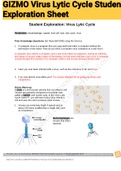
A virus is a microscopic particle that can infect a cell.
vi y re
Viruses are primarily composed of a protein coat,
called a capsid, and nucleic acid. In the Virus Lytic
Cycle Gizmo™, you will learn how a virus infects a
cell and uses the cell to produce more viruses.
ed d
ar stu
1. Viruses are extremely small. A typical virus is
about 100 times smaller than a single cell, such
as a bacterium.
is
Bacteriophages are
Th
2.
viruses that infect
bacteria.
sh
This study source was downloaded by 100000828331062 from CourseHero.com on 07-17-2021 05:31:46 GMT -05:00
2019
https://www.coursehero.com/file/62874224/Gizmo-Virus-Lytic-Cycle-Student-Exploration-Sheetdocx/
, Activity A: Get the Gizmo ready:
Lytic cycle If necessary, click Reset ( ).
Introduction: Unlike living organisms, viruses cannot reproduce on their own. Instead, viruses
infect host cells, taking over the cell’s machinery to produce more viruses. This process is
called the lytic cycle.
Question: What are the steps of the lytic cycle?
1. Observe: Use the navigation arrows on the DESCRIPTION tab to read about the stages of
the lytic cycle. Using your own words, summarize each step of the cycle.
Step Summary
A lytic bacteriophage virus attaches itself to a bacterial cell. The virus is
1 a very simple structure, composed of a protein capsid, nucleic acid, and
m
a tail section.
er as
co
↓
eH w
o.
rs e
The virus injects its nucleic acid into the cell. The nucleic acid uses the
ou urc
2 cell’s ribosomes to make virus proteins. The proteins break up the cell’s
DNA.
o
↓
aC s
vi y re
The virus capsid and tail, now useless, detach from the cell and
3 disintegrate. Inside the cell, the viral nucleic acid takes over and directs
the production of new virus proteins and nucleic acid
ed d
↓
ar stu
is
4 The virus proteins and nucleic acid assemble into new viruses.
Th
↓
sh
Special proteins produced by the viral nucleic acid cause the host
5 bacterial cell to lyse (burst), destroying the cell in the process. The
numerous new viruses are now free to infect other cells.
(Activity A continued on next page)
This study source was downloaded by 100000828331062 from CourseHero.com on 07-17-2021 05:31:46 GMT -05:00
2019
https://www.coursehero.com/file/62874224/Gizmo-Virus-Lytic-Cycle-Student-Exploration-Sheetdocx/
Exploration Sheet
Name: Darlin Paz Date:5/17/2020
Student Exploration: Virus Lytic Cycle
Vocabulary: bacteriophage, capsid, host cell, lyse, lytic cycle, virus
Prior Knowledge Questions (Do these BEFORE using the Gizmo.)
1. A computer virus is a program that can copy itself and infect a computer without the
permission of the owner. How do you think a computer virus compares to a real virus?
A computer virus infects a computer, and a real virus infects an organism. During an infection,
both types of viruses make copies of themselves so that more infections can occur. A computer
viruses disrupts the functions of a computer, while a real viruses destroys its host cells.
m
er as
co
eH w
2. Have you ever been infected with a virus, such as the cold virus or flu virus? yes
o.
rs e
ou urc
3. If so, how did the virus affect you? The viruses affected me by giving me fevers and
congestions.
o
Gizmo Warm-up
aC s
A virus is a microscopic particle that can infect a cell.
vi y re
Viruses are primarily composed of a protein coat,
called a capsid, and nucleic acid. In the Virus Lytic
Cycle Gizmo™, you will learn how a virus infects a
cell and uses the cell to produce more viruses.
ed d
ar stu
1. Viruses are extremely small. A typical virus is
about 100 times smaller than a single cell, such
as a bacterium.
is
Bacteriophages are
Th
2.
viruses that infect
bacteria.
sh
This study source was downloaded by 100000828331062 from CourseHero.com on 07-17-2021 05:31:46 GMT -05:00
2019
https://www.coursehero.com/file/62874224/Gizmo-Virus-Lytic-Cycle-Student-Exploration-Sheetdocx/
, Activity A: Get the Gizmo ready:
Lytic cycle If necessary, click Reset ( ).
Introduction: Unlike living organisms, viruses cannot reproduce on their own. Instead, viruses
infect host cells, taking over the cell’s machinery to produce more viruses. This process is
called the lytic cycle.
Question: What are the steps of the lytic cycle?
1. Observe: Use the navigation arrows on the DESCRIPTION tab to read about the stages of
the lytic cycle. Using your own words, summarize each step of the cycle.
Step Summary
A lytic bacteriophage virus attaches itself to a bacterial cell. The virus is
1 a very simple structure, composed of a protein capsid, nucleic acid, and
m
a tail section.
er as
co
↓
eH w
o.
rs e
The virus injects its nucleic acid into the cell. The nucleic acid uses the
ou urc
2 cell’s ribosomes to make virus proteins. The proteins break up the cell’s
DNA.
o
↓
aC s
vi y re
The virus capsid and tail, now useless, detach from the cell and
3 disintegrate. Inside the cell, the viral nucleic acid takes over and directs
the production of new virus proteins and nucleic acid
ed d
↓
ar stu
is
4 The virus proteins and nucleic acid assemble into new viruses.
Th
↓
sh
Special proteins produced by the viral nucleic acid cause the host
5 bacterial cell to lyse (burst), destroying the cell in the process. The
numerous new viruses are now free to infect other cells.
(Activity A continued on next page)
This study source was downloaded by 100000828331062 from CourseHero.com on 07-17-2021 05:31:46 GMT -05:00
2019
https://www.coursehero.com/file/62874224/Gizmo-Virus-Lytic-Cycle-Student-Exploration-Sheetdocx/


