CHEM1810 Tutorial 3
Inorganic Chemistry – Structure and Bonding
Hybridization Theory and Molecular Orbital Theory
For discussion in the week of November 8, 2021
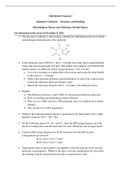
1. The structure of caffeine is shown below. Identify the hybridization present in all the
non-hydrogen atoms present in this molecule.
2. In the ethanoate anion (CH3CO2-), the C—O bonds have been shown experimentally
to have the same bond length (125 pm). This differs from ethanoic acid (CH3CO2H),
which contains two different carbon-oxygen distances (122, 132 pm).
a. Use Lewis structures to explain these observations and assign the bond lengths
to the correct C—O bonds.
b. What is the molecular geometry and hybridization of each of the carbon atoms
in both the ethanoate anion and ethanoic acid?
c. Sketch the molecular orbital for the C—O bonds in the ethanoate anion.
3. Explain:
a) The difference between and MOs for homonuclear diatomic molecules.
b) How are bonding and antibonding orbitals different?
c) Why are two MOs and one MO generated when we combine the p atomic
orbitals?
d) Why are the two MOs degenerate?
4. Which of the following helium species is predicted by the MO model to be a stable
diatomic molecule? He22+ , He2+, He2.
5. For the following species O2, O2+, and O2-, draw the MO energy diagram, give the
electron configuration, and the bond order for each. Which has the strongest bond?
6. Construct MO energy diagrams for the B2 molecule from the MO electron
configurations given below:
B2 A: (2s)2 (2s*)2 (2p)2
B2 B: (2s)2 (2s*)2 (2p)2
b. Experimental data on the magnetic susceptibility of the B2 molecule shows that the
molecule is paramagnetic. Which of the above electron configuration best describes
the bonding in the B2 molecule based on these experimental results?