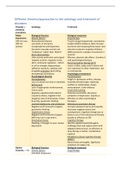
Different theories/approaches to the aetiology and treatment of
disorders
Disorder + Aetiology Treatment
(lifetime)
prevalence
Major Biological theories Biological treatment
Depression, Genetic factors Drug therapy
20% for men, Neurochemical factors Tricyclic drugs (imipramine), monoamine
30% for Low levels of serotonin, oxidase (MAO) inhibitors. Both increase
women norepinephrine and dopamine. serotonin and norepinephrine levels. And
Serotonin may play central role. selective serotonin reuptake inhibitors
“imbalance” rather than “deficit” (SSRIs) prevents reuptake of serotonin in
Brain abnormalities neurons.
Little activity prefrontal cortex (goal- Effective, physical side effects. Combine it
related), anterior cingulate cortex with psychological therapy.
(ACC, emotional regulation – deficit Electroconvulsive therapy (ECT)
in will to change), hippocampus Used in 1930s, today only if severe and
(affective reactions, sadness) and not responsive to other treatments. Use
amygdala activation (prioritizing is controversial.
threatening information) Psychological treatments
Psychological theories Psychoanalysis
Psychodynamic Insight in repressed conflict, releases
Loss of a loved one (real or symbolic) inwardly directed anger, exploring
Behavioural conflicts in relationships, dream
Lack of appropriate reinforcement, interpretation. Little evidence.
vicious cycle Social skills training
Negative cognitions/self-schema Improves social skills, decreases
Caused by biases, negative triad symptoms of depression. Equally as
(negative view of themselves, future effective as other psychological
& world), pessimistic thinking therapies.
Learned helplessness and attribution Behavioural activation therapy
Negative stuff is bound to happen, Increases pleasant events and rewards,
pessimistic thinking decreases negative events and
Hopelessness theory consequences. Cognitive change just as
Negative stuff is bound to happen likely to occur from behavioural therapy.
AND they can’t cope with it Equally as effective as CBT.
Rumination theory Cognitive therapy
Dwelling, is thought to even resolve Identify negative beliefs/thoughts,
depression challenge them and replace them with
adaptive/rational ones. As effective as
drug therapy or better. Combination
superior.
Mindfulness-based cognitive therapy
(MBCT)
Neutral look at thoughts. Significant
reduction of relapse risk.
Bipolar Biological theories Biological treatment
Disorder, +-1% Genetic factors Drug therapy
Inherited component
, Neurochemical factors Lithium carbonate relieves manic AND
Dopamine/norepinephrine depressive episodes. Usage is risky.
irregularities, high levels Combining antipsychotic and
norepinephrine in mania antidepressant drugs has significant
Triggers for depression and mania effect.
in bipolar disorder Psychological treatment
Negative life events, dysregulation in Cognitive therapy
BAS, sleep problems Identify negative beliefs/thoughts,
challenge them and replace them with
adaptive/rational ones. As effective as
drug therapy or better. Combination
superior.
Schizophrenia, Biological theories Biological treatments
lifetime Genetic factors Electroconvulsive therapy (ECT) and
prevalence all Runs in families, one of the most psychosurgery
schizophrenia heritable of psychiatric disorders Used between 1930-1950, today only if
spectrum Molecular genetics comorbid with depression and not
disorders 0.3- Deficits in eye-tracking performance responsive to other treatments,
0.7% indicator of inherited predisposition, prefrontal lobotomy (disruptive patients,
mutations causing DNA deletions makes more passive and discharges
Delusional and duplications linked with them, higher mortality rates and affected
disorder +- schizophrenia capacities)
0.2%, Brain neurotransmitters Antipsychotic drugs
Excess activity of dopamine in the First intervention line, effective for
brief psychotic mesolimbic pathway explaining positive symptoms, first-gen (1940-1950)
disorder +- 9% positive symptoms (hypothalamus, blocks dopamine activity lifelong meds,
amygdala, hippocampus, nuclear second-gen (1980s) targets dopamine
accumbens), underactivity of receptors
dopamine in the mesocortical Psychological therapies
pathway explaining negative Social skills training
symptoms (prefrontal cortex) Role-playing, modelling and positive
Neuroscience reinforcements, supported employment
Enlarged ventricles, reduced grey Cognitive behaviour therapy (CBT)
matter in prefrontal cortex, Turning abnormal cognitions into
abnormalities in temporal cortex ‘normal’ ones, personal therapy,
Psychological theories reattribution therapy, well tolerated by
Psychodynamic theories sufferers
Regression to previous ego state, Personal therapy
primary narcissism, Learning signs of relapse, relaxation
schizophrenogenic mother. Very techs, negative cognitions and prolonging
little evidence. positive changes, complying with
Behavioural theories medication regimes
Bizarre behaviour (done due to Cognitive remediation training (CRT) or
drifted attention because of a cognitive enhancement therapy (CET)
disrupted family) gets attention thus Programmes to improve cognitive deficits
rewarded. Might be a true theory. Family interventions
Cognitive theories Supportive family management, applied
Cognitive deficits, bad orienting family management
response, correlates with negative Community care
symptoms, cognitive biases Assertive community treatment, assertive
(attentional, attributional and outreach. Difficult to resource and
disorders
Disorder + Aetiology Treatment
(lifetime)
prevalence
Major Biological theories Biological treatment
Depression, Genetic factors Drug therapy
20% for men, Neurochemical factors Tricyclic drugs (imipramine), monoamine
30% for Low levels of serotonin, oxidase (MAO) inhibitors. Both increase
women norepinephrine and dopamine. serotonin and norepinephrine levels. And
Serotonin may play central role. selective serotonin reuptake inhibitors
“imbalance” rather than “deficit” (SSRIs) prevents reuptake of serotonin in
Brain abnormalities neurons.
Little activity prefrontal cortex (goal- Effective, physical side effects. Combine it
related), anterior cingulate cortex with psychological therapy.
(ACC, emotional regulation – deficit Electroconvulsive therapy (ECT)
in will to change), hippocampus Used in 1930s, today only if severe and
(affective reactions, sadness) and not responsive to other treatments. Use
amygdala activation (prioritizing is controversial.
threatening information) Psychological treatments
Psychological theories Psychoanalysis
Psychodynamic Insight in repressed conflict, releases
Loss of a loved one (real or symbolic) inwardly directed anger, exploring
Behavioural conflicts in relationships, dream
Lack of appropriate reinforcement, interpretation. Little evidence.
vicious cycle Social skills training
Negative cognitions/self-schema Improves social skills, decreases
Caused by biases, negative triad symptoms of depression. Equally as
(negative view of themselves, future effective as other psychological
& world), pessimistic thinking therapies.
Learned helplessness and attribution Behavioural activation therapy
Negative stuff is bound to happen, Increases pleasant events and rewards,
pessimistic thinking decreases negative events and
Hopelessness theory consequences. Cognitive change just as
Negative stuff is bound to happen likely to occur from behavioural therapy.
AND they can’t cope with it Equally as effective as CBT.
Rumination theory Cognitive therapy
Dwelling, is thought to even resolve Identify negative beliefs/thoughts,
depression challenge them and replace them with
adaptive/rational ones. As effective as
drug therapy or better. Combination
superior.
Mindfulness-based cognitive therapy
(MBCT)
Neutral look at thoughts. Significant
reduction of relapse risk.
Bipolar Biological theories Biological treatment
Disorder, +-1% Genetic factors Drug therapy
Inherited component
, Neurochemical factors Lithium carbonate relieves manic AND
Dopamine/norepinephrine depressive episodes. Usage is risky.
irregularities, high levels Combining antipsychotic and
norepinephrine in mania antidepressant drugs has significant
Triggers for depression and mania effect.
in bipolar disorder Psychological treatment
Negative life events, dysregulation in Cognitive therapy
BAS, sleep problems Identify negative beliefs/thoughts,
challenge them and replace them with
adaptive/rational ones. As effective as
drug therapy or better. Combination
superior.
Schizophrenia, Biological theories Biological treatments
lifetime Genetic factors Electroconvulsive therapy (ECT) and
prevalence all Runs in families, one of the most psychosurgery
schizophrenia heritable of psychiatric disorders Used between 1930-1950, today only if
spectrum Molecular genetics comorbid with depression and not
disorders 0.3- Deficits in eye-tracking performance responsive to other treatments,
0.7% indicator of inherited predisposition, prefrontal lobotomy (disruptive patients,
mutations causing DNA deletions makes more passive and discharges
Delusional and duplications linked with them, higher mortality rates and affected
disorder +- schizophrenia capacities)
0.2%, Brain neurotransmitters Antipsychotic drugs
Excess activity of dopamine in the First intervention line, effective for
brief psychotic mesolimbic pathway explaining positive symptoms, first-gen (1940-1950)
disorder +- 9% positive symptoms (hypothalamus, blocks dopamine activity lifelong meds,
amygdala, hippocampus, nuclear second-gen (1980s) targets dopamine
accumbens), underactivity of receptors
dopamine in the mesocortical Psychological therapies
pathway explaining negative Social skills training
symptoms (prefrontal cortex) Role-playing, modelling and positive
Neuroscience reinforcements, supported employment
Enlarged ventricles, reduced grey Cognitive behaviour therapy (CBT)
matter in prefrontal cortex, Turning abnormal cognitions into
abnormalities in temporal cortex ‘normal’ ones, personal therapy,
Psychological theories reattribution therapy, well tolerated by
Psychodynamic theories sufferers
Regression to previous ego state, Personal therapy
primary narcissism, Learning signs of relapse, relaxation
schizophrenogenic mother. Very techs, negative cognitions and prolonging
little evidence. positive changes, complying with
Behavioural theories medication regimes
Bizarre behaviour (done due to Cognitive remediation training (CRT) or
drifted attention because of a cognitive enhancement therapy (CET)
disrupted family) gets attention thus Programmes to improve cognitive deficits
rewarded. Might be a true theory. Family interventions
Cognitive theories Supportive family management, applied
Cognitive deficits, bad orienting family management
response, correlates with negative Community care
symptoms, cognitive biases Assertive community treatment, assertive
(attentional, attributional and outreach. Difficult to resource and