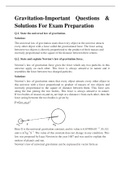
Gravitation-Important Questions &
Solutions For Exam Preparation
Q.1. State the universal law of gravitation.
Solution:
The universal law of gravitation states that every object in the universe attracts
every other object with a force called the gravitational force. The force acting
between two objects is directly proportional to the product of their masses and
inversely proportional to the square of the distance between their centers.
Q.2. State and explain Newton’s law of gravitation force.
Newton’s law of gravitation force gives the force which any two particles in this
universe apply on each other. This force is always attractive in nature and it
resembles the force between two charged particles.
Solution:
Newton’s law of gravitation states that every object attracts every other object in
this universe with a force proportional to product of masses of two objects and
inversely proportional to the square of distance between them. This force acts
along the line joining the two bodies. This force is always attractive in nature.
If two bodies of masses m1and m2 are kept at a distance r from each other, then the
force acting between the two bodies is given by
F=Gm1m2/r2
Here G is the universal gravitation constant, and its value is 6.67408×10⁻¹¹. It's S.I.
unit is m3kg−1S−2. The value of this constant does not change in any condition. This
law was proposed by Isaac Newton in the year 1687 and was used to explain the
motion of planets and sun.
Newton’s law of universal gravitation can be expressed in vector form as
, F21→=−Gm1m2|/|r12|2r12Λ
Where
F21→ is the force applied on body 2 by body 1, G is gravitational constant, |r12→|
Q.3. What do you mean by acceleration due to gravity?
Solution:
When an object falls freely from a certain height towards the earth’s surface, its
velocity keeps changing. This velocity change produces acceleration in the object
known as acceleration due to gravity and denoted by ‘g’.
The value of the acceleration due to gravity on Earth is,
Q.4. What is the difference between mass and weight of an object?
Solution:
Difference between mass and weight of an object is as follows:
Sl. Mass Weight
No.
Mass is the amount Weight is the force exerted on a body due to
1. of matter contained the gravitational pull of another body such as
in a body. Earth, the sun and the moon.
Mass is an intrinsic
2. Weight is an extrinsic property of a body.
property of a body.
Mass is the measure
3. Weight is the measure of force.
of inertia.
4. The mass of a body The weight of a body depends on the local
Solutions For Exam Preparation
Q.1. State the universal law of gravitation.
Solution:
The universal law of gravitation states that every object in the universe attracts
every other object with a force called the gravitational force. The force acting
between two objects is directly proportional to the product of their masses and
inversely proportional to the square of the distance between their centers.
Q.2. State and explain Newton’s law of gravitation force.
Newton’s law of gravitation force gives the force which any two particles in this
universe apply on each other. This force is always attractive in nature and it
resembles the force between two charged particles.
Solution:
Newton’s law of gravitation states that every object attracts every other object in
this universe with a force proportional to product of masses of two objects and
inversely proportional to the square of distance between them. This force acts
along the line joining the two bodies. This force is always attractive in nature.
If two bodies of masses m1and m2 are kept at a distance r from each other, then the
force acting between the two bodies is given by
F=Gm1m2/r2
Here G is the universal gravitation constant, and its value is 6.67408×10⁻¹¹. It's S.I.
unit is m3kg−1S−2. The value of this constant does not change in any condition. This
law was proposed by Isaac Newton in the year 1687 and was used to explain the
motion of planets and sun.
Newton’s law of universal gravitation can be expressed in vector form as
, F21→=−Gm1m2|/|r12|2r12Λ
Where
F21→ is the force applied on body 2 by body 1, G is gravitational constant, |r12→|
Q.3. What do you mean by acceleration due to gravity?
Solution:
When an object falls freely from a certain height towards the earth’s surface, its
velocity keeps changing. This velocity change produces acceleration in the object
known as acceleration due to gravity and denoted by ‘g’.
The value of the acceleration due to gravity on Earth is,
Q.4. What is the difference between mass and weight of an object?
Solution:
Difference between mass and weight of an object is as follows:
Sl. Mass Weight
No.
Mass is the amount Weight is the force exerted on a body due to
1. of matter contained the gravitational pull of another body such as
in a body. Earth, the sun and the moon.
Mass is an intrinsic
2. Weight is an extrinsic property of a body.
property of a body.
Mass is the measure
3. Weight is the measure of force.
of inertia.
4. The mass of a body The weight of a body depends on the local