

NUR2755 / NUR 2755 Multidimensional Care IV Final Exam Review | Already Rated A | LATEST 2021/2022 | Rasmussen College
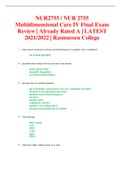
NUR2755 / NUR 2755 Multidimensional Care IV Final Exam Review | Already Rated A | LATEST 2021/2022 | Rasmussen College 1. what causes increased or thick secretions/mucus in a patient who is intubated - not enough humidity 2. possible interventions for low pressure vent alarms - check patient first! - manually bag patient - reconnect/unkink tubing 3. nursing care of ventilated patient - q2-4 respiratory assessment, oral care, suctioning if needed - q4 head to toe assessment and vitals - maintain head of bed 30 degrees - q2 turns - monitor I&O - collaborate with RT - monitor vent settings q8-12 - manual resuscitation bag at bedside 4. Vent Settings - tidal volume - rate - FIO2 - %O2 - sighs - PEEP 5. what does tidal volume mean on a vent - amount of air delivered w/each machine breath 6. what is the rate mean on a vent - number of breaths delivered by the machine in a minute 7. what does FIO2 mean on a vent - fraction of inspired O2 (written as 0.6) 8. what does PEEP mean - Positive end-expiratory pressure during mechanical ventilation. - PEEP aids in preventing alveolar and small airway collapse and may help recruit lung units that were previously collapsed. 9. what does sighs mean on a vent - deep breaths (higher vol) delivered periodically by vent 10. what does an FIO2 of 0.6 mean - 60% of oxygen 11. acronym for vent alarms - HOLD: - Hi pressure alarm= Obstruction - Low pressure alarm= Disconnection 12. what interventions help prevent ventilator acquired pneumonia (VAP) - HOB 30 degrees (helps to prevent aspiration) - oral care q2-4 - q2 turns - ulcer prophylaxis (famotidine/Pepcid) 13. what does ARDS stand for - acute respiratory distress syndrome 14. what intervention is done for a healthy person who sustains an acute lung injury - mechanical ventilation 15. pathophysiology of ARDS - increased alveolar permeability + leaking of fluid = alveolar collapse 16. what causes ARDS - sepsis - burns - pancreatitis - transfusion - trauma - diffuse pulmonary infection - gastric aspiration - O2 toxicity - lung contusion 17. s/s of ARDS - persistent hypoxia (even with O2 therapy) - dyspnea - decreased pulmonary compliance - non cardiac pulmonary edema 18. how to diagnose ARDS - refractory hypoxia - chest x ray shows glossy + white out (diffuse patchy infiltrates) - normal wedge pressure - pO2/FIO2 200 19. phases of ARDS - injury (exudative) phase o alveolar collapse o refractory hypoxemia - -reparative (proliferative) phase o decreased lung compliance - -fibrotic phase o surfactant cells are damaged 20. assessment of patient on vent - vitals - O2 saturation - auscultate breath sounds - pain/anxiety - tube placement - vent settings 21. nursing care for ARDS - ET + Mechanical vent w/ PEEP or CPAP - light IV fluids, diuretics, antibiotics - start nutrition (TPN or tube feeds) 22. risk factors for pulmonary embolism (PE) - immobile, obese, advanced age, surgery - central venous catheter, embolic event history - pregnancy, oral contraceptives, estrogen therapy - heart failure, trauma, smoker 23. assessment findings for PE - sudden dyspnea - chest pain - feeling of impending doom - JVD - tachy - chest petechiae - ECG changes - abnormal heart sounds 24. normal INR range
Document information
- Uploaded on
- December 5, 2021
- Number of pages
- 43
- Written in
- 2021/2022
- Type
- Exam (elaborations)
- Contains
- Questions & answers


