
1
GCE ‘O’ Level Elective History Unit 2
Chapter 2: Stalin’s Soviet Union
In this chapter:
- Rise of Stalin
- Impact of Stalin’s rule
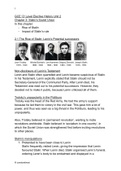
2.1 The Rise of Stalin: Lenin’s Potential successors
Leon Trotsky Nikolai Bukharin Lev Kamenev Grigory Zinoviev Joseph Stalin
1879 - 1940 1888 - 1938 1883 - 1936 1883 - 1936 1878 - 1953
Non-disclosure of Lenin’s Testament
Lenin and Stalin often quarrelled and Lenin became suspicious of Stalin.
In his Testament, Lenin explicitly stated that Stalin should not be
Secretary-General of the Communist Party. After Lenin died, his
Testament was read out to his potential successors. However, they
decided not to make it public, because Lenin criticised all of them.
Trotsky’s unpopularity in the Politburo
Trotsky was the head of the Red Army. He had the army’s support
because he led them to victory in the civil war. This gave him a lot of
power, and thus was seen as a big threat in the Politburo, leading to his
unpopularity.
Also, Trotsky believed in ‘permanent revolution’, wanting to incite
revolutions worldwide. Stalin believed in ‘socialism in one country’, in
which the Soviet Union was strengthened first before inciting revolutions
to other places.
Stalin’s manipulations
1. Pretended to have been close to Lenin
Stalin frequently visited Lenin, giving the impression that Lenin
favoured Stalin. When Lenin died, Stalin organised Lenin’s funeral,
ordering Lenin’s body to be embalmed and displayed in a
© constantinexi
, 2
mausoleum in Moscow. He also gave the funeral speech and was
the chief mourner. He also renamed the city of Petrograd to
Leningrad.
2. Control over Party organisation
Stalin, as Secretary-General, could appoint and re-assign Party
members. He could replace his opponents’ allies with his own
allies. Trotsky’s support base decreased and he was expelled from
the Party in 1927.
3. Exploitation of ideological divisions
Stalin allied with the moderates, and first expelled Trotsky from
the Party, then isolated Kamenev and Zinoviev. Then, he switched
to the radicals’ side and attacked Bukharin and Rykov.
© constantinexi
GCE ‘O’ Level Elective History Unit 2
Chapter 2: Stalin’s Soviet Union
In this chapter:
- Rise of Stalin
- Impact of Stalin’s rule
2.1 The Rise of Stalin: Lenin’s Potential successors
Leon Trotsky Nikolai Bukharin Lev Kamenev Grigory Zinoviev Joseph Stalin
1879 - 1940 1888 - 1938 1883 - 1936 1883 - 1936 1878 - 1953
Non-disclosure of Lenin’s Testament
Lenin and Stalin often quarrelled and Lenin became suspicious of Stalin.
In his Testament, Lenin explicitly stated that Stalin should not be
Secretary-General of the Communist Party. After Lenin died, his
Testament was read out to his potential successors. However, they
decided not to make it public, because Lenin criticised all of them.
Trotsky’s unpopularity in the Politburo
Trotsky was the head of the Red Army. He had the army’s support
because he led them to victory in the civil war. This gave him a lot of
power, and thus was seen as a big threat in the Politburo, leading to his
unpopularity.
Also, Trotsky believed in ‘permanent revolution’, wanting to incite
revolutions worldwide. Stalin believed in ‘socialism in one country’, in
which the Soviet Union was strengthened first before inciting revolutions
to other places.
Stalin’s manipulations
1. Pretended to have been close to Lenin
Stalin frequently visited Lenin, giving the impression that Lenin
favoured Stalin. When Lenin died, Stalin organised Lenin’s funeral,
ordering Lenin’s body to be embalmed and displayed in a
© constantinexi
, 2
mausoleum in Moscow. He also gave the funeral speech and was
the chief mourner. He also renamed the city of Petrograd to
Leningrad.
2. Control over Party organisation
Stalin, as Secretary-General, could appoint and re-assign Party
members. He could replace his opponents’ allies with his own
allies. Trotsky’s support base decreased and he was expelled from
the Party in 1927.
3. Exploitation of ideological divisions
Stalin allied with the moderates, and first expelled Trotsky from
the Party, then isolated Kamenev and Zinoviev. Then, he switched
to the radicals’ side and attacked Bukharin and Rykov.
© constantinexi


