NURS 493 topic 4-Literature Evaluation Table Spate NRS 493
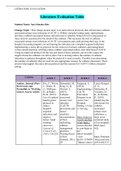
Literature Evaluation Table Student Name: Sara Emalee Pate Change Topic : This change project topic is on nurse-driven protocols that will decrease catheter associated urinary tract infections (CAUTI’s). Within a hospital setting many adult patients develop a catheter associated urinary infection due to catheters being left in for long period of times and not reassessed for the needs of the catheter. This increases the risk of catheter associated urinary tract infections (CAUTI’s) for patients and could prolong their stay in the hospital increasing hospital cost and turning the infection into a hospital acquired infections. Implementing a nurse driven protocol for the removal of urinary catheters and management versus current practices will help reduce catheter associated urinary tract infections (CAUTI). Using an improved protocol for the use and need of these catheters can not only reduce the length of time the catheters are left in place, but it can help reduce the number of catheter infections in patients throughout when the protocol is used correctly. Possible even decreasing the number of catheters that are used for non-appropriate reasons for catheter placement. These articles help support the nurse-driven protocol and the reasons for CAUTI’s within a hospital setting. Criteria Article 1 Article 2 Article 3 Article 4 Author, Journal (Peer- Fox, C., Wavra, Hernandez, M., Ferguson, A. Letica-Kriegel, Reviewed), and T., Drake, D. King, A., & (2018). A. S., Permalink or Working A., Mulligan, Stewart, L. Implementing a Salmasian, H., Link to Access Article D., & Bader, (2019). CAUTI Vawdrey, D. M. K. (2015). Catheter- Prevention K., & Perotte, Use of a patient associated Program in an R. (2019). hand hygiene urinary tract Acute Care Identifying the protocol to infection Hospital risk factors for reduce (CAUTI) Setting. Urolog catheter- hospital- prevention and ic Nursing associated acquired nurses’ urinary tract infections and checklist infections: a improve documentation large cross- nurses’ hand of their washing. indwelling n?url=https:// of six hospitals. American catheter ho BMJ Open, Journal of management Critical Care, practices. px? 24(3), 216-224. Nursing Praxis direct=true&db in New =ccm https://bmjopen Zealand, 35(1), &AN= . 29. 74&site=edsive nt/9/2/e. =&s ite=eds- live&scope=sit e&custid=s833 3196& groupid=main &profile=eds1 &scope=site&c ustid=s8333 196&groupid= main&profile= eds1 abstract Article Title and Year Published Use of a Patient Hand Hygiene Protocol to Reduce Hospital- Acquired Infections and Improve Nurses’ Hand Washing (2015) Catheter- associated urinary tract infection (CAUTI) prevention and nurses’ checklist documentation of their indwelling catheter management practices. (2019) Implementing a CAUTI Prevention Program in an Acute Care Hospital Setting. (2018) Identifying the risk factors for catheter- associated urinary tract infections (2019) Research Questions (Qualitative)/Hypothesi s (Quantitative), and Purposes/Aim of Study Research Question-The impacts of regular hand washing among health professionals in preventing hospital- acquired infections. Objective- To investigate if regular hand hygiene reduces hospital- acquired diseases and whether it improves compliance rate among the nurses in an ICU.p45 Research Question-Will introducing an indwelling catheter management checklist before catheter use decrease CAUTI development and improve nursing quality of care for patients? Objective- To implement a checklist before catheter placement giving reason to why it is indicated possible preventing inappropriate insertion. Research Question- Implementing an interactive CAUTI prevention educational program enhance the nurse’s knowledge on the appropriate use of the indwelling urinary catheter and reduce the incidence of CAUTI’s Objective- Implement a a program that will enhance the knowledge of nurses on catheters and how to prevent catheter associated urinary tract infections (CAUTIs). Research Question- The risk factors for CAUTIs, a large cross- sectional study. Objectives: To examine how the risk for developing CAUTIs changes over time. Additionally, to assess whether the time one stays with a catheter from insertion has effects on development of CAUTI. To ascertain if development of CAUTIs varied according to risk factors such as age, sex, patient type (surgical vs. medical) and comorbidities. Design (Type of Quantitative, or Type of Qualitative) Quantitative Quanititative- Mixed method Quantitative Qualitative Setting/Sample Patients and nurses within the selected hospital settings. Public hospital in Auckland, New Zealand. 50 nurses within two surgical units. Southeastern region of the United States Urban academic and referral health system of over 2500 beds. Methods: Intervention/Instrumen ts New hand hygiene protocol Data was gathered using the self- administered Daily Urinary Catheter Maintenance Checklist (adopted from CDC evidence- based guidelines implemented in various hospitals all over the US and developed for use in this research. p.33 Nurses were educated on how to use the new checklist during the pre- intervention phase. The checklist contains procedure- specific evidence-based care practices Pre- and post- survey on how the educational program worked N/A
Document information
- Uploaded on
- November 24, 2021
- Number of pages
- 15
- Written in
- 2021/2022
- Type
- Exam (elaborations)
- Contains
- Questions & answers