
mne3701_exam_prep_final
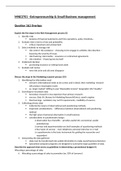
MNE3701 –Entrepreneurship & Small Business management Question 1&2 Overlaps Explain the five steps in the Risk Management process (5) 1. Identify risks Analysis of financial statements and firms operations, policy checklists… 2. Evaluate risks in terms of size and probability critical, important and unimportant 3. Select methods to manage risk risk control: risk avoidance – choosing not to engage in activities risk reduction – lessening the severity of losses risk financing: risk transfer – insurance or contractual agreements risk retention – financing loss by itself 4. Implement decision purchasing insurance or setting funds aside 5. Evaluate and review new risks arise and old ones disappear Discuss the steps in the Marketing research process (10) 1. Identifying the information need venture’s informational needs to be correct and in detail, then marketing research will produce meaningful results ex. target market? Willing to pay? Disposable income? Geographic info? Quality? 2. Searching for secondary data Secondary research is less expensive than primary research. sources: Stats SA, Bureau for Marketing Research(Unisa), search engines Shortcomings: outdated, may not fit requirements, credibility of sources. 3. Collecting primary data Collected by means of observational and questioning methods. important considerations: - differences between observational and questioning method the high value of personal observation in small business considerations in questionnaire design: o observation has 3 benefits – provides useful info, economical, avoids potential bias o surveys and experimentation are both examples of questioning methods o four types of surveys – mail, telephone, personal interview or e-mail o a questionnaire is the basic instrument for guiding the researcher and respondent 4. Interpreting the data gathered data must be transformed into usable information to make sound business decisions Specialised computer programs are designed to summarise large quantities of data. Describe the approach that serves as guidelines in determining a promotional budget (4) Allocating a percentage of sales o Allocating a percentage of sales to promotion (ex. 30% of turnover) o Disadvantage – when sales decline, less money is spent on promotion, which does not solve the problem. Deciding how much can be spared o Spending whatever is left over on promotion after paying all expenses. o Disadvantage – it ignores promotional goals, because different approaches to promotion are required. Spending as much as one’s competitors o Business hopes to reach same customers by duplicating competitors promotional efforts o Disadvantage – may result in copying of competitors mistakes Determining what it will take to do the job o Based on proper market analysis and all the alternatives available as promotional channels o Preferred approach to promotional expenditure. o Disadvantage – very time consuming and requires a greater understanding. Explain the five key factors that must be considered when choosing the location of a business (10) 1. Customer accessibility Retail outlets and service firms are businesses that must be located to make access easy. 2. Business environment conditions Weather, competition, crime, legal requirements and tax structures. 3. Resource availability Proximity(nearness) to raw materials, suitability of labour supply, availability of transport 4. Entrepreneur’s personal preferences Choice of local site or location offering unique lifestyle advantage 5. Site availability and costs Either close to the customer (retail) or the supplier (supplier of intermediate goods) leasing a site is advisable because a large cash outlay is avoided and thus reduces risk Discuss the eight psychological and sociological influences on consumers and their relevance on consumer behaviour (8) Four psychological influences: 1. Needs o Starting point for all behaviour o Basic needs physiological(hunger), social(what you wear), psychological(what you think), spiritual(emotion) 2. Perceptions o Processes that give meaning to the stimuli confronting customers o Perceptual categorisation grouping similar things, to manage huge quantities of incoming stimuli 3. Motivations o Intrinsic/extrinsic force that organises and give direction to the tension caused by unsatisfied needs o Unsatisfied needs create tension within an individual and is then motivated to reduce the tension
Document information
- Uploaded on
- November 11, 2021
- Number of pages
- 15
- Written in
- 2021/2022
- Type
- Exam (elaborations)
- Contains
- Questions & answers


