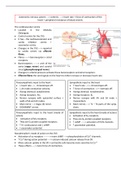
Autonomic nervous system ---> controls ----> heart rate + force of contraction of the
heart + peripheral resistance of blood vessels.
The cardiovascular centre
• Located in the Medulla
Oblongata.
• Control centre for the CVS.
• It has – the cardioaccelerator and
cardio inhibitor centre +
vasomotor centre.
• Changes in the CVS ---> reported
to cardio centre via afferent
fibres.
• Fibres -----> baroreceptors + atrial
receptors.
• Baroreceptors ------> arch of the
aorta (vagus nerve) and carotid
sinus (glossopharyngeal nerve).
• Changes in arterial pressure activate these baroreceptors and atrial receptors.
• Efferent fibres the send signals to the heart to either increase or decrease heart rate.
Parasympathetic input to the heart Sympathetic input to the heart
• ↓ heart rate --> - chronotropic eff. • ↑ heart rate ---> + chronotropic eff.
• ↓ AV node conduction velocity. • ↑ force of contraction --> + inotropic eff.
• Acting chemical: acetylcholine. • Acting chemical: noradrenaline.
• Acting receptors: M2. • Acting receptors: B1.
• Nerves synapse with epicardial surface + • Nerves synapse with AV and SA node +
walls of SA and AV nodes. myocardium.
• Main nerve ---> Vagus (X) nerve. • Main nerves ---> T1 – T4 parts of the symp.
• DOMINANT at rest. chain.
Parasympathetic input to the heart (mode of Sympathetic input to the heart (mode of action)
action) • Activation of B1 receptors.
• Activation of M2 receptors. • They are Ga protein coupled receptors.
• They are Gi protein coupled receptors. • ↑ cAMP -----> activation of HCN channels.
• ↑ K+ conductance and ↓ cAMP. • ↑ pacemaker potential.
• ↓ pacemaker potential.
Noradrenaline’s mode of action on the CVS
• Activation of a1 receptors --------> more cAMP ---> phosphorylation of Ca+2 channels.
• ↑ Ca+2 during action potential ----> calcium induced calcium release from SR.
• More calcium uptake in the SR + contractile cells become more sensitive to Ca +2
• These effects ----> more force of contraction.
heart + peripheral resistance of blood vessels.
The cardiovascular centre
• Located in the Medulla
Oblongata.
• Control centre for the CVS.
• It has – the cardioaccelerator and
cardio inhibitor centre +
vasomotor centre.
• Changes in the CVS ---> reported
to cardio centre via afferent
fibres.
• Fibres -----> baroreceptors + atrial
receptors.
• Baroreceptors ------> arch of the
aorta (vagus nerve) and carotid
sinus (glossopharyngeal nerve).
• Changes in arterial pressure activate these baroreceptors and atrial receptors.
• Efferent fibres the send signals to the heart to either increase or decrease heart rate.
Parasympathetic input to the heart Sympathetic input to the heart
• ↓ heart rate --> - chronotropic eff. • ↑ heart rate ---> + chronotropic eff.
• ↓ AV node conduction velocity. • ↑ force of contraction --> + inotropic eff.
• Acting chemical: acetylcholine. • Acting chemical: noradrenaline.
• Acting receptors: M2. • Acting receptors: B1.
• Nerves synapse with epicardial surface + • Nerves synapse with AV and SA node +
walls of SA and AV nodes. myocardium.
• Main nerve ---> Vagus (X) nerve. • Main nerves ---> T1 – T4 parts of the symp.
• DOMINANT at rest. chain.
Parasympathetic input to the heart (mode of Sympathetic input to the heart (mode of action)
action) • Activation of B1 receptors.
• Activation of M2 receptors. • They are Ga protein coupled receptors.
• They are Gi protein coupled receptors. • ↑ cAMP -----> activation of HCN channels.
• ↑ K+ conductance and ↓ cAMP. • ↑ pacemaker potential.
• ↓ pacemaker potential.
Noradrenaline’s mode of action on the CVS
• Activation of a1 receptors --------> more cAMP ---> phosphorylation of Ca+2 channels.
• ↑ Ca+2 during action potential ----> calcium induced calcium release from SR.
• More calcium uptake in the SR + contractile cells become more sensitive to Ca +2
• These effects ----> more force of contraction.