Information assignment week 1
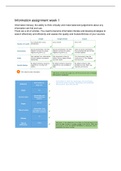
Information literacy: the ability to think critically and make balanced judgements about any
information we find and use.
There are a lot of articles. You need to become information literate and develop strategies to
search effectively and efficiently and assess the quality and trustworthiness of your sources.
,
,Tutor class week 1
[Title/Abstract] -> than the keyword has to be in ‘’/ ‘’
High ranking papers get the high rank (high impact factor) because they get cited much.
Use impact factor (>1,5).
When a study has a controversial subject, check the financers.
Check the comments on the paper.
Always check ‘similar articles’ to see if your search is complete.
Pubmed.
World cancer research fund, or international agency for research on cancer.
Cochrane library reviews are high ranked.
Nutrition is complementary science.
Synonyms, like the chemical name... , should be included in the search string.
Database on protocols: www.clinicaltrials.gov ;
When you want to publish, you have to upload your protocols to such a site first, because
journals want proof that you didn't change your protocols during the study.
Information assignment week 2
Reading: Lovegrove chapter 4; Methods to determine dietary intake
Nutrition transition: moving away from traditional diets towards more Western diets (rich in
energy, fats, salt and sugar), is consistently observed with accelerated phenomena worldwide.
Food frequency questionnaire (FFQ)) assessment method: has been repeatedly challenged with
respect to validity and reliability for measuring individual dietary intake. Nutritional research has
increasingly favoured approaches integrating traditional and more innovative measurements of
dietary exposure (including biological and metabolite markers) to improve individual and
population mean intakes and distribution.
Traditional dietary assessment methods
, Dietary assessment methodologies can be classified according to different criteria, including the
duration of the period of registration (short-term vs long term) and the time frame of the data
collected (past/retro vs current/prospective).
Observational methods for dietary intake: field workers visit homes or schools to observe
and record intake for discrete time periods (now also with cameras).
- objective assessment,
- highly intensive-> expensive,
- observation may alter individuals eating patterns,
- not feasible for obtaining habitual dietary data,
- this method is mostly used for validating other dietary assessment methods.
Food diary/food record: open ended method that requires subject (or observer) reports all
the foods and beverages consumed at the time of consumption, to minimise reliance on
memory. Reviewing the food records with participants richt after data collection is desirable
in order to capture adequate detail.
- detailed,
- increased accuracy because of actually consumed foods,
- no memory needed if recorded immediately,
- high investigator cost and respondent burden,
- might affect respondents eating behaviour,
- often under reported,
- drop-out increases with the number of daily records requested,
- literacy and high respondent motivation and compliance are required -> may lead to
a non-representative sample,
- often used as a reference method in relative validation studies.
24-hour dietary recall methods: open ended method asking the participant to remember and
report all the foods and beverages consumed in the preceding 24 hours or over the previous
day. The recall is often structured (per meal) using specific probes and cognitive processes,
to help respondents recall their diet. Typically conducted by interview.
- relatively low respondent burden,
Information literacy: the ability to think critically and make balanced judgements about any
information we find and use.
There are a lot of articles. You need to become information literate and develop strategies to
search effectively and efficiently and assess the quality and trustworthiness of your sources.
,
,Tutor class week 1
[Title/Abstract] -> than the keyword has to be in ‘’/ ‘’
High ranking papers get the high rank (high impact factor) because they get cited much.
Use impact factor (>1,5).
When a study has a controversial subject, check the financers.
Check the comments on the paper.
Always check ‘similar articles’ to see if your search is complete.
Pubmed.
World cancer research fund, or international agency for research on cancer.
Cochrane library reviews are high ranked.
Nutrition is complementary science.
Synonyms, like the chemical name... , should be included in the search string.
Database on protocols: www.clinicaltrials.gov ;
When you want to publish, you have to upload your protocols to such a site first, because
journals want proof that you didn't change your protocols during the study.
Information assignment week 2
Reading: Lovegrove chapter 4; Methods to determine dietary intake
Nutrition transition: moving away from traditional diets towards more Western diets (rich in
energy, fats, salt and sugar), is consistently observed with accelerated phenomena worldwide.
Food frequency questionnaire (FFQ)) assessment method: has been repeatedly challenged with
respect to validity and reliability for measuring individual dietary intake. Nutritional research has
increasingly favoured approaches integrating traditional and more innovative measurements of
dietary exposure (including biological and metabolite markers) to improve individual and
population mean intakes and distribution.
Traditional dietary assessment methods
, Dietary assessment methodologies can be classified according to different criteria, including the
duration of the period of registration (short-term vs long term) and the time frame of the data
collected (past/retro vs current/prospective).
Observational methods for dietary intake: field workers visit homes or schools to observe
and record intake for discrete time periods (now also with cameras).
- objective assessment,
- highly intensive-> expensive,
- observation may alter individuals eating patterns,
- not feasible for obtaining habitual dietary data,
- this method is mostly used for validating other dietary assessment methods.
Food diary/food record: open ended method that requires subject (or observer) reports all
the foods and beverages consumed at the time of consumption, to minimise reliance on
memory. Reviewing the food records with participants richt after data collection is desirable
in order to capture adequate detail.
- detailed,
- increased accuracy because of actually consumed foods,
- no memory needed if recorded immediately,
- high investigator cost and respondent burden,
- might affect respondents eating behaviour,
- often under reported,
- drop-out increases with the number of daily records requested,
- literacy and high respondent motivation and compliance are required -> may lead to
a non-representative sample,
- often used as a reference method in relative validation studies.
24-hour dietary recall methods: open ended method asking the participant to remember and
report all the foods and beverages consumed in the preceding 24 hours or over the previous
day. The recall is often structured (per meal) using specific probes and cognitive processes,
to help respondents recall their diet. Typically conducted by interview.
- relatively low respondent burden,