
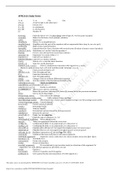
APM2616 Study Notes Helpful.
APM2616 Study Notes 3 + b; 3 – b; 3*b; 3/b; A^3_2; A superscript 3 and subscript 2 A^(-1); Inverse of A i1 = 10; is a statement i1:= 10; is a declaration PI Number PI factor(x); Finds the factors of ‘x’ in descending order (Page 24 / 152 for good example) normal(f) Makes f in the form of a/b (analytic solution) sqrt(); Squareroot simplify(f); Writes ‘f’ in a simplified form simplify(f,exp); Simplifies only the part of the equation with an exponential form (exp, ln, cos, sin, sqrt) partfrac(f); Makes f into a partial fraction expand(f); Expands function f into a function with several terms (Product of sums to sum of product) subs(f,a=1,b=2); Substitutes a=1 and b=2 into the equation f float(x); Forces x into decimal form (numerical solution) series(f,x=1); Expresses f in a series when x = 1 limit(f,x=1); Limit of f as x tends to 1 limit(f,x=infinity); Limit of f as x tends to infinity F(a-b); Subs in a-b = x into the above function Solve(f , x); Solve for x in the function f Solve({f1,f2,f3} , {x,y,z}); Solves 3 simultaneous equations with regards to x, y and z -- (Easier to make an array ‘eq1:= {f1,f2,f3}’ and then write ‘solve{eq1, {x, y, z}; f’’(x); Finds second derivative of f diff( f(x) , x, x); Does the same as f’’(x) f’(x); Finds first derivative of f diff( f(x) , x); Does the same as f’(x) ode(f); Changes f into an ordinary differential equation DIGITS := 100; Sets the number of decimal places (Default is 10) subs(sin(x), sin=cos) Check out definition subs(diff(f,x), x=1)Derivative of f, at x = 1 subset(x+y+z, x+y=z) Similar to substitute #..COMMENT..# Allows you to add in a comment % Means the previous statement. EG, factor(%) means factor the previous statement info(); Gives a list of all packages info(package_name); Gives info on the package package_name::routine_name Calls a subpart from a package export(package_name); Allows you to use routine_name without having to use the package_name prefix unexport(package_name); Cancels export() factorLU(A) Factors into (L, U, [1,2,3]) x mod y Remainder of x/y modp(x,y) Same as x mod y op(object) Returns last operand (Good for storing answers) op(object, i) Returns ith operand print(NoNL, f) Prints f on the same line sign(z) Finds the sign of a function ( z / |z| series(exp(-x), x, infinity) Never ending series expr(s) Takes an expression without the error term coeff(p, n) Coefficients of all the x’s in polynomial ‘p’ to the power ‘n’ coeff(p, x, n) Coefficients of all the x’s in polynomial ‘p’ to the power ‘n’ nthcoeff(f, n) Find the nth coefficient of f. Arranged from highest power to lowest power nthterm(f, n) Find the nth term of f. Arranged from highest power to lowest power collect(p, [x, y]) Rewrites expression as ∑ a(xi yi ) (Page 70 / 152) combine(f) Combines like bases and powers with same exponents combine(f, argument) Argument: sincos, sinhcosh, ln etc. (sincos makes sincos into ∑sin +∑cos assume(x 0) Sets limits for x unassume(x) Undoes the assume reset() Resets all identifiers rewrite(f, argument) IE, rewrite(tan(x), exp) rewrites tan(x) as a function of the argument ‘ln’ - arguments: cot, coth, diff, fact, gamma, ln, piecewise, sin, tan fact(n) Equals n! heaviside(f) returns 1 if positive and 0 if negative partfrac(f, x) Gives partial fraction decomposition of f with regards to x
Document information
- Uploaded on
- November 8, 2021
- Number of pages
- 8
- Written in
- 2021/2022
- Type
- Exam (elaborations)
- Contains
- Questions & answers


