
PUB3704 study notes-exam prep
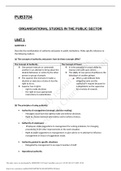
PUB3704 ORGANISATIONAL STUDIES IN THE PUBLIC SECTOR UNIT 1 QUESTION 1 Describe the manifestation of authority and power in public institutions. Make specific reference to the following matters: (a) The concepts of authority and power: how do these concepts differ? The Concept of Authority The Concept of Power One person instructs or commands another in an attempt to bring about the desired behaviour or action by the other person or group of people. The superior (the instructor) makes a decision or exercises a choice & has the right to do so. Superior has 2 rights: - right to make decisions - the right to issue appropriate instructions to subordinates It is the potential or actual ability to impose one’s will upon others. The ability of one person to influence the behaviour of another person. When a sub-ordinate feels obliged to carry out the supervisor’s request because he is dependent on the supervisor for a variety of rewards. (b) The principles of using authority. Authority of management (strategic, decision making). - Managers must have the right to make and enforce decisions. - Right to choose between alternatives and to enforce choices. Authority of employees - Employees make suggestions to management for solving problems, for changing procedures or for other improvements in the work situation. - Right to make suggestions to management, to give advice or to attempt to influence management in favour of suggestions made. Authority granted in specific situations - Delegated by management to an expert member of staff. Operational authority This study source was downloaded by from CourseH on :42:17 GMT -05:00 This study resource was shared via CourseH - All employees have the right to work without excessive supervision. & have authority to make certain decisions. (c) The basis for the use of power by individuals. Rational or legitimate power - Starts when one person accepts, because of some set of rules or codes, that another person has certain powers that both parties regard as legitimate. - Stems from a position that one holds or from his/her position in the hierarchy. (eg, police, magistrate in court). Power to grant or refuse benefits - Power is obtained through the ability of one person to control the rewards or benefits granted to another person. - Power to grant or refuse benefits (eg, manager who has control of salary increase may have power over employees). Coercion - Ability of one person to coerce another or to mete out punishment in one form or another is a strong basis for power or influence in organisations. - Relies on possibility of punishment to gain power. (An ANC example is used in this context due to current debates in organisational politics involving Constitutional Court ruling on RSA President over Nkandla matter). - (e.g. ANC secretary general threatening provincial structures for not agreeing with national decision to support the President). Referent power - Is the power that A has over B because B identifies with A. - Such identification enables A to influence the behaviour of B without either A or B being aware of such identification. - E.g. the power a role model has over their supporters. Charismatic power - Influence or power based on the personality of a person. - E.g. Hitler. Power derived from expertise - Their power is derived from their knowledge or special skills. - The expert is respected for their abilities, regardless of the position one occupies in the organisation. (d) The basis for the use of power by departments or units in public institutions. Power gained through control of resources Power gained by resolving critical or strategic issues Substitutability This study source was downloaded by from CourseH on :42:17 GMT -05:00 This study resource was shared via CourseH Power and the locus of power in organisations Power and position in the hierarchy (Marks will be allocated as follows: a=(10), b=(5), c=(5), d=(5)) [25] QUESTION 2 The National Treasury has established the Office of the Chief Procurement Officer (OCPO), whose purpose is, inter alia, to “promote, support and enforce the transparent and effective management of state supply chain and the sound stewardship of government assets and resources”. In this regard, the OCPO has established a central supplier database that all public institutions have to use to source suppliers. With this in mind, evaluate the merits of centralisation, decentralisation, concentration and deconcentration, by providing theory-driven arguments. [25]
Document information
- Uploaded on
- November 5, 2021
- Number of pages
- 5
- Written in
- 2021/2022
- Type
- Exam (elaborations)
- Contains
- Questions & answers


