
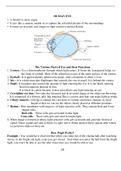
HUMAN EYE
A Sensitive sense organ.
It acts like a camera, enable us to capture the colourful picture of the surroundings.
It forms an inverted, real image on light sensitive surface Retina.
The Various Parts of Eye and their Functions
1. Cornea : It is a thin membrane through which light enters. It forms the transparent bulge on
the front of eyeball. Most of the refraction occurs at the outer surface of the cornea.
2. Eyeball : It is approximately spherical in shape, with a diameter of about 2.3cm.
3. Iris : It is a dark muscular diaphragm that controls the size of pupil. It is behind the cornea.
4. Pupil : It regulates and control the amount of light entering the eye. It is the black opening
between aqueous humour & lens.
It is black in colour because it does not reflects any light entering an eye.
5. Crystalline eye lens : Provides the focussed real & inverted image of the object on the retina.
It is composed of a fibrous, jelly like material.This is convex lens that converges light at retina.
6. Ciliary muscles : It helps to change the curvature of eyelens and hence changes its focal
length so that we can see the object clearly placed at different positions.
7. Retina : Thin membrane with large no. of light sensitive cells. They contain Rod and Cone
shaped cells.
Rod cells – These cells gets activated in dim light.
Cone cells – These cells gets activated in bright light.
8. When image is formed at retina, light sensitive cells gets activated and generate electrical
signal. These signals are sent to brain via optic nerve. Brain analyse these signals after which
we perceive object as they are.
How Pupil Works?
Example : You would have observed that when you come out of the cinema hall after watching
movie, in the bright sun light, your eyes get closed . And when you enter the hall from the bright
light, you won't be able to see but after some time you would be able to see.
(1)
,Here the pupil of an eye provides a variable aperture, whose size is controlled by iris
(a) When the light is bright : Iris contracts the pupil, so that less light enters the eye.
(b) When the light is dim : Iris expand the pupil, so that more light enters the eye.
Persistence of Vision : It is the time for which the sensation of an object continue in the eye. It
is about 1/16th of a second.
Power of Accommodation
The ability of eye lens to adjust its focal length with the help of ciliary muscles is called power of
accommodation.
Ciliary Muslces
Relaxed Contract
1. Eye lens becomes thin. 1. Eye lens becomes thick.
2. Increases the focal length. 2. Decreases the focal length.
3. Enable us to see distant object clearly. 3. Enable us to see nearby object clearly.
Near point of the Eye
It is 25cm for normal eye. The minimum distance at which object can be seen most distinctly
without strain.
Far point of the Eye
It is infinity for normal eye. It is the farthest point upto which the eye can see objects clearly.
Defects of Vision
1. Cataract : The image can not be seen distinctly because eye lens become milky and cloudy.
This condition is known as cataract, it can cause complete or partial loss of vision. This can be
corrected by surgical removal of extra growth (cataract surgery).
2. Myopia : (Near Sightedness)
Myopia is that defect of vision in which a person cannot see distant objects but can see nearby
objects.
Cause of defect
a. Excessive curvature of eye lens means Eye lens becomes thick and its focal length decreases.
b. Elongation of the eye ball.
(2)
, Near point of Myopic eye – 25 cm
Far point of Myopic eye – less than Infinity
Correction
Corrected by using a Concave Lens of appropriate power.
3. Hypermetropia (Far - Sightedness)
Hypermetropia is that defect of vision in which a person cannot see nearby objects but can see
distant objects.
The Reason of defect
1. Increase in focal length of the eye lens (Thin eye lens)
2. Eye ball has become too small.
Near point of Hypermetropic eye – more than 25 cm
Far point of Hypermetropic eye – Infinity
(3)
, Correction
Corrected by using a Convex Lens of appropriate power.
4. Presbyopia
As we become old, the power of accommodation of the eye usually decreases, the near point
gradually recedes away. This defect is called Presbyopia, a special kind of Hypermetropia.
Person may suffer from both myopia and hypermetropia.
Reason of defect : Gradual weakening of ciliary muscles and decreasing the flexibility of the
eye lens.
Correction : Using Bifocal lens with appropriate power.
Bifocal lens consist of both concave and convex lens, upper position consist of concave lens and
lower portion consist of convex lens.
Refraction of Light through a Prism
Prism : It has two triangular bases and three rectangular lateral surfaces. These surfaces are
inclined to each other. The angle between its two lateral faces is called Angle of Prism.
Angle of Deviation (D) : The angle between the incident ray and emergent ray.
(4)
A Sensitive sense organ.
It acts like a camera, enable us to capture the colourful picture of the surroundings.
It forms an inverted, real image on light sensitive surface Retina.
The Various Parts of Eye and their Functions
1. Cornea : It is a thin membrane through which light enters. It forms the transparent bulge on
the front of eyeball. Most of the refraction occurs at the outer surface of the cornea.
2. Eyeball : It is approximately spherical in shape, with a diameter of about 2.3cm.
3. Iris : It is a dark muscular diaphragm that controls the size of pupil. It is behind the cornea.
4. Pupil : It regulates and control the amount of light entering the eye. It is the black opening
between aqueous humour & lens.
It is black in colour because it does not reflects any light entering an eye.
5. Crystalline eye lens : Provides the focussed real & inverted image of the object on the retina.
It is composed of a fibrous, jelly like material.This is convex lens that converges light at retina.
6. Ciliary muscles : It helps to change the curvature of eyelens and hence changes its focal
length so that we can see the object clearly placed at different positions.
7. Retina : Thin membrane with large no. of light sensitive cells. They contain Rod and Cone
shaped cells.
Rod cells – These cells gets activated in dim light.
Cone cells – These cells gets activated in bright light.
8. When image is formed at retina, light sensitive cells gets activated and generate electrical
signal. These signals are sent to brain via optic nerve. Brain analyse these signals after which
we perceive object as they are.
How Pupil Works?
Example : You would have observed that when you come out of the cinema hall after watching
movie, in the bright sun light, your eyes get closed . And when you enter the hall from the bright
light, you won't be able to see but after some time you would be able to see.
(1)
,Here the pupil of an eye provides a variable aperture, whose size is controlled by iris
(a) When the light is bright : Iris contracts the pupil, so that less light enters the eye.
(b) When the light is dim : Iris expand the pupil, so that more light enters the eye.
Persistence of Vision : It is the time for which the sensation of an object continue in the eye. It
is about 1/16th of a second.
Power of Accommodation
The ability of eye lens to adjust its focal length with the help of ciliary muscles is called power of
accommodation.
Ciliary Muslces
Relaxed Contract
1. Eye lens becomes thin. 1. Eye lens becomes thick.
2. Increases the focal length. 2. Decreases the focal length.
3. Enable us to see distant object clearly. 3. Enable us to see nearby object clearly.
Near point of the Eye
It is 25cm for normal eye. The minimum distance at which object can be seen most distinctly
without strain.
Far point of the Eye
It is infinity for normal eye. It is the farthest point upto which the eye can see objects clearly.
Defects of Vision
1. Cataract : The image can not be seen distinctly because eye lens become milky and cloudy.
This condition is known as cataract, it can cause complete or partial loss of vision. This can be
corrected by surgical removal of extra growth (cataract surgery).
2. Myopia : (Near Sightedness)
Myopia is that defect of vision in which a person cannot see distant objects but can see nearby
objects.
Cause of defect
a. Excessive curvature of eye lens means Eye lens becomes thick and its focal length decreases.
b. Elongation of the eye ball.
(2)
, Near point of Myopic eye – 25 cm
Far point of Myopic eye – less than Infinity
Correction
Corrected by using a Concave Lens of appropriate power.
3. Hypermetropia (Far - Sightedness)
Hypermetropia is that defect of vision in which a person cannot see nearby objects but can see
distant objects.
The Reason of defect
1. Increase in focal length of the eye lens (Thin eye lens)
2. Eye ball has become too small.
Near point of Hypermetropic eye – more than 25 cm
Far point of Hypermetropic eye – Infinity
(3)
, Correction
Corrected by using a Convex Lens of appropriate power.
4. Presbyopia
As we become old, the power of accommodation of the eye usually decreases, the near point
gradually recedes away. This defect is called Presbyopia, a special kind of Hypermetropia.
Person may suffer from both myopia and hypermetropia.
Reason of defect : Gradual weakening of ciliary muscles and decreasing the flexibility of the
eye lens.
Correction : Using Bifocal lens with appropriate power.
Bifocal lens consist of both concave and convex lens, upper position consist of concave lens and
lower portion consist of convex lens.
Refraction of Light through a Prism
Prism : It has two triangular bases and three rectangular lateral surfaces. These surfaces are
inclined to each other. The angle between its two lateral faces is called Angle of Prism.
Angle of Deviation (D) : The angle between the incident ray and emergent ray.
(4)


