
Lecture 1: Business Professionals Introduction
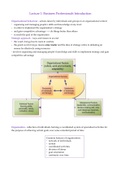
Organisational behaviour - actions taken by individuals and groups in an organisational context
- organising and managing people’s skills and knowledge at any level
- in order to implement the organisation’s strategy
- and gain competitive advantage —> do things better than others
- to reach the goal of the organisation
Strategic approach - ways and means to an end
- the word strategy has its roots in warfare
- the greek word strategos means army leader and the idea of strategy refers to defeating an
enemy by effectively using resources
- involves organising and managing people’s knowledge and skills to implement strategy and gain
competitive advantage
Organisation - collection of individuals forming a coordinated system of specialised activities for
the purpose of achieving certain goals over some extended period of time
Common features of organisations:
- network of individuals
- system
- coordinated activities
- division of labour
- goal orientation
- continuity over time
,Senior managers: Middle managers: Lower-level managers:
- activities - activities - activities
• discuss their vision, strategy and • champion strategic ideas and • coach associates
other major issues help firm to remain adaptive • remove obstacles for associates
• help middle mangers define and • process data and information • deal with associates personal
re-define roles and manage for use by other individuals problems
conflict • deliver strategic initiatives to • design jobs, team structures and
• create and maintain the lower-level managers reward systems
organisation’s culture - skills - skills
- skills • networking • teaching
• discuss their vision, strategy and • communicating • listening
other major issues • influencing • understanding personalities
• listening • analysing • managing stress
• conflict management • motivating • negotiating
• negotiation • understanding values • influencing
• motivation • managing stress • concealing
• conceptualisation • analysing
• communication • group dynamics
• understanding the perspectives of
others
• interpersonal influence
Importance of understanding organisational behaviour:
- enhance our ability to leverage people’s potential within the organisation
- gain confidence in empowering associates to work toward solving problems
- integrate behavioural science knowledge to organisational applications
Three types of resources:
1. physical capital
- plant, equipment, technology, buildings
2. human capital
- intelligence, traineeship, experience
3. organisational capital
- culture, structure, collective skills and know-
how
Human capital - sum of skills, knowledge and general attributes of people in the organisation
- being able to preform some aspect of work better
than a competitor offers customers added
value and a competitive advantage High-involvement management dimensions:
- value - selective hiring
- extensive training
• individuals capability to support strategy - decision power
- rareness - information sharing
- incentive compensation
, • unique skills and talents
- imitability
• extent that individual skills and talents can be copied
Positive organisational behaviour - nurtures individual’s strengths for personal and professional
advantage
_______________________________________________________________________________________
Lecture 2: Learning and Motivation
Learning - process through which individuals change their behaviour based on positive or
negative experiences in a situation
Operant Conditioning - Skinner Social Learning theory - Bandura
explanation for consequence-based learning explanation for consequence-based learning
assumes learning results from simple acknowledges the higher mental functioning of
conditioning human beings
higher mental functioning is irrelevant recognises the role such as functioning can play
in learning


