
Roman Housing
The domus(home)
The Romans lived in three different types of houses. The first type was a domus. Most
wealthy Roman families had a comfortable domus in town. Although these houses varied in
size, domus followed the same basic design, and was sturdily built from stone, cement and
wood. Windows were often just a slit in the outside wall which was widened on the inside to
let in the maximum light. They were sometimes glazed. Larger windows were often barred
with an iron grille and often shuttered. Houses were peaceful, private places, but they were
also designed to welcome visitors. Important people made their homes look very grand to
impress their guests.
Rooms
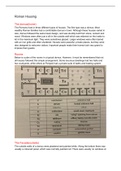
Below is a plan of the rooms in a typical domus. However, it must be remembered that not
all houses followed this simple arrangement. Some luxurious dwellings had two halls and
two courtyards, while others at Pompeii had a private suite of baths and heating system.
The Facade(outside)
The outside walls of a domus were plastered and painted white. Along the bottom there was
usually a coloured panel, which was normally painted red. There were usually no windows at
, street level. This was to keep out noise, sun, smells and burglars.
Vestibulum(entrance hall)
The vestibulum was a long, narrow passage, which connected the front door to the atrium.
Only the family and important guests entered the house this way. Other people, including
slaves, used a side entrance. The front door was nearly always a double door. The floor of
the vestibulum was often decorated with mosaics with a message for the visitor, such as
"Greetings or "Welcome Money." Mosaics of dogs were a popular choice. In the entrance of
one house at Pompeii is a mosaic showing a chained dog baring its teeth with the warning
"Beware of the dog" (cave canem). Often a real dog, or a slave, kept guard in the
The domus(home)
The Romans lived in three different types of houses. The first type was a domus. Most
wealthy Roman families had a comfortable domus in town. Although these houses varied in
size, domus followed the same basic design, and was sturdily built from stone, cement and
wood. Windows were often just a slit in the outside wall which was widened on the inside to
let in the maximum light. They were sometimes glazed. Larger windows were often barred
with an iron grille and often shuttered. Houses were peaceful, private places, but they were
also designed to welcome visitors. Important people made their homes look very grand to
impress their guests.
Rooms
Below is a plan of the rooms in a typical domus. However, it must be remembered that not
all houses followed this simple arrangement. Some luxurious dwellings had two halls and
two courtyards, while others at Pompeii had a private suite of baths and heating system.
The Facade(outside)
The outside walls of a domus were plastered and painted white. Along the bottom there was
usually a coloured panel, which was normally painted red. There were usually no windows at
, street level. This was to keep out noise, sun, smells and burglars.
Vestibulum(entrance hall)
The vestibulum was a long, narrow passage, which connected the front door to the atrium.
Only the family and important guests entered the house this way. Other people, including
slaves, used a side entrance. The front door was nearly always a double door. The floor of
the vestibulum was often decorated with mosaics with a message for the visitor, such as
"Greetings or "Welcome Money." Mosaics of dogs were a popular choice. In the entrance of
one house at Pompeii is a mosaic showing a chained dog baring its teeth with the warning
"Beware of the dog" (cave canem). Often a real dog, or a slave, kept guard in the


