
STEMS - Stems support a display of leaves
- Stems orient the leaves toward the
• ORIGIN light with minimal overlap among
• FUNCTIONS the leaves.
• EXTERNAL ANATOMY
• INTERNAL ANATOMY
• SPECIALIZED STEMS
• PHYSIOLOGY
ORIGIN
• First stem of a plant develops from
part of a seed embryo called epicotyl,
which is a continuation of the
hypocotyl.
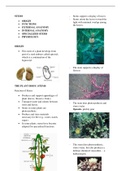
- The stem supports a display of
flowers
THE PLANT BODY: STEMS
Function of Stems
• Produces and support appendages of
plant (leaves, flowers< fruits)
• Transport water and solutes between
- The stem does photosynthesis and
roots and leaves.
stores water
• Stems in some plants are Opuntia- prickly pear
photosynthetic.
• Produce and store materials
necessary for life (e.g., water, starch,
sugar).
• In some plants, stems have become
adapted for specialized functions.
- This stem does photosynthesis,
stores water, but also produces a
defense chemical: mescaline… a
hallucinogen.
, TWO TYPES OF AERIAL STEMS EXTERNAL ANATOMY
HERBACEOUS STEMS
• Soft and green
• Little growth in diameter
• Tissues chiefly primary
• Chiefly annual
• Covered by epidermis
• Buds mostly naked
EXTERNAL MORPHOLOGY OF A
STEM
• Node- the area or region where
leaves are attached
• Internode- The are or region
between nodes
• Bud- occurs in the angle between the
petiole and the stem
WOODY STEMS a.) Axillary Bud
b.) Terminal Bud
• Tough and not green • Stipules- paired leaf-like appendages
• Considerable growth in diameter at the base of the petiole
• Tissues chiefly secondary • Leaf scar- scar left by a fallen leaf
• Chiefly perennial • Bundle scars- scars that mark the
• Covered by corky bark location of the water-conducting
• Buds chiefly covered by scales tissues located within the leaf scars
• Lenticels- Dark spots or elevations
that allow gas exchange in the stem
STEM APICAL MERISTEM
A WOODY TWIG


