CO-ORDINATION
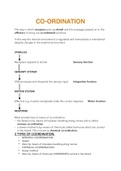
The way in which receptors pick up stimuli and the messages passed on to the
effectors to bring out co-ordinated activities.
In this way the internal environment is regulated and homeostasis is maintained
despite changes in the external environment.
STIMULUS
Receptors respond to stimuli Sensory function
SENSORY SYSTEM
CNS processes and interprets the sensory input Integrative function
MOTOR SYSTEM
Effectors e.g. muscles and glands make the correct response Motor function
RESPONSE
Most animals have 2 means of co-ordination:
- the fastest is by means of impulses travelling along nerves and is called
nervous co-ordination
- a slower method is by means of chemicals called hormones which are carried
in the blood. This is know as chemical co-ordination.
2 TYPES OF COORDINATION:
• NERVOUS COORDINATION:
• fastest
• done by means of impulses travelling along nerves
• CHEMICAL COORDINATION:
• slower method
• done by means of chemicals (HORMONES) carried in the blood
, NERVOUS SYSTEM
❖ NEURONS allow communication in the body
❖ neurons are surrounded by a supporting tissue--->NEUROLGIA
CENTRAL NERVOUS SYSTEM:
• brain
• spinal cord
PERIPHERAL NERVOUS SYSTEM:
• 12 pairs of cranial nerves
• 31 pairs of spinal nerves
The peripheral nervous system is then divided further into 2 groups
SOMATIC NERVOUS SYSTEM:
• innervates (supplies with nerves) voluntary muscles
• responses you can control
AUTONOMIC NERVOUS SYSTEM:
• innervates involuntary muscles, cardiac muscle and glands
• we cannot control this--->heart/gland secretion
The autonomic nervous system is then divided further into 2 groups
SYMPATHEIC NERVOUS SYSTEM:
• prepares body for action/fight or flight
PARASYMPATHETIC NERVOUS SYSTEM:
• returns body back to the normal state
The way in which receptors pick up stimuli and the messages passed on to the
effectors to bring out co-ordinated activities.
In this way the internal environment is regulated and homeostasis is maintained
despite changes in the external environment.
STIMULUS
Receptors respond to stimuli Sensory function
SENSORY SYSTEM
CNS processes and interprets the sensory input Integrative function
MOTOR SYSTEM
Effectors e.g. muscles and glands make the correct response Motor function
RESPONSE
Most animals have 2 means of co-ordination:
- the fastest is by means of impulses travelling along nerves and is called
nervous co-ordination
- a slower method is by means of chemicals called hormones which are carried
in the blood. This is know as chemical co-ordination.
2 TYPES OF COORDINATION:
• NERVOUS COORDINATION:
• fastest
• done by means of impulses travelling along nerves
• CHEMICAL COORDINATION:
• slower method
• done by means of chemicals (HORMONES) carried in the blood
, NERVOUS SYSTEM
❖ NEURONS allow communication in the body
❖ neurons are surrounded by a supporting tissue--->NEUROLGIA
CENTRAL NERVOUS SYSTEM:
• brain
• spinal cord
PERIPHERAL NERVOUS SYSTEM:
• 12 pairs of cranial nerves
• 31 pairs of spinal nerves
The peripheral nervous system is then divided further into 2 groups
SOMATIC NERVOUS SYSTEM:
• innervates (supplies with nerves) voluntary muscles
• responses you can control
AUTONOMIC NERVOUS SYSTEM:
• innervates involuntary muscles, cardiac muscle and glands
• we cannot control this--->heart/gland secretion
The autonomic nervous system is then divided further into 2 groups
SYMPATHEIC NERVOUS SYSTEM:
• prepares body for action/fight or flight
PARASYMPATHETIC NERVOUS SYSTEM:
• returns body back to the normal state