
STUDY GUIDE 04 / GRADE 12
Probability & Counting
Probability foundations
P(A) = n(A)/n(S) (equally likely outcomes)
P(A ∪ B) = P(A) + P(B) − P(A ∩ B)
Union means A or B or both. Intersection means both. Mutually exclusive events cannot
occur together: P(A ∩ B) = 0. Exhaustive events cover the sample space: P(A ∪ B) = 1.
P(A′) = 1 − P(A)
Independent events: occurrence of one does not change the probability of the other. P(A ∩
B) = P(A)P(B). Mutually exclusive events with nonzero probabilities are not independent.
Venn diagram example
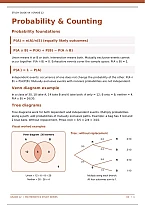
In a class of 30, 18 take A, 14 take B and 6 take both. A only = 12; B only = 8; neither = 4.
P(A ∪ B) = 26/30.
Tree diagrams
Tree diagrams work for both dependent and independent events. Multiply probabilities
along a path; add probabilities of mutually exclusive paths. Example: a bag has 3 red and
2 blue balls. Without replacement, P(two red) = 3/5 × 2/4 = 3/10.
Visual worked examples
Venn diagram | 30 learners Tree | without replacement
A B 2/4 R 3/10
R
3/5
2/4 B 3/10
12 6 8
3/4 R 3/10
2/5
4 B
1/4 B 1/10
Union = 12 + 6 + 8 = 26 Multiply along each branch.
Neither = 30 - 26 = 4 All four outcomes sum to 1.
GRADE 12 / MATHEMATICS STUDY SERIES 04 • 1


