Exam (elaborations) RSC 2601
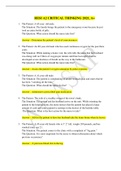
Option (1) is the key Option (1) is the correct answer because communalism implies that researchers will make their information known to the scientific community. It is precisely this norm of scientific commonality that leads to scientific progress which is made known inter alia in scientific journals and during conferences. Option (2) is incorrect because the welfare of people is not the primary concern of the scientific community. Option (3) is incorrect because it is not an offence to develop entrepreneurship amidst scientific enterprise. Option (4) is incorrect because honesty is incorporated within the context of communalism in science. A lack of honesty refers to deliberate false reporting of results with the aim to mislead people. QUESTION 3 Option (4) is the key Option (4) is correct because the statement uncritically repeats a view one often finds in the media. Option (1) is incorrect because there is no reference to tradition in the stem of the question. Option (2) is incorrect as there is no mention whatsoever to suggest any sort of mysticism in the question. Option (3) is incorrect because there is no reference to common sense in the stem of the question. QUESTION 4 Option (5) is the key Option (5) is correct as the researcher makes a hasty decision as to whether the prescribed book poses any difficulty based on an interview with only two students. This is a premature decision. Option (1) is not correct as the researcher did make an accurate observation with regards to the two students’ opinion of the prescribed book. Option (2) is not applicable as the researcher has to have a bigger sample in order to make an overgeneralisation (should have conducted interviews with more students). Option (3) is incorrect as the researcher had not engaged in a sufficient number of interviews with more students to make any selection of results possible. Option (4) is incorrect as there is no evidence to suggest ego involvement. QUESTION 5 Option (4) is the key Option (4) is the key The hypothesis and operationalisation are discussed in sections 2.4.4 and 2.4.5 of the study guide. You were required to identify examples of operationalised hypotheses. Read example (a). This example reports data on car hijackings. It is a factual statement. There is no suggestion of a relationship between variables. Since example (a) is not a hypothesis ......................................CONTINUED....................................
Written for
- Institution
-
123 University
- Course
-
RSC 2601
Document information
- Uploaded on
- September 29, 2021
- Number of pages
- 32
- Written in
- 2021/2022
- Type
- Exam (elaborations)
- Contains
- Questions & answers
Subjects
-
question 5 option 4 is the key option 4 is the key the hypothesis and operationalisation are discussed in sections 244 and 245 of the study guide you were required to identify examples of o