
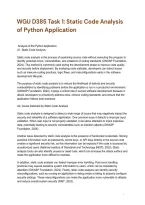
WGU D385 Task 1: Static Code Analysis
of Python Application
Analysis of the Python Application
A1. Static Code Analysis
Static code analysis is the process of examining source code without executing the program to
identify potential errors, vulnerabilities, and violations of coding standards (OWASP Foundation,
2024). This method is commonly used during the development phase to improve code quality
and security before deployment. By analyzing code statically, developers can detect issues
such as insecure coding practices, logic flaws, and misconfigurations early in the software
development lifecycle.
The purpose of static code analysis is to reduce the likelihood of defects and security
vulnerabilities by identifying problems before the application is run in a production environment
(OWASP Foundation, 2024). It plays a critical role in secure software development because it
allows developers to proactively address risks, enforce coding standards, and ensure that the
application follows best practices.
A2. Issues Detected by Static Code Analysis
Static code analysis is designed to detect a wide range of issues that may negatively impact the
security and reliability of a software application. One common issue it detects is improper input
validation. When user input is not properly validated, it can allow attackers to inject malicious
data, potentially leading to security vulnerabilities such as injection attacks (OWASP
Foundation, 2024).
Another issue detected by static code analysis is the presence of hardcoded credentials. Storing
sensitive information such as passwords, secret keys, or API keys directly in the source code
creates a significant security risk, as this information can be exposed if the code is accessed by
unauthorized users (National Institute of Standards and Technology [NIST], 2023). Static
analysis tools can also identify unused or dead code, which can increase the attack surface and
make the application more difficult to maintain.
In addition, static code analysis can detect improper error handling. Poor error handling
practices may expose sensitive system information to users, which can be exploited by
attackers (OWASP Foundation, 2024). Finally, static code analysis can identify security
misconfigurations, such as running an application in debug mode or failing to properly configure
security settings. These misconfigurations can make the application more vulnerable to attacks
and reduce overall system security (NIST, 2023).
)
, A3. Issues Identified During Manual Code Review
During the manual review of the provided Flask-based application, several security and
reliability issues were identified. The first issue was the absence of a structured logging
mechanism. Without proper logging, it is difficult to monitor system activity, detect errors, or
)
of Python Application
Analysis of the Python Application
A1. Static Code Analysis
Static code analysis is the process of examining source code without executing the program to
identify potential errors, vulnerabilities, and violations of coding standards (OWASP Foundation,
2024). This method is commonly used during the development phase to improve code quality
and security before deployment. By analyzing code statically, developers can detect issues
such as insecure coding practices, logic flaws, and misconfigurations early in the software
development lifecycle.
The purpose of static code analysis is to reduce the likelihood of defects and security
vulnerabilities by identifying problems before the application is run in a production environment
(OWASP Foundation, 2024). It plays a critical role in secure software development because it
allows developers to proactively address risks, enforce coding standards, and ensure that the
application follows best practices.
A2. Issues Detected by Static Code Analysis
Static code analysis is designed to detect a wide range of issues that may negatively impact the
security and reliability of a software application. One common issue it detects is improper input
validation. When user input is not properly validated, it can allow attackers to inject malicious
data, potentially leading to security vulnerabilities such as injection attacks (OWASP
Foundation, 2024).
Another issue detected by static code analysis is the presence of hardcoded credentials. Storing
sensitive information such as passwords, secret keys, or API keys directly in the source code
creates a significant security risk, as this information can be exposed if the code is accessed by
unauthorized users (National Institute of Standards and Technology [NIST], 2023). Static
analysis tools can also identify unused or dead code, which can increase the attack surface and
make the application more difficult to maintain.
In addition, static code analysis can detect improper error handling. Poor error handling
practices may expose sensitive system information to users, which can be exploited by
attackers (OWASP Foundation, 2024). Finally, static code analysis can identify security
misconfigurations, such as running an application in debug mode or failing to properly configure
security settings. These misconfigurations can make the application more vulnerable to attacks
and reduce overall system security (NIST, 2023).
)
, A3. Issues Identified During Manual Code Review
During the manual review of the provided Flask-based application, several security and
reliability issues were identified. The first issue was the absence of a structured logging
mechanism. Without proper logging, it is difficult to monitor system activity, detect errors, or
)


