
CAOHC Test Study Guide - Exam Ready A+ Scored
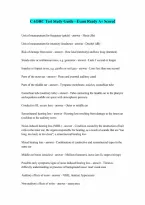
CAOHC Test Study Guide - Exam Ready A+ Scored Unit of measurement for frequency (pitch) - answer - Hertz (Hz) Unit of measurement for intensity (loudness) - answer - Decibel (dB) Risk of damage from noise - answer - How loud (intensity) and how long (duration) Steady-state or continuous noise, e.g. generator - answer - Lasts 1 second or longer Impulse or Impact noise, e.g. gunfire or nail gun - answer - Lasts less than one second Parts of the outer ear - answer - Pinna and external auditory canal Parts of the middle ear - answer - Tympanic membrane, ossicles, eustachian tube Eustachian tube (auditory tube) - answer - Tube connecting the middle ear to the pharynx and equalizes middle ear space with atmospheric pressure Conductive HL occurs here - answer - Outer or middle ear Sensorineural hearing loss - answer - Hearing loss resulting from damage to the inner ear (cochlea) or the auditory nerve Noise-induced hearing loss (NIHL) - answer - Condition caused by the destruction of hair cells in the inner ear, the organs responsible for hearing, as a result of sounds that are "too long, too loud, or too close"; a sensorineural hearing loss Mixed hearing loss - answer - Combination of conductive and sensorineural types in the same ear Middle ear bones (ossicles) - answer - Malleus (hammer), incus (anvil), stapes (stirrup) Possible early symptoms/signs of noise induced hearing loss - answer - Tinnitus; difficulty understanding in presence of background noise; read visual cues Auditory effects of noise - answer - NIHL; tinnitus; hyperacusis Non-auditory effects of noise - answer - annoyance sleep disturbance attention motivation stress reactions cardiovascular problems endocrine problems 3 foot rule - answer - Good rule of thumb to recognize hazardous noise exposure levels/situations: the rule is: if you have to shout at arms length (~3ft), in order to be understood over the background noise, then you're likely exposed to hazardous noise levels & should be wearing hearing protection to prevent NIHL OSHA (Occupational Safety and Health Administration) versus National institute of Occupational Safety and Heath (NIOSH) - answer - OSHA enforces regulation and NIOSH recommends best practice based on science and research Sound pressure level (SPL) versus hearing level (HL) - answer - SPL describes noise measurements taken with a sound level meter or dosimeter; HL describes threshold levels obtained with an audiometer; 0 dB HL is not equal to 0 dB SPL Noise Dosimeter - answer - A sound measurement device used to record the amount of sound exposure over an extended period of time (usually a work day) Personal vs. Area Sound level meter - answer - Uses a microphone to sense pressure variations in sound waves; the meter converts those pressures directly into decibels; provides a noise measurement that is a snapshot in time. Time Weighted Average (TWA) - answer - An evaluation of exposures that is time-weighted over an established period. It allow the exposure levels to be averaged generally over an eight-hour time period. OSHA exchange rate - answer - 5 dB; for every 5 dB you go over the PEL of 90dBA TWA you half the allowable time of exposure OSHA Action Level for noise - answer - 85dBA TWA Sound Level Meter A-weighted Scale - answer - OSHA requires this scale as it resembles how the human ear responds to sound (humans hear best from 500 Hz to 4000 Hz) Human Frequency Response at Birth - answer - 20 Hz to 20,000 Hz (20 kHz) Human speech frequency range - answer - 250 Hz to 4000 Hz Elements of a Hearing Conservation Program - answer - Noise hazard assessment; engineering/administrative controls; annual hearing monitoring; annual training/education; hearing protection; recordkeeping OSHA Noise Amendment - answer - 29 CFR 1910.95 Hughson-Westlake Procedure - answer - Common procedure for obtaining threshold; the audiologist decreases stimulus intensity by 10 dB with a (+) response and increases by 5 dB with a (-) respo
Document information
- Uploaded on
- November 1, 2026
- Number of pages
- 7
- Written in
- 2026/2027
- Type
- Exam (elaborations)
- Contains
- Questions & answers


