
APEA 3P Exam Package Study Materials - Full Answer Key Verified
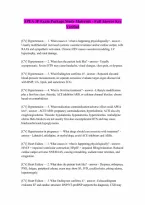
APEA 3P Exam Package Study Materials - Full Answer Key Verified [CV] Hypertension — 1. What causes it / what is happening physiologically? - answer - Usually multifactorial: increased systemic vascular resistance and/or cardiac output, with RAAS and sympathetic activation. Chronic HTN causes vascular remodeling, LV hypertrophy, and renal damage. [CV] Hypertension — 2. What does the patient look like? - answer - Usually asymptomatic. Severe HTN may cause headache, visual changes, chest pain, or dyspnea. [CV] Hypertension — 3. What finding/test confirms it? - answer - Repeated elevated blood-pressure measurements on separate occasions; evaluate target-organ disease/risk with BMP, UA, lipids, and sometimes ECG. [CV] Hypertension — 4. What is first-line treatment? - answer - Lifestyle modification plus a first-line class: thiazide, ACE inhibitor/ARB, or calcium-channel blocker; choose based on comorbidities. [CV] Hypertension — 5. What medication contraindication/adverse effect could APEA test? - answer - ACEI/ARB: pregnancy contraindication, hyperkalemia; ACEI also dry cough/angioedema. Thiazide: hypokalemia, hyponatremia, hyperuricemia. Amlodipine: edema. Beta blockers are not usually first-line uncomplicated HTN and may cause bradycardia/mask hypoglycemia. [CV] Hypertension in pregnancy — What drugs should you associate with treatment? - answer - Labetalol, nifedipine, or methyldopa; avoid ACE inhibitors and ARBs. [CV] Heart Failure — 1. What causes it / what is happening physiologically? - answer - HFrEF = impaired ventricular contraction; HFpEF = impaired filling/relaxation. Reduced cardiac output activates SNS/RAAS, causing remodeling, sodium/water retention, and congestion. [CV] Heart Failure — 2. What does the patient look like? - answer - Dyspnea, orthopnea, PND, fatigue, peripheral edema; exam may show S3, JVD, crackles/rales, pitting edema, hepatomegaly. [CV] Heart Failure — 3. What finding/test confirms it? - answer - Echocardiogram evaluates EF and cardiac structure; BNP/NT-proBNP supports the diagnosis; CXR may show pulmonary congestion/cardiomegaly. [CV] Heart Failure — 4. What is first-line treatment? - answer - For HFrEF: ARNI/ACEI/ARB + evidence-based beta blocker + mineralocorticoid receptor antagonist + SGLT2 inhibitor; loop diuretic for congestion/symptom relief. [CV] Heart Failure — 5. What medication contraindication/adverse effect could APEA test? - answer - Avoid verapamil/diltiazem in significant HFrEF. Spironolactone and ACEI/ARB can cause hyperkalemia; loop diuretics can cause hypokalemia/dehydration; do not abruptly stop beta blockers. [CV] Heart Failure — What classic exam cluster should trigger the diagnosis? - answer - S3 + JVD + crackles + peripheral edema + orthopnea = heart failure/volume overload. [CV] Atrial Fibrillation — 1. What causes it / what is happening physiologically? - answer - Chaotic atrial electrical activity causes loss of coordinated atrial contraction and promotes blood stasis in the left atrial appendage, increasing embolic stroke risk. [CV] Atrial Fibrillation — 2. What does the patient look like? - answer - May be asymptomatic or have palpitations, fatigue, dyspnea, or dizziness; classic exam finding is an irregularly irregular pulse. [CV] Atrial Fibrillation — 3. What finding/test confirms it? - answer - ECG: no distinct P waves with irregularly spaced QRS complexes. Also assess reversible triggers with TSH, electrolytes, infection evaluation, and echo as indicated. [CV] Atrial Fibrillation — 4. What is first-line treatment? - answer - Address three goals: rate control (beta blocker or diltiazem/verapamil), selected rhythm control, and stroke prevention with anticoagulation when indicated. [CV] Atrial Fibrillation — 5. What medication contraindication/adverse effect could APEA test? - answer - Mechanical valve = warfarin, not DOAC. Warfarin requires INR monitoring and is teratogenic. DOAC dosing depends on renal function. Amiodarone can cause pulmonary, thyro
Document information
- Uploaded on
- October 31, 2026
- Number of pages
- 33
- Written in
- 2026/2027
- Type
- Exam (elaborations)
- Contains
- Questions & answers


