

PYC3701
CHAPTER 2 - SOCIAL COGNITION
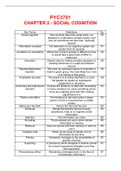
Key Terms Definitions Pg.
Social cognition How we think about the social world, our 55
attempts to understand complex issues, and
why we sometimes are less than “optimally
rational”
Information overload The demands on our cognitive system are 57
greater than its capacity
Conditions of uncertainty Where the “correct” answer is difficult to know 58
or would take a great deal of effort to
determine
Heuristics Simple rules for making complex decisions or 58
drawing inferences in a rapid and efficient
manner
Representativeness The more an individual seems to resemble or 58
heuristic match a given group, the more likely he or she
is to belong to that group
Availability heuristic The easier it is to bring information to mind, 59
the greater its impact on subsequent
judgements or decisions
Anchoring and adjustment Involves the tendency to deal with uncertainty 62
heuristic in many situations by using something we do
know as a starting point and then making
adjustments to it
Portion size effect The tendency to eat more when a larger 63
portion of food is received than a smaller
portion
Status quo heuristic Favour the old over the new 63
Schemas Mental frameworks formed through 65
experience, help us to organise social
information
Attention The information we notice 66
Encoding The processes we use to store noticed 66
information in memory
Retrieval How we recover info from memory in order to 66
use it
Cognitive load When we are tying to handle a lot of 66
information at one time
Priming Temporary increases in the accessibility of 67
specific schemas
Unpriming A process by which thoughts or actions primed 67
by a recent experience dissipate once they
find expression
Perseverance effect Remaining unchanged even in the face of 67
contradictory information
, Metaphor A linguistic device that relates or compares a 68
typically abstract concept to another unrelated
concept, by suggesting a similarity between
them
Controlled processing A systematic, logical, and highly effortful 70
manner of social thought
Automatic processing Fast, relatively effortless, and intuitive manner 70
Optimistic bias A powerful predisposition to overlook risks and 74
expect things to turn out well
Overconfidence bias Greater confidence in our beliefs or 74
judgements than is justified
Planning fallacy Our tendency to believe that we can get more 76
done in a given period of time than we actually
can
Counterfactual thinking “what might have been” 78
Magical thinking Such thinking makes assumptions that don’t 79
hold up to rational scrutiny but that feel
compelling nonetheless
Terror management Efforts to come to terms with the certainty of 80
death and its unsettling implications
Mood congruence effects Refers to the fact that a current mood serves 82
as a kind of filter, primarily permitting info that
is consistent with your moods to be stored in
long-term memory
Mood-dependent memory Reflects what specific information is retrieved 82
from memory
Affective forecasts Predictions of how we would feel about an 84
event we have not experienced
Heuristics: How We Employ Simple Rules in Social Cognition
Heuristics – definition in table
Representativeness: Judging by Resemblance:
Are such judgements accurate?
o Often they are, because belonging to certain groups does affect the
behaviour and styles of persons in them, and because people with
certain traits are attracted to particular groups in the first place
o Can be wrong as judgements made on the basis of this rule tend to
ignore base rate – the frequency with which given events or categories
occur in the total population
Also used when judging whether specific causes resemble each other and are
therefore likely to produce effects that are similar in terms of magnitude
Availability: “If I Can Recall Many Instances, They Must Be Frequent?”
Definition in table
Makes good sense most of the time
But relying on it in making social judgements can also lead to errors
o It can lead us to overestimate the likelihood of events that are dramatic
but rare, because they are easy to bring to mind
CHAPTER 2 - SOCIAL COGNITION
Key Terms Definitions Pg.
Social cognition How we think about the social world, our 55
attempts to understand complex issues, and
why we sometimes are less than “optimally
rational”
Information overload The demands on our cognitive system are 57
greater than its capacity
Conditions of uncertainty Where the “correct” answer is difficult to know 58
or would take a great deal of effort to
determine
Heuristics Simple rules for making complex decisions or 58
drawing inferences in a rapid and efficient
manner
Representativeness The more an individual seems to resemble or 58
heuristic match a given group, the more likely he or she
is to belong to that group
Availability heuristic The easier it is to bring information to mind, 59
the greater its impact on subsequent
judgements or decisions
Anchoring and adjustment Involves the tendency to deal with uncertainty 62
heuristic in many situations by using something we do
know as a starting point and then making
adjustments to it
Portion size effect The tendency to eat more when a larger 63
portion of food is received than a smaller
portion
Status quo heuristic Favour the old over the new 63
Schemas Mental frameworks formed through 65
experience, help us to organise social
information
Attention The information we notice 66
Encoding The processes we use to store noticed 66
information in memory
Retrieval How we recover info from memory in order to 66
use it
Cognitive load When we are tying to handle a lot of 66
information at one time
Priming Temporary increases in the accessibility of 67
specific schemas
Unpriming A process by which thoughts or actions primed 67
by a recent experience dissipate once they
find expression
Perseverance effect Remaining unchanged even in the face of 67
contradictory information
, Metaphor A linguistic device that relates or compares a 68
typically abstract concept to another unrelated
concept, by suggesting a similarity between
them
Controlled processing A systematic, logical, and highly effortful 70
manner of social thought
Automatic processing Fast, relatively effortless, and intuitive manner 70
Optimistic bias A powerful predisposition to overlook risks and 74
expect things to turn out well
Overconfidence bias Greater confidence in our beliefs or 74
judgements than is justified
Planning fallacy Our tendency to believe that we can get more 76
done in a given period of time than we actually
can
Counterfactual thinking “what might have been” 78
Magical thinking Such thinking makes assumptions that don’t 79
hold up to rational scrutiny but that feel
compelling nonetheless
Terror management Efforts to come to terms with the certainty of 80
death and its unsettling implications
Mood congruence effects Refers to the fact that a current mood serves 82
as a kind of filter, primarily permitting info that
is consistent with your moods to be stored in
long-term memory
Mood-dependent memory Reflects what specific information is retrieved 82
from memory
Affective forecasts Predictions of how we would feel about an 84
event we have not experienced
Heuristics: How We Employ Simple Rules in Social Cognition
Heuristics – definition in table
Representativeness: Judging by Resemblance:
Are such judgements accurate?
o Often they are, because belonging to certain groups does affect the
behaviour and styles of persons in them, and because people with
certain traits are attracted to particular groups in the first place
o Can be wrong as judgements made on the basis of this rule tend to
ignore base rate – the frequency with which given events or categories
occur in the total population
Also used when judging whether specific causes resemble each other and are
therefore likely to produce effects that are similar in terms of magnitude
Availability: “If I Can Recall Many Instances, They Must Be Frequent?”
Definition in table
Makes good sense most of the time
But relying on it in making social judgements can also lead to errors
o It can lead us to overestimate the likelihood of events that are dramatic
but rare, because they are easy to bring to mind


