
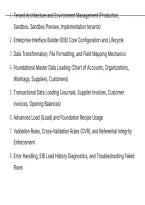
1. Tenant Architecture and Environment Management (Production,
Sandbox, Sandbox Preview, Implementation tenants)
2. Enterprise Interface Builder (EIB) Core Configuration and Lifecycle
3. Data Transformation, File Formatting, and Field Mapping Mechanics
4. Foundational Master Data Loading (Chart of Accounts, Organizations,
Worktags, Suppliers, Customers)
5. Transactional Data Loading (Journals, Supplier Invoices, Customer
Invoices, Opening Balances)
6. Advanced Load (iLoad) and Foundation Recipe Usage
7. Validation Rules, Cross-Validation Rules (CVR), and Referential Integrity
Enforcement
8. Error Handling, EIB Load History Diagnostics, and Troubleshooting Failed
Rows
, 9. Integration System Users (ISU), Security Configuration, and Access
Governance for Data Loads
10. High-Volume Load Performance Optimization and Batching Strategies
Workday Financial Data Loading Certification
Practice Examination
1. A financial implementation consultant is preparing to migrate the legacy
Chart of Accounts into a newly provisioned Workday tenant and needs the
standard out-of-the-box tool that accepts spreadsheet templates for this
foundational master data load. Which Workday capability is most
appropriate?
A. Workday Studio
B. Enterprise Interface Builder (EIB)
,C. Custom Report Writer
D. Business Process Workflow Designer
Answer: B
Rationale: The Enterprise Interface Builder (EIB) is the standard, out-of-the-
box inbound integration tool used for loading master data such as the Chart
of Accounts via spreadsheet templates, while Workday Studio is reserved
for highly complex custom integration logic that exceeds standard EIB
capabilities . 7 13
2. During a supplier data migration, the integration team must uniquely
identify each legacy supplier record to prevent duplicate creation in
Workday, and they need to select the appropriate identifier to map to the
Workday Reference ID field. Which source identifier should the team
map?
, A. The supplier's federal tax identification number
B. The legacy system's unique supplier record key
C. The supplier's primary bank account number
D. The Workday ID (WID) generated by the system
Answer: B
Rationale: The Reference ID, often called the Integration ID, is the unique
identifier used during data loads to map legacy records to Workday records
for preventing duplicates and enabling future updates, whereas the WID is
internally generated by Workday and cannot serve as an input for record
creation . 7 13
3. An implementation consultant configuring the Load Chart of Accounts
EIB must enforce that only specific combinations of Cost Centers and
Account Types are accepted during the data load. Which Workday feature
must be configured to validate these dimensional combinations?


