
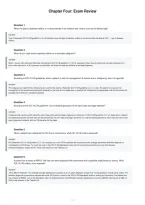
Chapter Four: Exam Review
Question 1.
When the type of diabetes mellitus is not documented in the medical note, what is used as the default type?
ANSWER
Type 2 Rationale: ICD-10-CM guideline I.C.4.a.2 indicates when the type of diabetes mellitus is not documented the default is E11.-, type 2 diabetes
mellitus.
Question 2.
When do you code acute respiratory failure as a secondary diagnosis?
ANSWER
When it occurs after admission Rationale: According to ICD-10-CM guideline I.C.10.b.2, respiratory failure may be listed as a secondary diagnosis if it
occurs after admission, or if it is present on admission, but does not meet the definition of principal diagnosis.
Question 3.
According to ICD-10-CM guidelines, when a patient is seen for management of anemia due to malignancy, how is it reported?
ANSWER
The malignancy is reported first, followed by the code for the anemia. Rationale: ICD-10-CM guideline I.C.2.c.1, when the patient is being seen for
management of the anemia associated with malignancy, the code for the malignancy is reported first, followed by the appropriate code for the anemia (for
example D63.0 Anemia in neoplastic disease).
Question 4.
According to the ICD-10-CM guidelines, how is bilateral glaucoma of the same type and stage reported?
ANSWER
A bilateral code can be used to report the type of glaucoma and the stage of glaucoma. Rationale: In ICD-10-CM guideline I.C.7.a.2 states when a patient
has bilateral glaucoma and both eyes are documented as the same type and stage, and there is a code for bilateral glaucoma, report only the code for the
type of glaucoma, bilateral, with the 7th character for the stage.
Question 5.
When a patient has a blood test for HIV that is inconclusive, what ICD-10-CM code is assigned?
ANSWER
R75 Rationale: ICD-10-CM guideline I.C.1.a.2.e instructs us to use R75 for patients with inconclusive HIV serology and without definitive diagnosis or
manifestations of the illness. To locate the code in the ICD-10-CM Alphabetic Index look for Human/immunodeficiency virus (HIV) disease
(infection)/laboratory evidence R75. Verify code selection in the Tabular List.
Question 6.
A patient has a history of MRSA. She has just been diagnosed with pneumonia due to possible staphylococcus aureus. What
ICD-10-CM code(s) is/are reported?
ANSWER
J18.9, Z86.14 Rationale: The verbiage possible staphylococcus aureus is an uncertain diagnosis and per ICD-10-CM guidelines should not be coded. The
definitive diagnosis is pneumonia reported with code J18.9 which is found in the ICD-10-CM Alphabetic Index by looking for Pneumonia. The patient also
has a history of MRSA. Look in the Alphabetic Index for History/personal (of)/Methicillin resistant Staphylococcus aureus (MRSA) referring you to Z86.14.
Verify code selection in the Tabular List.
1/6
, Question 7.
A 35 year-old woman is experiencing dizziness with nausea and vomiting. The provider documents auditory vertigo of both ears,
possible Meniere's disease. What ICD-10-CM code(s) is/are reported?
ANSWER
H81.313 Rationale: In the ICD-10-CM Alphabetic Index look for Vertigo/auditory telling you to see Vertigo, aural. Vertigo/aural which guides you to code
H81.31-. In the Tabular List 6th character 3 is selected because the condition is bilateral. The Meniere's disease is a possible diagnosis and is not reported.
Per ICD-10-CM guideline I.B.5 signs and symptoms that are associated routinely with a disease process should not be assigned as additional codes.
Dizziness, nausea and vomiting are symptoms of the vertigo and are not reported separately. Verify code selection in the Tabular List.
Question 8.
A patient is seen in the ED for having unprotected sexual intercourse a few months prior. She recently found out that the individual
she was with has HIV. She is only being tested for HIV. What ICD-10-CM code(s) is/are reported?
ANSWER
Z11.4 Rationale: Per ICD-10-CM guideline I.C.1.a.2.h, if a patient is being seen to determine her HIV status use code Z11.4. In the ICD-10-CM Alphabetic
Index look for Screening /disease/human immunodeficiency virus (HIV) Z11.4. Verify in the Tabular List.
Question 9.
A 54 year-old male goes to his primary care provider with dizziness. On physical exam his blood pressure is 200/130. After a
complete work-up, including laboratory tests, the provider makes a diagnosis of end stage renal disease and hypertension. What are
the appropriate diagnosis codes for this encounter?
ANSWER
I12.0, N18.6 Rationale: ICD-10-CM guideline I.C.9.a.2 indicates to assign codes from category I12 when conditions classified to category N18 are present
with hypertension. A causal re-lationship is assumed between hypertension and chronic kidney disease. Guideline I.C.14.a.1 tells us to code N18.6 when the
provider has documented end stage re-nal disease. In the ICD-10-CM Alphabetic Index look for Hypertension, hypertensive/with kidney involvement and you
are directed to see Hypertension, kidney. Hypertension/kidney/with/stage 5 chronic kidney disease (CKD) or end stage renal disease (ESRD) referring you
to I12.0. In the Tabular List there is an instructional note to use an additional code to identify the stage of the chronic kidney disease (N18.5, N18.6). In this
case the patient has end stage renal disease, reporting code N18.6. This is found in the Alphabetic Index by looking for Diseases, diseased/re-nal/with/end
stage (failure) referring you to N18.6. Verify code selection in the Tabular List.
Question 10.
What codes, according to ICD-10-CM guidelines, describe a patient that has hypertension with left heart failure?
ANSWER
I11.0, I150.1 Rationale: According to ICD-10-CM guideline I.C.9.a, there is a presumed causal re-lationship between hypertension and heart involvement. In
this case, the patient has hypertension and left heart failure. In the ICD-10-CM Alphabetic Index look for Hypertension, hypertensive/heart/with heart failure
(congestive) I11.0. Verify the code in the Tabular List. There is an instructional note under code I11.0 that tells us to use an additional code to identify the
type of heart failure (ICD-10-CM guideline I.C.9.a.1). The additional code is sequenced second. The patient has left heart failure. Look in the ICD-10-CM
Alphabetic Index for Failure/heart/left (ventricular ) and you are directed to see Failure, ventricular, left which directs you to code I50.1. Verify the code in the
Tabular List. Under code section I50 there is an instructional note telling us to code first heart failure due to hypertension. This confirms our sequencing.
Question 11.
A 45 year-old patient is scheduled to have an INFUSAID pump installed. He has primary liver cancer and the pump is being inserted
for continuous administration of 5-FU. A pocket is created just under the skin and the pump is placed in the pocket. A catheter is
attached to the pump and to the subclavian vein. The pump is filled with a chemotherapy agent provided by the hospital and the
patient is given his first treatment and observed for adverse reaction and discharged to home. What ICD-10-CM codes are reported?
ANSWER
Z51.11, C22.8 Rationale: ICD-10-CM Guideline I.C.2.e.2 indicates an encounter for chemotherapy code is to be reported as the primary code with a code for
the cancer as secondary when the reason for the visit is solely for chemotherapy. Look in the ICD-10-CM Alphabetic Index for Chemotherapy (session)
(for)/cancer Z51.11. For the malignancy, look in the ICD-10-CM Table of Neoplasms for liver/primary and use the code from the Malignant Primary column
which directs the coder to C22.8. Verify code selection in the Tabular List.
2/6


