2026,
nment3:41:20
3@#&&*#&()&(*&)*$*)($*)*@($*(*@)$(*@$(&(*$$(&*$($2ZOIZHxh-2Page
10/27/2026,
AM~~~~~~())))))))))))))(@)(*@U*(Applied
4:25:30 AMApplied Climatology - Lecture_Lab
Climatology assignment
- Lecture_Lab
310/27/2026,
1 of
assignment
20Applied3:41:20
3@#&&*#&()&(*&)*$*)($*)*@($*(*@)$(*@$(&(*$$(&*$($2ZOIZHxh-2Page
Climatology
AM~~~~~~())))))))))))))(@)(*@U*(Applied
- Lecture_Lab assignment 3.pdf10/27/2026,
Climatology
3:41:39
- Lecture_Lab
AM 1 of
as
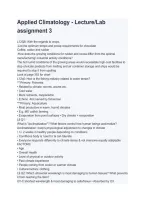
Applied Climatology - Lecture/Lab
assignment 3
L12Q6: With the regards to crops,
-List the optimum temps and precip requirements for chocolate
Coffee, cotton and rubber
-How does the growing conditions for rubber and cocoa differ from the optimal
manufacturing/ industrial activity conditions?
The hot humid conditions of the growing areas would necessitate high-cost facilities to
stop cholcate products from melting and air container storage and ships would be
required to stop it from spoiling.
Look at page 353 for chart
L12q5: How is the fishing industry related to water temps?
***Primary: Fisheries
• Related to climate: storms, waves etc.
• Cold water
• More nutrients, zooplankton
• El Nino -first named by fishermen
***Primary: Aquaculture
• Most productive in warm, humid climates
• E.g. MS catfish farming
• Evaporation from pond surfaces • Dry climate > evaporation
L9 Q1:
What is "acclimatization"? What factors control how human beings acclimatize?
Acclimatization: body's physiological adjustment to changes in climate
• +/- 2 weeks in healthy people depending on conditions
• Conditions body is 'used to' & can tolerate
• Everyone responds differently to climate stress & not everyone equally adaptable
FACTORS:
• Age
• Overall Health
• Level of physical or outdoor activity
• Past climate experience
• People coming from cooler or warmer climate
• Cultural factors: clothing
L9 Q2: Which ultraviolet wavelengh is most damaging to human tissues? What prevents
it from reaching the Skin?
UV-C:shortest wavelength & most damaging to cells/tissue • Absorbed by O3
nment 3@#&&*#&()&(*&)*$*)($*)*@($*(*@)$(*@$(&(*$$(&*$($2ZOIZHxh-2Page
10/27/2026, 4:25:30 AMApplied Climatology - Lecture_Lab assignment 310/27/2026,
1 of 20Applied3:41:20
Climatology
AM~~~~~~())))))))))))))(@)(*@U*(Applied
- Lecture_Lab assignment 3.pdf10/27/2026,
Climatology
3:41:39
- Lecture_Lab
AM as
,2026,
nment3:41:20
3@#&&*#&()&(*&)*$*)($*)*@($*(*@)$(*@$(&(*$$(&*$($2ZOIZHxh-2Page
10/27/2026,
AM~~~~~~())))))))))))))(@)(*@U*(Applied
4:25:30 AMApplied Climatology - Lecture_Lab
Climatology assignment
- Lecture_Lab
310/27/2026,
2 of
assignment
20Applied3:41:20
3@#&&*#&()&(*&)*$*)($*)*@($*(*@)$(*@$(&(*$$(&*$($2ZOIZHxh-2Page
Climatology
AM~~~~~~())))))))))))))(@)(*@U*(Applied
- Lecture_Lab assignment 3.pdf10/27/2026,
Climatology
3:41:39
- Lecture_Lab
AM 2 of
as
• UV-B (middle λ) & UV-A (longest λ) produce melanin in skin
CLOTHING:
Climate and Clothing
• In cold: layers of loosely-woven knits • Trap air between layers for insulation
• Allow for evaporation & waterproof
• In heat: clothing should reduce radiation gain (albedo: light colors) • Enhance
evaporation: thin, breathable material
L9 Q3: What is melanin? What does it do?
** Melanin is a brown/black pigment that absorbs UV radiation & darkens skin
• Tan does not protect skin from sun damage
**UV-B (middle λ) & UV-A (longest λ) produce melanin in skin
L9 Q4: What are health issues with overexposure to the sun?
Disadvantages (overexposure):
• Sunburn
• Photoaging: premature aging of skin
• Skin Cancer
• Most rapidly increasing cancer in US
• Over 40,000 cases Melanoma/yr • 9,500 people die each year
• Cataracts
• Immune system suppression
L9 Q5
-What is the UV Index?
-What are some of the precautions recommended to avoid sunburn? -Using the table in
the lecture slides as well as referring to the lecture or book discussion on the UV index,
describe what precautions are recommended for different UV Index values.
-What is considered minimal, moderate, etc. level of UV?
-How quickly will skin burn under the different conditions?
-When would it be necessary to wear a hat, stay indoors, etc?
UV INDEX:
MIN 0-2/ HAT/ 30-60 MINS TO BURN
nment 3@#&&*#&()&(*&)*$*)($*)*@($*(*@)$(*@$(&(*$$(&*$($2ZOIZHxh-2Page
10/27/2026, 4:25:30 AMApplied Climatology - Lecture_Lab assignment 310/27/2026,
2 of 20Applied3:41:20
Climatology
AM~~~~~~())))))))))))))(@)(*@U*(Applied
- Lecture_Lab assignment 3.pdf10/27/2026,
Climatology
3:41:39
- Lecture_Lab
AM as
,2026,
nment3:41:20
3@#&&*#&()&(*&)*$*)($*)*@($*(*@)$(*@$(&(*$$(&*$($2ZOIZHxh-2Page
10/27/2026,
AM~~~~~~())))))))))))))(@)(*@U*(Applied
4:25:30 AMApplied Climatology - Lecture_Lab
Climatology assignment
- Lecture_Lab
310/27/2026,
3 of
assignment
20Applied3:41:20
3@#&&*#&()&(*&)*$*)($*)*@($*(*@)$(*@$(&(*$$(&*$($2ZOIZHxh-2Page
Climatology
AM~~~~~~())))))))))))))(@)(*@U*(Applied
- Lecture_Lab assignment 3.pdf10/27/2026,
Climatology
3:41:39
- Lecture_Lab
AM 3 of
as
LOW 3-4/ HAT SPF15+/15-20 MINS TO BURN
MODERATE: 5-6/ HAT/SPF15/SHADY/1-12 MINS TO BURN
HiGH: 7-9: HAT/SPF15+/SHADY/STAY INDOOR 10ATO4PM/
VERY HIGH: 10-15: ALL ABOVE AND STAY INDOORS/ 4-6 MINS TO BURN
L9 Q6 What is sad? What are the symptoms? What conditions lead to higher
incidences?
-SAD is seasonal affective disorder or winter blues
SYMPTOMS—
- Loss of appetite
-decreased energy
-irritability
-oversleeping
-difficulty focusing
What conditions Lear to higher incidences?
-Maybe linked with changes in sunlight
-possibly related melatonin or serotonin
-Maybe associated with vitamin D
Higher incidence—-
Higher incidence where days are shorter and sun angles are lower.
LINK—
Between serotonin and climate
Concentrations of serotonin drop to the lowest level.
L9 Q7: What is serotonin? How does it vary on a seasonal basis? How does it relate to
sunshine amount?
SAD: link between serotonin and climate
Treatment:
Link between serotonin & climate
• Concentrations of serotonin drop to their lowest levels during the winter
• Treatment: Phototherapy (full-spectrum) & anti-depressants
• Also instances of late spring/early summer SAD (less common)
• Important to rule out other factors that might cause depression • Cultural-link: more
holidays during winter months
• Seasonal job loss
L9 Q8: Describe the mechanisms of heat exchanges between the human body and the
environment.
nment 3@#&&*#&()&(*&)*$*)($*)*@($*(*@)$(*@$(&(*$$(&*$($2ZOIZHxh-2Page
10/27/2026, 4:25:30 AMApplied Climatology - Lecture_Lab assignment 310/27/2026,
3 of 20Applied3:41:20
Climatology
AM~~~~~~())))))))))))))(@)(*@U*(Applied
- Lecture_Lab assignment 3.pdf10/27/2026,
Climatology
3:41:39
- Lecture_Lab
AM as
nment3:41:20
3@#&&*#&()&(*&)*$*)($*)*@($*(*@)$(*@$(&(*$$(&*$($2ZOIZHxh-2Page
10/27/2026,
AM~~~~~~())))))))))))))(@)(*@U*(Applied
4:25:30 AMApplied Climatology - Lecture_Lab
Climatology assignment
- Lecture_Lab
310/27/2026,
1 of
assignment
20Applied3:41:20
3@#&&*#&()&(*&)*$*)($*)*@($*(*@)$(*@$(&(*$$(&*$($2ZOIZHxh-2Page
Climatology
AM~~~~~~())))))))))))))(@)(*@U*(Applied
- Lecture_Lab assignment 3.pdf10/27/2026,
Climatology
3:41:39
- Lecture_Lab
AM 1 of
as
Applied Climatology - Lecture/Lab
assignment 3
L12Q6: With the regards to crops,
-List the optimum temps and precip requirements for chocolate
Coffee, cotton and rubber
-How does the growing conditions for rubber and cocoa differ from the optimal
manufacturing/ industrial activity conditions?
The hot humid conditions of the growing areas would necessitate high-cost facilities to
stop cholcate products from melting and air container storage and ships would be
required to stop it from spoiling.
Look at page 353 for chart
L12q5: How is the fishing industry related to water temps?
***Primary: Fisheries
• Related to climate: storms, waves etc.
• Cold water
• More nutrients, zooplankton
• El Nino -first named by fishermen
***Primary: Aquaculture
• Most productive in warm, humid climates
• E.g. MS catfish farming
• Evaporation from pond surfaces • Dry climate > evaporation
L9 Q1:
What is "acclimatization"? What factors control how human beings acclimatize?
Acclimatization: body's physiological adjustment to changes in climate
• +/- 2 weeks in healthy people depending on conditions
• Conditions body is 'used to' & can tolerate
• Everyone responds differently to climate stress & not everyone equally adaptable
FACTORS:
• Age
• Overall Health
• Level of physical or outdoor activity
• Past climate experience
• People coming from cooler or warmer climate
• Cultural factors: clothing
L9 Q2: Which ultraviolet wavelengh is most damaging to human tissues? What prevents
it from reaching the Skin?
UV-C:shortest wavelength & most damaging to cells/tissue • Absorbed by O3
nment 3@#&&*#&()&(*&)*$*)($*)*@($*(*@)$(*@$(&(*$$(&*$($2ZOIZHxh-2Page
10/27/2026, 4:25:30 AMApplied Climatology - Lecture_Lab assignment 310/27/2026,
1 of 20Applied3:41:20
Climatology
AM~~~~~~())))))))))))))(@)(*@U*(Applied
- Lecture_Lab assignment 3.pdf10/27/2026,
Climatology
3:41:39
- Lecture_Lab
AM as
,2026,
nment3:41:20
3@#&&*#&()&(*&)*$*)($*)*@($*(*@)$(*@$(&(*$$(&*$($2ZOIZHxh-2Page
10/27/2026,
AM~~~~~~())))))))))))))(@)(*@U*(Applied
4:25:30 AMApplied Climatology - Lecture_Lab
Climatology assignment
- Lecture_Lab
310/27/2026,
2 of
assignment
20Applied3:41:20
3@#&&*#&()&(*&)*$*)($*)*@($*(*@)$(*@$(&(*$$(&*$($2ZOIZHxh-2Page
Climatology
AM~~~~~~())))))))))))))(@)(*@U*(Applied
- Lecture_Lab assignment 3.pdf10/27/2026,
Climatology
3:41:39
- Lecture_Lab
AM 2 of
as
• UV-B (middle λ) & UV-A (longest λ) produce melanin in skin
CLOTHING:
Climate and Clothing
• In cold: layers of loosely-woven knits • Trap air between layers for insulation
• Allow for evaporation & waterproof
• In heat: clothing should reduce radiation gain (albedo: light colors) • Enhance
evaporation: thin, breathable material
L9 Q3: What is melanin? What does it do?
** Melanin is a brown/black pigment that absorbs UV radiation & darkens skin
• Tan does not protect skin from sun damage
**UV-B (middle λ) & UV-A (longest λ) produce melanin in skin
L9 Q4: What are health issues with overexposure to the sun?
Disadvantages (overexposure):
• Sunburn
• Photoaging: premature aging of skin
• Skin Cancer
• Most rapidly increasing cancer in US
• Over 40,000 cases Melanoma/yr • 9,500 people die each year
• Cataracts
• Immune system suppression
L9 Q5
-What is the UV Index?
-What are some of the precautions recommended to avoid sunburn? -Using the table in
the lecture slides as well as referring to the lecture or book discussion on the UV index,
describe what precautions are recommended for different UV Index values.
-What is considered minimal, moderate, etc. level of UV?
-How quickly will skin burn under the different conditions?
-When would it be necessary to wear a hat, stay indoors, etc?
UV INDEX:
MIN 0-2/ HAT/ 30-60 MINS TO BURN
nment 3@#&&*#&()&(*&)*$*)($*)*@($*(*@)$(*@$(&(*$$(&*$($2ZOIZHxh-2Page
10/27/2026, 4:25:30 AMApplied Climatology - Lecture_Lab assignment 310/27/2026,
2 of 20Applied3:41:20
Climatology
AM~~~~~~())))))))))))))(@)(*@U*(Applied
- Lecture_Lab assignment 3.pdf10/27/2026,
Climatology
3:41:39
- Lecture_Lab
AM as
,2026,
nment3:41:20
3@#&&*#&()&(*&)*$*)($*)*@($*(*@)$(*@$(&(*$$(&*$($2ZOIZHxh-2Page
10/27/2026,
AM~~~~~~())))))))))))))(@)(*@U*(Applied
4:25:30 AMApplied Climatology - Lecture_Lab
Climatology assignment
- Lecture_Lab
310/27/2026,
3 of
assignment
20Applied3:41:20
3@#&&*#&()&(*&)*$*)($*)*@($*(*@)$(*@$(&(*$$(&*$($2ZOIZHxh-2Page
Climatology
AM~~~~~~())))))))))))))(@)(*@U*(Applied
- Lecture_Lab assignment 3.pdf10/27/2026,
Climatology
3:41:39
- Lecture_Lab
AM 3 of
as
LOW 3-4/ HAT SPF15+/15-20 MINS TO BURN
MODERATE: 5-6/ HAT/SPF15/SHADY/1-12 MINS TO BURN
HiGH: 7-9: HAT/SPF15+/SHADY/STAY INDOOR 10ATO4PM/
VERY HIGH: 10-15: ALL ABOVE AND STAY INDOORS/ 4-6 MINS TO BURN
L9 Q6 What is sad? What are the symptoms? What conditions lead to higher
incidences?
-SAD is seasonal affective disorder or winter blues
SYMPTOMS—
- Loss of appetite
-decreased energy
-irritability
-oversleeping
-difficulty focusing
What conditions Lear to higher incidences?
-Maybe linked with changes in sunlight
-possibly related melatonin or serotonin
-Maybe associated with vitamin D
Higher incidence—-
Higher incidence where days are shorter and sun angles are lower.
LINK—
Between serotonin and climate
Concentrations of serotonin drop to the lowest level.
L9 Q7: What is serotonin? How does it vary on a seasonal basis? How does it relate to
sunshine amount?
SAD: link between serotonin and climate
Treatment:
Link between serotonin & climate
• Concentrations of serotonin drop to their lowest levels during the winter
• Treatment: Phototherapy (full-spectrum) & anti-depressants
• Also instances of late spring/early summer SAD (less common)
• Important to rule out other factors that might cause depression • Cultural-link: more
holidays during winter months
• Seasonal job loss
L9 Q8: Describe the mechanisms of heat exchanges between the human body and the
environment.
nment 3@#&&*#&()&(*&)*$*)($*)*@($*(*@)$(*@$(&(*$$(&*$($2ZOIZHxh-2Page
10/27/2026, 4:25:30 AMApplied Climatology - Lecture_Lab assignment 310/27/2026,
3 of 20Applied3:41:20
Climatology
AM~~~~~~())))))))))))))(@)(*@U*(Applied
- Lecture_Lab assignment 3.pdf10/27/2026,
Climatology
3:41:39
- Lecture_Lab
AM as