
RASMUSSEN UNIVERSITY NUR 2 45 9 · E X A M 1 · ME NTA L HE A LTH
M E N TA L A N D B E H A V I O R A L H E A L T H N U R S I N G
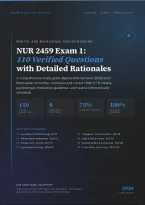
NUR 2459 Exam 1:
110 Verified Questions
with Detailed Rationales
A comprehensive study guide aligned with the latest 2026/2027
Rasmussen University curriculum and current DSM-5-TR criteria,
psychotropic medication guidelines, and trauma-informed care
standards.
110 8 75% 100%
T O TA L CO N T E N T SCE N A RI O - B A SE D V E RI F I E D
Q UE ST I O N S SE CT I O N S A N SW E RS
SECTION COVERAGE
01 Foundations of PMH Nursing · Q1–14 02 Therapeutic Communication · Q15–28
03 Mental Health Assessment · Q29–42 04 Legal & Ethical Issues · Q43–56
05 Anxiety, OCD, Trauma · Q57–72 06 Mood Disorders & Suicide Risk · Q73–88
07 Psychopharmacology · Q89–102 08 Crisis, Milieu, Community · Q103–110
NU R 2 45 9 E X A M 1 BLU E P RI NT
Cognitive Distribution: 30% Recall · 50% Application · 20% Analysis
Question Style: 75% Scenario-Based · 25% Direct Recall
2026
Latest Update
,NUR 2459 Exam 1 — Mental and Behavioral Health Nursing (110 Questions) Rasmussen University — 2026/2027 Update
NUR 2459 — Mental and Behavioral Health
Nursing
Exam 1 Study Guide — 110 Verified Questions with Detailed Rationales (Grade A, 100% Correct)
Examination Overview
This NUR 2459 Exam 1 study guide contains 110 mental and behavioral health nursing questions aligned with the
latest 2026/2027 Rasmussen University curriculum and current DSM-5-TR diagnostic criteria, psychotropic
medication guidelines, and trauma-informed care standards. Questions span eight content sections reflecting the
first-exam blueprint, with approximately 75% scenario-based items requiring application of therapeutic
communication, mental status examination interpretation, DSM-5-TR criteria, legal and ethical standards, and
psychopharmacology principles. The cognitive distribution follows 30% recall, 50% application, and 20% analysis in
keeping with the NUR 2459 standard. Each item includes a verified correct answer and a detailed rationale with
therapeutic communication principles, pathophysiologic basis, assessment findings, intervention priorities, and
prioritization frameworks such as Maslow, the nursing process, and trauma-informed care.
How to Use This Study Guide
Each question is presented with four response options (A–D), one verified correct answer, and a comprehensive
rationale that explains both why the correct option is right and why the distractors are wrong. NCLEX-style
therapeutic communication technique identification questions require distinguishing therapeutic responses (active
listening, reflection, clarification, silence) from non-therapeutic responses (false reassurance, giving advice, “why”
questions). Mental Status Examination interpretation scenarios require correct identification of components such as
mood versus affect, thought process versus thought content, and insight versus judgment. Legal and ethical scenarios
require application of client rights, commitment criteria, and confidentiality exceptions. Suicide risk assessment items
apply warning signs, risk factors, protective factors, and the Columbia-Suicide Severity Rating Scale (C-SSRS).
Psychopharmacology questions cover drug classification, side effect recognition, and monitoring parameters including
serotonin syndrome, neuroleptic malignant syndrome, lithium toxicity, and metabolic syndrome. Reviewing each
rationale carefully—understanding the reasoning behind each answer—is far more valuable for psychiatric nursing
mastery than memorization of the answer alone.
Examination Blueprint
# Section Question Range Count
1 Foundations of Psychiatric-Mental Health Nursing Q1–Q14 14
2 Therapeutic Communication and the Nurse-Client Relationship Q15–Q28 14
3 Mental Health Assessment and the Diagnostic Process Q29–Q42 14
4 Legal and Ethical Issues in Psychiatric Nursing Q43–Q56 14
5 Anxiety, OCD, and Trauma-Related Disorders Q57–Q72 16
6 Mood Disorders Q73–Q88 16
7 Psychopharmacology Fundamentals Q89–Q102 14
8 Crisis Intervention, Milieu Therapy, and Community Mental Health Q103–Q110 8
TOTAL Q1–Q110 110
Page 1
,NUR 2459 Exam 1 — Mental and Behavioral Health Nursing (110 Questions) Rasmussen University — 2026/2027 Update
SECTION 1: Foundations of Psychiatric-Mental Health Nursing
History, Theories, & Nursing Roles
Q1. A nurse is orienting to a psychiatric unit. Which statement best reflects Hildegard Peplau's
contribution to modern psychiatric nursing?
A. Peplau established the first asylum in the United States.
B. Peplau developed the therapeutic use of self and described the nurse-client relationship as a series of phases
(orientation, working, termination), forming the foundation of psychiatric nursing practice.
C. Peplau created the Diagnostic and Statistical Manual of Mental Disorders.
D. Peplau was the first nurse to prescribe psychotropic medications.
Correct Answer: B — Peplau developed the therapeutic use of self and described the nurse-client
relationship as a series of phases (orientation, working, termination), forming the foundation of psychiatric
nursing practice. [CORRECT]
Rationale: Hildegard Peplau, known as the 'mother of psychiatric nursing,' published Interpersonal Relations in Nursing in
1952, defining the therapeutic nurse-client relationship and its phases: preinteraction, orientation, working, and termination.
Peplau's work emphasized the therapeutic use of self and viewed nursing as a significant, therapeutic, interpersonal process.
Dorothea Dix advocated for the mentally ill and established asylums (A); the APA publishes the DSM-5-TR (C); advanced
practice psychiatric nurses may prescribe, but Peplau did not (D).
Q2. A psychiatric nurse is caring for a client who was abandoned by parents in early childhood and now
has difficulty trusting staff. Using Erik Erikson's psychosocial theory, which stage was most likely
disrupted?
A. Trust vs. Mistrust (infancy, 0-18 months)
B. Industry vs. Inferiority (school age, 6-12 years)
C. Identity vs. Role Confusion (adolescence, 12-18 years)
D. Generativity vs. Stagnation (middle adulthood, 40-65 years)
Correct Answer: A — Trust vs. Mistrust (infancy, 0-18 months) [CORRECT]
Rationale: Erik Erikson's psychosocial theory posits that infants develop basic trust when caregivers consistently meet their
needs. Disruption in this stage (from neglect, abandonment, or inconsistent caregiving) leads to mistrust, which can manifest
in adulthood as difficulty forming relationships and trusting others. Industry vs. Inferiority (B) involves competence in
school; Identity vs. Role Confusion (C) involves adolescent self-concept; Generativity vs. Stagnation (D) involves
contributing to the next generation. The nurse should establish a consistent, reliable relationship with the client to rebuild
trust.
Q3. A nurse is developing a primary prevention program for mental health in a community. Which
activity best represents primary prevention?
A. Referring a client with depression to a support group.
B. Teaching stress management and resilience skills to high school students before any mental health symptoms
develop.
C. Providing medication management for a client with schizophrenia.
D. Providing vocational rehabilitation for a client with chronic mental illness.
Correct Answer: B — Teaching stress management and resilience skills to high school students before any
mental health symptoms develop. [CORRECT]
Rationale: Primary prevention targets healthy individuals to prevent onset of disease. Teaching stress management,
resilience, coping skills, and mental health literacy to people without symptoms is primary prevention. Secondary prevention
(A) involves early detection and intervention for those at risk or with early symptoms (e.g., screening, support groups, brief
therapy). Tertiary prevention (C, D) focuses on reducing disability and improving quality of life for those with established
illness (e.g., medication management, rehabilitation, case management). The levels of prevention framework guides
community mental health programming.
Page 2
, NUR 2459 Exam 1 — Mental and Behavioral Health Nursing (110 Questions) Rasmussen University — 2026/2027 Update
Q4. A nurse is caring for a client who repeatedly says, "I just need you to tell me what to do." According
to Harry Stack Sullivan's interpersonal theory, the nurse's best response is based on which principle?
A. The nurse should give direct advice to reduce the client's anxiety.
B. The nurse should help the client explore feelings and develop self-understanding rather than give advice,
because anxiety is reduced through interpersonal learning and insight.
C. The nurse should ignore the client's requests.
D. The nurse should prescribe medication for anxiety.
Correct Answer: B — The nurse should help the client explore feelings and develop self-understanding
rather than give advice, because anxiety is reduced through interpersonal learning and insight. [CORRECT]
Rationale: Harry Stack Sullivan's interpersonal theory emphasizes that personality develops through interpersonal
interactions and that anxiety arises from interpersonal experiences. The therapeutic nurse-client relationship is the primary
tool for change, helping clients explore feelings, develop insight, and improve interpersonal patterns. Giving direct advice
(A) fosters dependence and undermines growth. Ignoring (C) violates therapeutic engagement. Medication (D) may be
appropriate if clinically indicated but does not replace interpersonal therapeutic work. The nurse uses the relationship itself
as the therapeutic agent.
Q5. A psychiatric nurse is caring for a client who uses defense mechanisms to manage anxiety. The nurse
understands that defense mechanisms, when used moderately and adaptively, are:
A. Always pathological and require immediate intervention.
B. Normal psychological processes that protect the individual from anxiety and preserve self-esteem; only
become problematic when used excessively or rigidly.
C. Indicators of severe mental illness requiring hospitalization.
D. Behaviors that should be confronted immediately by the nurse.
Correct Answer: B — Normal psychological processes that protect the individual from anxiety and preserve
self-esteem; only become problematic when used excessively or rigidly. [CORRECT]
Rationale: Defense mechanisms (Freud) are unconscious psychological strategies used to protect individuals from anxiety,
conflict, and threats to self-esteem. Common defense mechanisms include denial, projection, displacement, rationalization,
repression, sublimation, and humor. Used in moderation and adaptively (e.g., humor, sublimation, altruism), they are normal
and healthy. Used excessively or rigidly (e.g., chronic denial, severe projection), they can be maladaptive and interfere with
reality testing. The nurse should assess the client's use of defense mechanisms, support adaptive use, and gently challenge
maladaptive patterns within a therapeutic relationship, not confront aggressively (D).
Q6. A nurse is caring for a client who states, "I don't want to take this medication, I want to leave."
Which ethical principle is the nurse upholding by respecting the client's right to refuse treatment?
A. Beneficence
B. Autonomy
C. Justice
D. Non-maleficence
Correct Answer: B — Autonomy [CORRECT]
Rationale: Autonomy refers to the client's right to self-determination, including the right to refuse treatment, make
informed decisions, and have choices respected (within legal limits). Beneficence (A) is acting in the client's best interest;
non-maleficence (D) is doing no harm; justice (C) is fair distribution of resources and treatment. When a client refuses
medication, the nurse respects autonomy by acknowledging the right to refuse while also providing education (beneficence)
about consequences. Involuntary commitment and emergency situations may override autonomy based on danger to self or
others. The nurse should document the refusal, explore reasons, provide education, and notify the provider.
Page 3


