
NUR 2790 Professional Nursing III (PN3) Final Exam — Rasmussen University Latest Update | 100% Correct
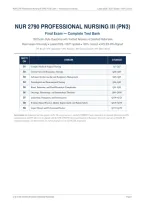
NUR 2790 PROFESSIONAL NURSING III (PN3)
Final Exam — Complete Test Bank
150 Exam-Style Questions with Verified Answers & Detailed Rationales
Rasmussen University • Latest Update • 100% Correct • NCLEX-RN Aligned
25% Recall / 55% Application / 20% Analysis • 80% Scenario-based / 20% Direct Recall
SECTI
DOMAIN Q RANGE
ON
S1 Complex Medical-Surgical Nursing Q1–Q25
S2 Critical Care and Emergency Nursing Q26–Q45
S3 Advanced Cardiovascular and Respiratory Management Q46–Q65
S4 Neurological and Neurosurgical Nursing Q66–Q80
S5 Renal, Endocrine, and Fluid/Electrolyte Complexities Q81–Q95
S6 Oncology, Hematology, and Immunologic Disorders Q96–Q108
S7 Leadership, Delegation, and Prioritization Q109–Q125
S8 Evidence-Based Practice, Quality Improvement, and Patient Safety Q126–Q138
S9 Legal, Ethical, and Professional Practice Q139–Q150
Instructions: Each question has four options (A–D). The correct answer is marked [CORRECT] and explained in the rationale. Questions are 80%
scenario-based and 20% direct recall, aligned with the NUR 2790 PN3 final exam blueprint at Rasmussen University and current NCLEX-RN
readiness standards. Use this test bank for end-of-program review and NCLEX preparation.
Q & A with Verified Answers & Detailed Rationales Page 1
,NUR 2790 Professional Nursing III (PN3) Final Exam — Rasmussen University Latest Update | 100% Correct
SECTION 1: Complex Medical-Surgical Nursing
Multi-System Failure, Shock States & Sepsis (Q1–Q25)
Q1: A 68-year-old client is admitted with hypovolemic shock secondary to a massive GI bleed. The
client's blood pressure is 86/52, HR 124, RR 26, urinary output 15 mL/hr. Central venous pressure
is 2 mmHg. Which interpretation by the nurse is most accurate?
A. Cardiogenic shock; prepare for inotropic support
B. Hypovolemic shock with decreased preload (low CVP), decreased afterload (hypotension), and
compensatory tachycardia; initiate massive transfusion protocol and crystalloid resuscitation [CORRECT]
C. Distributive shock with vasodilation
D. Obstructive shock from tension pneumothorax
Correct Answer: B
Rationale: Hypovolemic shock (blood or fluid loss) presents with decreased intravascular volume, low CVP (<5 mmHg),
hypotension, compensatory tachycardia, and oliguria due to decreased renal perfusion. Treatment priorities: control
bleeding (endoscopy, surgery), large-bore IV access, rapid crystalloid resuscitation (1–2 L isotonic saline), blood product
transfusion (massive transfusion protocol: 1:1:1 ratio of PRBC:FFP:platelets), vasopressors (norepinephrine) if
fluid-refractory, monitor lactate and base deficit for tissue perfusion assessment. Cardiogenic shock has high CVP;
distributive has low SVR with warm extremities; obstructive (tension pneumothorax, tamponade) has equalized chamber
pressures.
Q2: A client with septic shock has a central venous pressure of 12 mmHg, MAP 58 mmHg, lactate
4.2 mmol/L, and ScvO2 65% despite 30 mL/kg crystalloid resuscitation. Which action should the
nurse anticipate NEXT per the Surviving Sepsis Campaign 2021 bundle?
A. Continue fluid boluses until CVP reaches 16 mmHg
B. Initiate norepinephrine infusion to target MAP ≥65 mmHg; obtain blood cultures if not yet drawn;
administer broad-spectrum antibiotics within 1 hour; assess for source control; consider vasopressin 0.03
U/min if norepinephrine dose is high [CORRECT]
C. Administer furosemide to reduce fluid overload
D. Begin therapeutic hypothermia
Correct Answer: B
Rationale: Surviving Sepsis Campaign 2021 (hour-1 bundle): obtain blood cultures before antibiotics if no significant delay,
administer broad-spectrum antibiotics within 1 hour, rapid crystalloid 30 mL/kg for hypotension or lactate ≥4, begin
vasopressors (norepinephrine first-line) if hypotensive during/after fluids to target MAP ≥65 mmHg, assess for source
control, monitor lactate for clearance. For persistent hypotension after adequate fluid resuscitation (this client),
norepinephrine is the first-line vasopressor; add vasopressin 0.03 U/min if norepinephrine dose exceeds 0.25–0.5
mcg/kg/min. Corticosteroids (hydrocortisone 200 mg/day) are considered for vasopressor-refractory septic shock.
Q & A with Verified Answers & Detailed Rationales Page 2
,NUR 2790 Professional Nursing III (PN3) Final Exam — Rasmussen University Latest Update | 100% Correct
Q3: A client with suspected sepsis has a temperature of 38.6°C, HR 118, RR 28, PaCO2 30 mmHg,
WBC 16,000/mm³ with 12% bands. How many SIRS criteria are met?
A. 2 of 4 criteria
B. 4 of 4 criteria (all four: fever, tachycardia, tachypnea/hypocapnia, leukocytosis with bands) [CORRECT]
C. 1 of 4 criteria
D. 3 of 4 criteria
Correct Answer: B
Rationale: SIRS criteria (4 of them): (1) temperature >38°C or <36°C (this client has 38.6°C); (2) HR >90 bpm (this client
has 118); (3) RR >20 or PaCO2 <32 mmHg (this client has 28 RR and PaCO2 30); (4) WBC >12,000, <4,000, or >10%
bands (this client has 16,000 with 12% bands). The client meets all 4 criteria. Note: SIRS has been replaced by qSOFA (RR
≥22, altered mentation, SBP ≤100) for identification of sepsis in some guidelines, but SIRS remains useful for screening.
Sepsis is now defined as life-threatening organ dysfunction caused by dysregulated host response to infection (SOFA ≥2
point increase from baseline).
Q4: A client with cardiogenic shock is on a dobutamine drip at 5 mcg/kg/min. The nurse notes new
ventricular ectopy (PVCs) on the monitor. The client's BP is 92/58. Which action by the nurse is
most appropriate?
A. Increase the dobutamine dose
B. Notify the provider; anticipate reducing the dobutamine dose (beta-1 agonist can precipitate arrhythmias),
assess for hypokalemia and hypomagnesemia, monitor continuous ECG, and prepare for possible addition of
norepinephrine to maintain MAP [CORRECT]
C. Administer beta blocker to control PVCs
D. Discontinue the dobutamine immediately
Correct Answer: B
Rationale: Dobutamine (beta-1 agonist with mild beta-2 effects) is an inotrope used in cardiogenic shock to improve
cardiac output, but it can precipitate tachyarrhythmias (PVCs, VT, AF) due to increased myocardial oxygen demand and
beta-1 stimulation. Management: notify the provider, anticipate dose reduction or addition of norepinephrine (alpha +
beta-1) to maintain MAP, assess and correct electrolytes (K+, Mg++, ionized Ca), continuous ECG monitoring, and
consider mechanical circulatory support (IABP, Impella, ECMO) in refractory cases. Beta-blockers are contraindicated in
acute shock. Abrupt discontinuation may worsen cardiac output.
Q5: A client with anaphylactic shock after IV contrast administration has stridor, wheezing,
hypoxia, and hypotension (BP 78/42). Which action should the nurse take FIRST?
A. Administer diphenhydramine IV
B. Stop the offending agent, call for help, place supine with legs elevated (unless respiratory distress requires
upright), administer high-flow oxygen via non-rebreather, administer IM epinephrine 0.3–0.5 mg (1:1,000) in
the anterolateral thigh, establish IV access for fluids, prepare to intubate [CORRECT]
C. Administer hydrocortisone IV
D. Administer albuterol nebulizer
Correct Answer: B
Rationale: Anaphylaxis is a life-threatening type 1 hypersensitivity reaction with rapid onset; IM epinephrine (0.3–0.5 mg
of 1:1,000 [1 mg/mL], anterolateral thigh) is the first-line treatment and must be given immediately. Repeat in 5–15
minutes if no improvement. Additional: stop offending agent, supine with elevated legs (unless respiratory distress),
high-flow oxygen, IV access with crystalloid bolus (normal saline 20 mL/kg), H1 blocker (diphenhydramine) and H2
blocker (famotidine), corticosteroid (methylprednisolone) for delayed reactions, beta-agonist nebulizer for bronchospasm,
and prepare for intubation if airway edema. Antihistamines and corticosteroids are adjunctive; epinephrine is definitive.
Q & A with Verified Answers & Detailed Rationales Page 3
, NUR 2790 Professional Nursing III (PN3) Final Exam — Rasmussen University Latest Update | 100% Correct
Q6: A client with neurogenic shock from a T4 spinal cord injury has hypotension (BP 84/48),
bradycardia (HR 46), and warm, dry lower extremities. Which interpretation by the nurse is most
accurate?
A. Hypovolemic shock; administer fluid bolus
B. Neurogenic (distributive) shock with loss of sympathetic tone below the lesion causing vasodilation,
hypotension, and unopposed parasympathetic activity (bradycardia); administer IV fluids and vasopressors
(norepinephrine or phenylephrine) and treat bradycardia (atropine if symptomatic) [CORRECT]
C. Cardiogenic shock; initiate inotrope
D. Septic shock; begin antibiotic sepsis bundle
Correct Answer: B
Rationale: Neurogenic shock (a form of distributive shock) occurs with spinal cord injury at T6 or above, disrupting
sympathetic outflow (vasomotor tone) while parasympathetic activity (vagus nerve) remains intact. Classic triad:
hypotension, bradycardia, and warm dry skin below the level of injury (vasodilation). Treatment: IV fluids, vasopressors
(norepinephrine for combined alpha+beta effects, or phenylephrine for pure alpha-1), atropine for symptomatic
bradycardia, and address concurrent injuries. Hypovolemic shock has tachycardia; cardiogenic has high CVP and cold
extremities; septic shock has tachycardia and fever/hyperthermia.
Q7: A client in shock has an arterial line showing a systolic BP of 68 mmHg and a MAP of 52
mmHg. The provider orders a norepinephrine drip titrated to keep MAP ≥65 mmHg. The standard
concentration is 4 mg in 250 mL D5W. The current rate is 15 mL/hr. The client weighs 80 kg. What
is the current dose in mcg/kg/min?
A. 0.25 mcg/kg/min
B. 0.5 mcg/kg/min
C. 0.05 mcg/kg/min (4 mg = 4,000 mcg in 250 mL = 16 mcg/mL; 15 mL/hr × 16 mcg/mL = 240 mcg/hr; 240 ÷
60 min/hr = 4 mcg/min; 4 mcg/min ÷ 80 kg = 0.05 mcg/kg/min) [CORRECT]
D. 0.8 mcg/kg/min
Correct Answer: C
Rationale: Calculation: concentration = 4 mg in 250 mL = 4,000 mcg / 250 mL = 16 mcg/mL. At 15 mL/hr: 15 × 16 = 240
mcg/hr. Convert to mcg/min: = 4 mcg/min. Weight-based: 4 mcg/min / 80 kg = 0.05 mcg/kg/min. Standard
norepinephrine starting dose is 0.05–0.15 mcg/kg/min, titrated every 5 minutes to target MAP ≥65 mmHg, maximum
typically 1 mcg/kg/min. The nurse should double-check calculations with another licensed nurse and use an infusion pump;
titrate per protocol based on MAP response. Always verify concentration, weight in kg, and units carefully when titrating
vasoactive medications.
Q & A with Verified Answers & Detailed Rationales Page 4


