
NUR 2180
Quiz 1
Physical Assessment
75 Questions | Latest
Rasmussen University
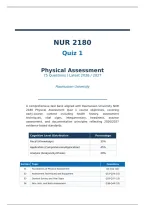
A comprehensive test bank aligned with Rasmussen University NUR
2180 Physical Assessment Quiz 1 course objectives, covering
early-course content including health history, assessment
techniques, vital signs, integumentary, head/neck, eye/ear
assessment, and documentation principles reflecting 2026/2027
evidence-based standards.
Cognitive Level Distribution Percentage
Recall (Knowledge) 35%
Application (Comprehension/Application) 45%
Analysis (Analysis/Synthesis) 20%
Section Topic Questions
S1 Foundations of Physical Assessment Q1-Q12 (12)
S2 Assessment Techniques and Equipment Q13-Q24 (12)
S3 General Survey and Vital Signs Q25-Q37 (13)
S4 Skin, Hair, and Nails Assessment Q38-Q49 (12)
, S5 Head, Face, and Neck Assessment Q50-Q59 (10)
S6 Eye and Ear Assessment Basics Q60-Q69 (10)
S7 Documentation and Clinical Application Q70-Q75 (6)
Each question includes 4 options (A-D), correct answer, and detailed clinical rationale with physical assessment
reasoning, anatomical basis, and technique principles.
NUR 2180 Quiz 1 - Physical Assessment (Rasmussen University) | 2026/2027 | Page 2
, Section 1: Foundations of Physical Assessment
Health History | Interviewing Techniques | Cultural Considerations
Questions Q1-Q12 | 12 Questions
Q1. A nurse is preparing to conduct a comprehensive health history
interview with a newly admitted adult client. Which component is part of
the biographic data?
A. Chief complaint and present health status
B. Date of birth, occupation, and contact information [CORRECT]
C. Past medical history and surgical history
D. Family history of chronic illness
Correct Answer: B
Rationale: Biographic data includes demographic information that identifies the
client: full name, date of birth, gender, address, phone number, occupation,
employer, marital status, race/ethnicity, and emergency contact. Option A is the
chief complaint/present illness. Option C is past medical history. Option D is family
history. The biographic data is collected FIRST in the health history to establish the
client's identity and provide context for the assessment.
Q2. A nurse is conducting a health history interview. The client states,
"I've been having chest pain for the past 2 days." Which response by the
nurse uses the interviewing technique of clarification?
A. "Tell me more about how the pain feels."
B. "I understand chest pain can be frightening."
C. "Do you mean the pain is sharp, dull, or burning?" [CORRECT]
D. "Chest pain can be caused by many things."
Correct Answer: C
Rationale: Clarification is used when the nurse needs more specific information to
ensure accurate understanding. Asking the client to specify the type of pain
(sharp, dull, or burning) clarifies the vague statement and provides clinically useful
data. Option A is an open-ended question (broad opening). Option B is offering
empathy/validation. Option D is a closed-ended statement that ends exploration.
Clarification enhances data accuracy by encouraging the client to be more specific
about their symptoms.
Q3. A nurse is interviewing a client who appears hesitant to discuss
alcohol use. Which interview technique is MOST appropriate to encourage
the client to share sensitive information?
A. Asking directly, "How much alcohol do you drink each day?"
B. Using open-ended questions such as, "Tell me about your typical alcohol
use." [CORRECT]
NUR 2180 Quiz 1 - Physical Assessment (Rasmussen University) | 2026/2027 | Page 3
, C. Telling the client, "It's important to be honest about your drinking."
D. Skipping the alcohol history to avoid making the client uncomfortable
Correct Answer: B
Rationale: Open-ended questions ("Tell me about...") invite the client to share
information in their own words without feeling interrogated and are more effective
for sensitive topics. They reduce defensiveness and allow the client to set the
pace. Option A (direct closed question) may make the client defensive. Option C is
judgmental. Option D is unsafe—skipping relevant history compromises care. The
CAGE questionnaire (Cut down, Annoyed, Guilty, Eye-opener) is also a validated
alcohol screening tool used after open-ended questions to identify potential
alcohol use disorder.
Q4. A nurse is completing a health history with a client from a different
cultural background. Which approach is MOST appropriate to provide
culturally competent care?
A. Treating all clients the same regardless of cultural background
B. Asking the client about their health beliefs, practices, and preferences
while being aware of the nurse's own cultural biases [CORRECT]
C. Assuming the client follows the dominant cultural norms of the region
D. Avoiding discussion of cultural differences to prevent stereotyping
Correct Answer: B
Rationale: Cultural competence involves self-awareness of one's own biases,
asking the client about their beliefs, practices, and preferences, and integrating
cultural considerations into care. The LEARN model (Listen, Explain, Acknowledge,
Recommend, Negotiate) and Berlin's questions for cultural assessment guide this
process. Option A ignores cultural differences (the opposite of cultural
competence). Option C leads to assumptions and errors. Option D prevents
understanding the client's unique needs. Cultural humility—the ongoing process of
self-reflection and learning—is the goal.
Q5. A nurse is assessing a client's present illness history. The client
reports abdominal pain. Which element is part of the OPQRST mnemonic
for symptom analysis?
A. Onset, Provocation/Palliation, Quality, Radiation, Severity, Timing
[CORRECT]
B. Onset, Pulse, Quality, Respirations, Severity, Temperature
C. Orientation, Position, Quality, Rate, Site, Type
D. Origin, Pain, Quality, Region, Symptoms, Time
Correct Answer: A
NUR 2180 Quiz 1 - Physical Assessment (Rasmussen University) | 2026/2027 | Page 4


